
Alibaba Unveils Qwen3.5-Omni With 215 SOTA Wins, Disrupting Global Multimodal AI Race
Alibaba Cloud is widening its bet that the next AI battleground will be real-time, multimodal interaction—launching Qwen3.5-Omni as a model designed to “see,” “hear,” and act across text, images, audio and video rather than simply generate replies.
The release sharpens the Qwen lineup’s positioning in 2026’s enterprise AI market: winning workloads that sit closer to customer service, content compliance, media production and device-side assistants—areas where latency, long-context comprehension and tool use can matter as much as text benchmarks.
Alibaba Cloud said Qwen3.5-Omni-Plus recorded 215 state-of-the-art (SOTA) results across audio and audio-visual analysis, reasoning, dialogue and translation tasks, and that it outperformed Google’s Gemini 3.1 Pro in “general” audio understanding, reasoning, recognition, translation and conversation while reaching a similar level in overall audio-visual understanding.
Extending Multimodal Inputs Reframes Where AI Value Accrues
Qwen3.5-Omni’s core pitch is native multimodality: it ingests text, images, audio and audio-video, and generates fine-grained, timestamped captions for long-form media. Alibaba Cloud said the model supports 256K context and can process up to 10 hours of audio or one hour of video, targeting workflows where enterprises need structured outputs from unstructured streams.
That emphasis aligns with a shift investors have been tracking across the AI stack: monetization is increasingly tied to “boring” operational use cases—searchable meeting archives, compliance review, customer interactions and media indexing—rather than headline-grabbing chat features. Long-context audio-video understanding is particularly relevant for industries in China with heavy content throughput such as short video, education, livestreaming commerce and call centers.
Adding Tool Use Signals A Push Into Enterprise Agent Workflows
Alibaba Cloud said Qwen3.5-Omni natively supports WebSearch and complex Function Call, positioning it as an execution layer that can decide when to retrieve real-time information and trigger tools to complete tasks. In practical terms, this moves the model toward “agentic” workflows—booking, querying, summarizing, recommending—where cloud vendors compete on reliability and integration rather than pure model size.
The company also highlighted “Audio-Visual Vibe Coding,” described as an emergent capability to generate runnable code from audio-video instructions without dedicated training. While Alibaba Cloud did not provide third-party verification, the framing targets a fast-growing buyer segment in 2026: product teams using AI to compress prototyping cycles from idea to demo, especially for web front-ends and Python-based automation.
Upgrading Real-Time Speech Features Raises The Stakes For Voice Interfaces
Qwen3.5-Omni adds real-time interaction functions including semantic interruption handling, voice control (volume, pace and style) and voice cloning based on a user-provided recording. These features matter for enterprise deployments because they address failure modes that make voice assistants feel brittle—misinterpreting filler sounds, failing to yield to interruption, and inconsistent speech generation.
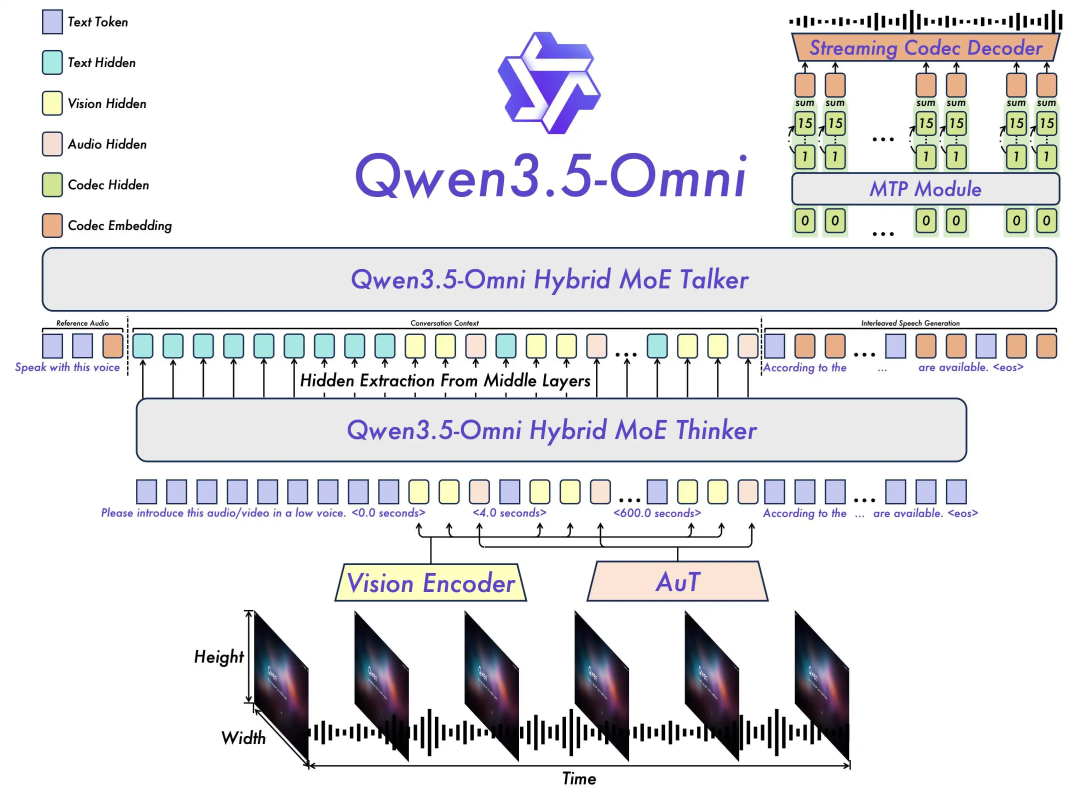
Alibaba Cloud said the model improves speech stability and alignment using ARIA, and uses RVQ encoding to reduce heavy diffusion-based computation. For customers, the implied trade-off is cost and latency: speech generation architectures that reduce compute can lower inference bills, which remains a gating factor for always-on, voice-first experiences.
Re-Architecting With MoE Targets Lower Inference Cost Per Workload
Under the hood, Qwen3.5-Omni continues a “Thinker-Talker” split—separating understanding from expression—while upgrading both to Hybrid-Attention Mixture-of-Experts (MoE). Alibaba Cloud said specialized “experts” for audio, video and text reduce cross-modality interference, helping maintain text and vision performance while scaling audio-video capabilities.
This architecture choice is as much commercial as technical: MoE designs aim to activate only parts of a model per request, improving throughput—an advantage for cloud platforms selling APIs to developers who measure models by cost per minute of audio, per hour of video, or per customer interaction.
Alibaba Cloud said Qwen3.5-Omni is available via its Model Studio platform “Bailian” with three sizes—Plus, Flash and Light—and provided online and offline demos via ModelScope.
Related Coverage:
Alibaba Launches Qianwen App in Major Push for Consumer AI Market
Alibaba’s Qwen AI Team Sees Talent Departures; JPM Flags Short-Term Execution Risk