
Pony.ai Hits Unit Profitability in Robotaxis, Shifting the Debate to Scale
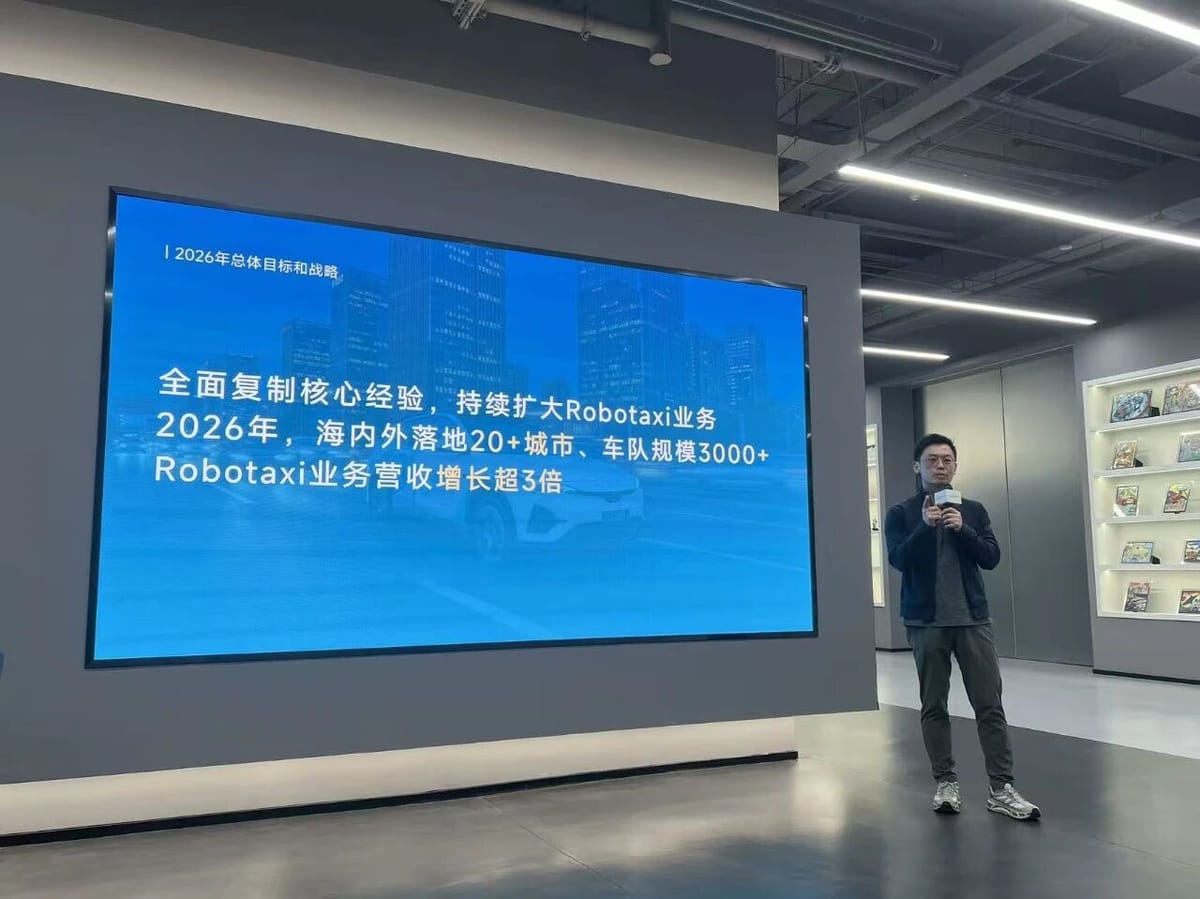
Pony.ai says it has turned unit economics positive for robotaxis in both Guangzhou and Shenzhen—an inflection point that shifts the investor debate from “can robotaxis make money?” to “how fast can the model scale” as the company targets more than 3,000 vehicles and deployments in over 20 cities in 2026.
The China-focused autonomous driving firm Pony.ai reported 2025 revenue of RMB 629 million (US$87.4 million), up 20.7% year-on-year, driven by gains from strategic investments. Robotaxi revenue reached RMB 166 million (US$23.1 million), up 128.6% year-on-year, accounting for about 40% of the annual total.
Initial market takeaway: Pony.ai is emphasizing unit-level profitability and repeatable operations as proof points to attract partners and capital while it prioritizes top-line growth over near-term companywide profitability.
Unit Economics Turn Positive as Daily Net Revenue Clears RMB 300
Pony.ai CFO Wang Haojun said the company’s Shenzhen robotaxi fleet has achieved positive unit economics based on “net revenue” after discounts. In February 2026, a robotaxi generated average daily net revenue of RMB 338 (about US$47), completing 23 trips per day. In March, the company recorded a peak of RMB 394 (about US$55) and 25 trips per day.
Wang said the cost structure splits into depreciation—about half of per-vehicle costs for its seventh-generation robotaxi depreciated over six years—and daily operating expenses, including remote assistance staff, ground support, insurance, charging, parking and connectivity.
He highlighted measurable cost compression: the remote-assistance staffing ratio improved from 1:20 (one remote operator for 20 vehicles) when Guangzhou turned unit economics positive at the end of 2025, to 1:30 by the end of that year. Commercial insurance pricing for robotaxis has also fallen roughly 50% versus traditional taxi benchmarks, according to the company.
The operational implication for investors is that profitability hinges on simultaneous optimization of both depreciation and daily opex; improving only one side is unlikely to sustain positive unit economics at roughly RMB 300 per day in revenue.
Product Differentiation Drives Repeat Usage More Than Subsidies
Pony.ai is positioning robotaxis as a differentiated mobility product rather than a subsidy-driven alternative to ride-hailing. Wang said the company is not pursuing a low-price strategy and argues that repeat usage—not promotions—underpins stable unit economics.
The company said its app has surpassed 1 million registered users, nearly tripling from a year earlier. In Shenzhen, it added that year-to-date orders in 2026 had already exceeded the full-year total for 2025 by mid-February 2026, signaling accelerating utilization.
Pony.ai attributes repeat demand to two features it claims conventional ride-hailing struggles to standardize: passenger privacy—particularly for female riders, who the company says show higher repeat usage—and consistent cabin conditions enabled by centralized fleet maintenance.
For the broader mobility sector, the message is that robotaxis may compete on reliability and service consistency, not just per-kilometer pricing—an approach that could protect take rates if utilization remains strong.
Simulation-Led Expansion Aims to Cut New-City Data Costs
Pony.ai’s expansion plan for 2026 calls for operations in more than 20 cities globally, with nearly half overseas across Asia, Europe and the Middle East. Chief Technology Officer Lou Tiancheng said the company’s “world model” and simulation pipeline can generate scenarios reflecting local traffic patterns, reducing the need for large volumes of on-road data collection when entering a new market.
The commercial risk, the company acknowledged, is not only technical adaptation but whether each city can support a workable combination of trip density and pricing amid differences in labor costs and fare levels. Wang said Pony.ai will not require each new city to reach breakeven before adding vehicles; it plans to scale first and optimize later, including in overseas markets where higher labor costs and higher fares can expand margin potential.
That strategy aligns Pony.ai more closely with platform-style expansion: maximize network size to lift orders per vehicle, then drive down unit costs through operating leverage—while accepting that aggregate profitability may lag.
Co-Build Fleet Partnerships Shift Capital Burden to Automakers and Operators
To scale from more than 1,000 vehicles today to more than 3,000 in 2026, Pony.ai plans to rely heavily on “co-built fleets,” where partners finance vehicle purchases while Pony.ai supplies the “AI driver” and earns licensing fees and, in some cases, revenue sharing. The company said more than 2,000 net new vehicles are planned for 2026, with nearly half delivered under the co-build model.
Toyota is the first named co-build partner, with 1,000 bZ4X robotaxis scheduled to be deployed this year, Pony.ai said. It also cited mobility and fleet partners including Ruqi Mobility, Aitbo and Sunshine Mobility.
The financing logic is straightforward: shifting vehicle capex off Pony.ai’s balance sheet reduces funding pressure during rapid expansion, while allowing the company to focus spending on R&D and OEM integration fees for its seventh-generation system. Pony.ai said its financial priority remains ensuring revenue growth outpaces expense growth, not maximizing near-term profit.
Related Coverage:
Pony.ai Ramps Up Robotaxi Fleet to 3,000 Units in Aggressive 2026 Expansion
Pony.ai Outlines Path to Profitability with Global Fleet Expansion Targets