
Leapmotor’s A10 Pulls 9,000 Weekend Orders, Testing China EV Demand in a 2026 Slump
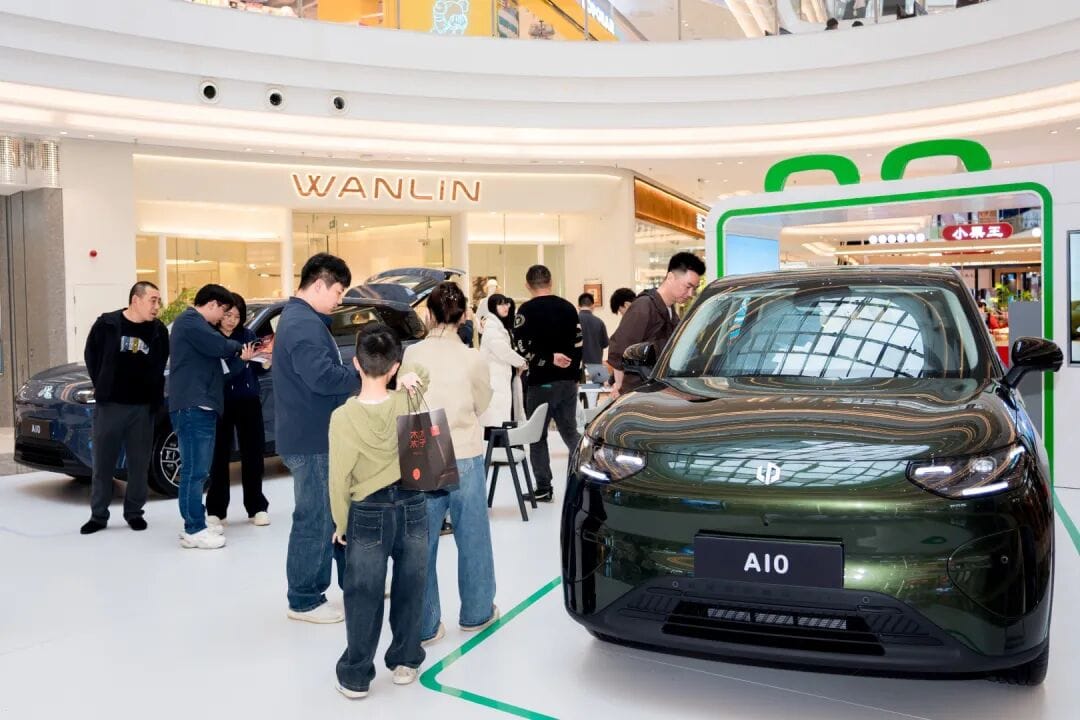
Leapmotor is using a sub-RMB 90,000 (US$12,500) electric SUV to generate one of China’s first clear demand signals in 2026’s cooling auto market, as investors and rivals reassess how far “smart driving” can be pushed down the price curve without destroying margins.
The company said its newly launched Leapmotor A10 — introduced on March 26 — drove two consecutive days of elevated “firm orders” over the weekend, with 4,394 units on Saturday and 4,692 on Sunday, taking the two-day tally above 9,000. Less than a week after launch, A10 firm orders exceeded 10,000, while store visits and test drives reached record highs for the brand.
The early momentum fed through to markets quickly. Leapmotor’s Hong Kong-listed shares rose as much as 5% intraday on March 27, the first trading day after the launch, as traders treated the A10 as an execution test for management’s 2026 sales target of 1.05 million vehicles after the company reported its first full-year profit in 2025.
Weakening Sales Highlight a Narrow Window for Winners
A10’s order burst lands against a soft start for China’s auto industry in 2026. China Association of Automobile Manufacturers data show total vehicle sales in January-February were about 4.15 million units, down year-on-year. New-energy vehicle sales fell faster: 1.71 million units over the two months, down 6.9%.
That contraction matters because it shifts bargaining power. When industry volumes sag, OEMs that can offer a visible feature advantage at mass-market prices tend to pull demand forward, while others are forced into broader discounts that can dilute brand equity and profitability. A10’s early numbers suggest pockets of demand remain, but they may be increasingly concentrated around models that can reframe value beyond sticker price.
Cutting Price While Adding LiDAR Forces a Reset in A0 EVs
Leapmotor priced the A10’s top trim at RMB 86,800 (US$12,100) while equipping it with a LiDAR-inclusive hardware suite aimed at enabling end-to-end navigation-assisted driving from parking spot to parking spot. In China’s A0-class EV segment, LiDAR has largely stayed above the RMB 150,000 range, making A10’s spec sheet a direct challenge to incumbents that compete mainly on design, range and basic driver assistance.
The company’s positioning also targets well-known benchmarks. BYD ’s Dolphin “smart driving” variants include the God’s Eye C system but do not use LiDAR and are priced above RMB 100,000. Geely Automobile Holdings’s Xingyuan — a recent monthly sales leader in the A0 pure-EV segment — similarly lacks LiDAR and offers more basic assisted-driving functions.
On charging and endurance, Leapmotor cites a 505-kilometer CLTC range for A10 and a 2.5C fast-charging capability, claiming a 30%-to-80% charge in 16 minutes. Many A0 EVs cluster around 300-400 kilometers of rated range, and some do not include fast charging as standard. For buyers, the package compresses a higher-end checklist into an entry price band — a combination that can convert showroom traffic into orders even when the broader market is cautious.
Vertical Integration Helps Fund the Feature Drop Without “Loss-Making Minis”
The central investor question is whether Leapmotor can sustain A10’s value proposition without repeating the sector’s common trap: low-priced city EVs that move volume but bleed cash. Leapmotor argues it can, pointing to a cost structure built on self-development and scale reuse.
The company says more than 65% of its core components are self-developed and self-manufactured, spanning the electric drivetrain and intelligent-driving software and hardware. That reduces reliance on supplier “black box” bundles and can lower exposure to component inflation and supply shocks — including memory chip price swings — by keeping more design and integration decisions in-house.
Leapmotor also emphasizes “one chip, multiple domains,” using a Qualcomm 8650 platform to cover both intelligent driving and cockpit computing, reducing hardware count and wiring complexity. It has consolidated functions such as vehicle control, battery management and thermal management into a central domain controller, shortening wiring harness length — a direct lever on weight, assembly time and bill-of-materials cost.
Platform commonality adds another layer. Leapmotor says A10 shares core parts across its B and C series, enabling purchasing scale that can be allocated to a lower-priced model without proportionally higher unit costs — a critical condition if the company aims to protect gross margin while chasing its 2026 volume goal.
New Model Pipeline Expands the Stakes Beyond a Single Launch
A10’s order performance is being read not just as a one-off hit but as a signal for Leapmotor’s broader cadence. The company is touring its upcoming D-series flagship D19 in 13 cities ahead of an April 16 launch, marketing it with a “500-kilometer” pure-electric range claim for its range-extended configuration. Management is betting that higher-end products can lift brand perception and feed back into mass-market demand — a dynamic Chinese EV makers increasingly rely on as feature diffusion accelerates.
For the industry, A10 sharpens the competitive line in 2026: the fight is shifting from pure price cuts toward the ability to industrialize advanced driver assistance and faster charging at mainstream price points. If Leapmotor’s order-to-delivery conversion holds and the cost logic scales, competitors will face pressure to match capabilities — or risk ceding share in a segment that is no longer defined only by affordability.
Related Coverage:
Leapmotor Brings LiDAR to $12,000 Segment, Escalating China’s ADAS Price War
Leapmotor's Dual Gambit: Vertical Integration Meets Premium Pivot After Million-Unit Milestone