
Ant Group's LingBot-Touch Challenges Big-Model Orthodoxy in Embodied AI Race
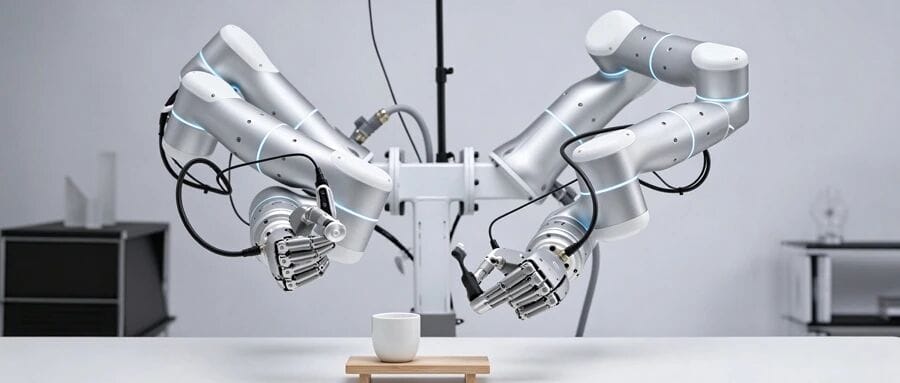
Ant Group's robotics unit has released a tactile model that is meant to sit underneath other companies' robot policies, not to replace them. Robbyant, formally Shanghai Ant Robbyant Technology, open-sourced LingBot-Touch on November 9 as a frozen encoder: it turns signals from magnetic, piezoresistive and visuotactile sensors into a shared set of tokens that existing action models can read.
That is a narrower offering than the language of a "foundation model" often implies, and it is the part of the release that matters commercially. Robbyant already lists a wider LingBot family — vision, depth, mapping, video, a VLA policy and world models — plus industry solutions and robot hardware. LingBot-Touch is the layer it is willing to put in public repositories so that other policies can add touch without learning a new sensor from scratch. The company's site describes the firm as an Ant Group embodied-AI company "building one brain for all robots." The open release is a bid to make that brain, or at least its sense of touch, reusable.
The public package matches that ambition only in part. The GitHub repository, licensed under Apache 2.0, provides the frozen target encoder and tools for extracting tactile features. Checkpoints for two sizes, Tiny and Small, are posted on Hugging Face and ModelScope; Hugging Face lists the Tiny weights as public and not gated. The accompanying paper, posted on arXiv the same day, says the release also includes a small set of sample recordings. It does not include the pretraining corpus or the training code.
The corpus is the claim Robbyant is really hanging the model on. The official project page and the paper put the pretraining set at 4,983 hours, 464,431 interaction episodes and about 1.33 billion frames, collected from tactile gloves and teleoperated robot hands and split across piezoresistive (2,197 hours), magnetic (1,136 hours) and visuotactile (1,650 hours) sensors. The smallest encoder, HaT-Tiny, has 5.46 million parameters. Those figures are Robbyant's. They have not been independently audited.
The performance numbers that have circulated with the launch should be read the same way. In Robbyant's real-robot tests, a frozen Tiny encoder pretrained on 4,000 hours was added to four policies — Diffusion Policy, Physical Intelligence's π0.5, Robbyant's own LingBot-VLA, and T-Rex — and evaluated on 26 tasks, 20 of them on Sharpa Wave hands whose visuotactile sensors appeared in pretraining and six on XHand1 hands whose magnetic sensor model did not. Each task ran for 20 trials, using the same demonstrations in three setups: no touch, the raw tactile signal, and LingBot-Touch tokens.
Averaged across all 26 tasks, the paper reports that LingBot-Touch raised Diffusion Policy's score from 21.6% to 35.6%, π0.5 from 48.1% to 69.9%, LingBot-VLA from 48.3% to 73.1%, and T-Rex from 45.4% to 68.6% — gains of 13.9 to 24.8 percentage points. Adding the raw signal produced, at most, about half that improvement, and in 22 of 104 task-policy pairs it made the original policy worse. On the unseen XHand1 sensors, the raw signal barely moved the averages; the frozen tokens still added 13.8 to 24.5 points, according to the same tables.
Two caveats sit inside those results, and they are easy to miss in a launch write-up. First, every figure is from the authors' own evaluation. The paper and project page do not report an independent reproduction. Second, "success rate" in this benchmark is not a binary pass-fail count. The paper's scoring appendix awards points for intermediate steps — approaching a page edge, rotating a cap, pressing an SD card — so a reported percentage is a share of available points across trials, not the share of runs that finished the job cleanly.
Robbyant is also explicit about what the model has not seen. Capacitive sensors were left out of pretraining because, the authors say, the recordings available to them did not meet their quality bar. The canonical geometry used in training focuses on fingertips, leaving the palm and the rest of the finger underrepresented. The real-robot work uses only two hand models. Those are the paper's limitations, not a reviewer's.
The strategic context is clearer than the product headline. China's embodied-AI sector has spent 2026 discovering that announced robot orders do not reliably become cash. Ant has been placing a different kind of bet on touch: earlier this year it led a financing round in Juciao, a fabric-based electronic-skin startup. LingBot-Touch is the software counterpart — a representation layer that can, in principle, travel across sensor brands and policy stacks. If the weights are actually used, Ant gets distribution in other firms' robots without having to ship the robots. If they are not, the company still has a technical paper and a public encoder, and the "one brain" claim remains a slogan.
For now, the release should be judged on what is in the repositories, not on the size of the training set behind them. The encoder is real, the license is permissive, and the transfer result on an unseen magnetic hand is the most interesting number in the paper. The 5,000-hour corpus and the 26-task scores stay, until someone else runs the tests, Robbyant's account of its own model.
Related Coverage:
Ant Group Leads RMB 100 Million Round in Juciao's Fabric-Based Robot E-Skin
Ant Group's Lingguan 2.0 Bets on 'Time-Aware' AI to Crack China's App Island Problem