
Agibot Crosses 20,000-Unit Milestone, But the Real Test Is Whether Robots Can Clock In
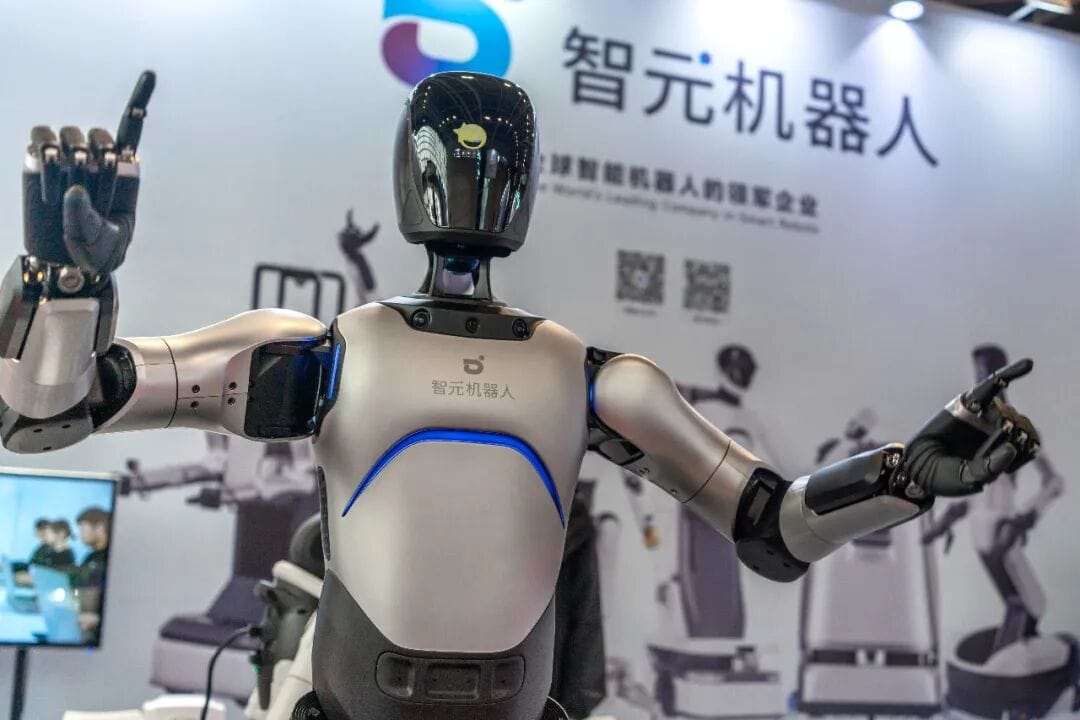
The Chinese humanoid robot leader is redefining success metrics as factory deployments expose a widening gap between units shipped and units productively working.
Agibot, the Shanghai-based humanoid robotics company backed by co-founder Peng Zhihui — better known by his online alias "Zhihui Jun" — has shipped its 20,000th robot and generated nearly RMB 2 billion (US$277.8 million) in revenue in the first half of 2026, cementing its position as the world's largest humanoid robot vendor by volume. Yet the company's own senior executives concede that a gap of several orders of magnitude separates units rolling off assembly lines from units generating measurable industrial output — a distinction that is fast becoming the defining fault line of the entire embodied AI sector.
According to Counterpoint Research data cited at Agibot's October 29 product event in Shanghai, the company shipped 9,700 units in H1 2026, commanding a global market share exceeding 43%. The company has also initiated preparations for a Hong Kong initial public offering. Despite the headline numbers, Wang Chuang, Agibot's Senior Vice President and Partner, offered a candid internal benchmark: "If we can get a few thousand units genuinely deployed this year, that would be impressive."
Third-Party Data Reveals Where the Robots Actually Go
The volume figures obscure a structural deployment problem that extends across the entire industry. Third-party tracking data shows that more than 60% of global humanoid robots delivered in H1 2026 ended up in laboratories, research institutions, trade show floors, and cultural tourism venues — with fewer than 20% entering active industrial workflows. For a sector marketing itself on the promise of replacing repetitive factory labor, that ratio represents a significant credibility overhang.
The gap is not primarily a hardware problem. It reflects the compounding difficulty of operating autonomous, vision-dependent robots in production environments where error tolerance is measured in parts per hundred thousand rather than parts per hundred. Semiconductor packaging and testing, for instance, requires round-the-clock operation with a 99.999% success rate — a threshold that gains urgency when a single chip can carry a component value of tens of thousands of renminbi.
Agibot and Longcheer Deploy the World's First Full 3C Production Line Covered by Embodied AI
Agibot's most commercially significant proof point is a jointly operated production line with contract electronics manufacturer Longcheer Technology, which entered scaled production in March 2026. During a six-day continuous livestream, the line's Ling Xi G2 robots logged more than 64 hours of operation, executed 64,824 pick-and-place cycles, and produced 17,625 tablet computers at an average takt time of 22 seconds per unit — statistically equivalent to human worker throughput. The error tolerance specification: one fault per 10,000 operations.
Agibot Research Institute President Yao Maoqing confirmed that the G2 platform has since expanded laterally from tablet inspection to smartphone inspection on the same line, with proof-of-concept completed and parallel-line integration underway. More than three 3C electronics firms are now in active collaboration with Agibot, with some having completed line integration. The company's heavy-payload variant, the G2 Max, has demonstrated bilateral arm capacity of 40 kg sustained and 50 kg peak, with applications in material handling and de-palletizing already validated at the Longcheer facility.
"Worken" Metric Attempts to Quantify What Shipment Numbers Cannot
Peng Zhihui used the Shanghai event to introduce a new unit of measurement — "Worken" — defined as a standardized measure of effective intelligent working hours generated by a robot. The portmanteau combines "Work" and "Token," deliberately referencing the AI industry's use of token counts to measure large language model computational output. His historical framing: horsepower measured mechanical force in the steam era; kilowatt-hours measured energy capacity in the electrical era; tokens measure machine cognition in the digital AI era. Worken, he argued, measures machine action.
A live Worken dashboard displaying per-unit contributions for October was shown at the event. However, the commercial model attached to the metric remains unsettled. Peng outlined three possible monetization vectors: hardware sales, service contracts, or co-creation arrangements with clients — with hardware representing a floor and AI capability representing the ceiling. Wang Chuang suggested a subscription model in which clients pre-purchase task bundles, with Worken units debited upon task completion.
Wang acknowledged the metric's current limitation directly: effective Worken calculation requires three inputs — units deployed, hours worked, and labor value density. The first two are tractable. "The one we genuinely cannot articulate clearly right now is value density," he said.
Engineer-to-Robot Ratios Tell the Scaling Story
The operational economics of large-scale deployment are perhaps better captured by staffing ratios than by any new metric. When Agibot deployed more than 300 robots across 100-plus locations at Zhuhai Chimelong Resort — which opened September 24, 2026 — the initial configuration required roughly one engineer per robot, making the total labor cost higher than the pure-human alternative it was meant to displace.
Through accumulated scene data and iterative model updates, that ratio has since improved to 3:1. The stated targets are 10:1 by year-end 2026 and 20:1 by 2027. Wang Chuang's read of the 20:1 threshold: at that ratio, adding a new deployment point requires only a 5% incremental headcount increase — a figure most enterprise clients can absorb within existing operational budgets.
Guangzhou Metro has deployed more than 120 G2 units for security guidance, passenger violation detection, multilingual assistance, and patrol functions — a scenario Wang characterized as technically more demanding than the tourism application given high traffic density, variable conditions, and elevated safety liability. Both tourism and transit deployments are advancing faster than pure industrial use cases, partly because service clients apply softer success criteria: incremental revenue, visitor engagement, and brand differentiation rather than strict cycle-time parity with human workers.
Data Scarcity Emerges as a Structural Constraint on Industrial Scaling
Agibot has constructed a 100-robot networked laboratory in which physical machines are linked via InfiniBand to an H100 training cluster and a 4090 edge inference cluster. Robots transmit operational data in real time; updated model weights — running into tens of gigabytes — are continuously pushed back to the fleet. A single robot failure under this architecture affects overall training throughput by approximately 1%, according to Yao. The scale effect is non-linear: comparing a four-robot training run against a 100-robot run produces outcomes that Yao described as "worlds apart."
Industrial deployments add a data sovereignty constraint. Many factory clients prohibit process and commercial data from leaving the facility. Agibot's solution is on-premises deployment of training servers and software platforms inside the client's perimeter, enabling model iteration without external data transfer. The industrial use case carries a structural offset: single-task repetitive operations — such as machine tending and material loading — can yield sufficient training diversity from one hour of capture data, because pre-training optimization weights variety over volume.
Yao offered a rough cost benchmark for the data economy emerging around robotics: a high-quality, standardized dataset of one million hours of robot operation will carry a market price of approximately RMB 200 million (US$27.8 million) within two to three years. Building and operating the data infrastructure — several thousand GPU cards — runs "several hundred million renminbi per year." Undirected data collection yields usable trajectories at a 10%–20% rate; structured in-scene collection pushes that figure to 80%–90%.
Compute Costs and Hardware Gaps Remain Unresolved
Peng flagged compute as a constraint that scales non-linearly with deployment context. Industrial robot operation consumes relatively few tokens; sustained interactive deployments — Chimelong robots logged more than one million guest interactions in their first month — consume substantially more. Agibot's training cluster will reach approximately 10,000 GPU cards this year, placing the company in direct competition with large foundation model providers for GPU allocation.
On the hardware side, Agibot's OmniHand — a dexterous hand with ten or more degrees of freedom and full tactile sensing — leads global shipment volumes in its category, yet Wang acknowledged that "most customers do not yet dare to use it in real production environments" because algorithm success rates trail those of simpler gripper-based end effectors. The roadmap targets driving reliability down to gripper equivalence while expanding degrees of freedom from 10 toward 20 and potentially reducing unit costs below gripper alternatives.
Peng's summary of Agibot's 2026 strategic position, in his own words: "Entering the Y moment — transitioning from development mode to deployment mode."
Related Coverage:
Humanoid Robots Pivot From Novelty to Utility as Big Tech Enters the Fray
Humanoid Robot Race Heats Up as China’s Unitree and US Rival Figure Take Divergent Paths