
China's Embodied AI Sector Hits a Cash-Flow Wall as Order Myths Unravel
Bankruptcies, stalled IPOs, and a funding cliff expose the gap between framework contracts and factory-floor revenue in the world's most heavily backed robotics market.
The embodied AI boom that defined China's technology investment narrative through early 2026 is colliding with an unforgiving reality: robots that cannot yet work for a living cannot sustain companies that promised they could.
The latest flashpoint is Wujing Weilai Dongli Technology, a Nanjing-based robotics startup that announced nearly RMB 1 billion (US$138.9 million) in framework orders just four months after its February 2026 founding, secured a RMB 110 million (US$15.3 million) financing round in July, then allegedly stopped paying its 30-to-40-person workforce from August onward—leaving an estimated RMB 8 million (US$1.1 million) in unpaid wages and triggering a chain of shutdowns that culminated in a full operational halt by October. The company's actual controller, Cui Xiaofei, had become unreachable even to the CEO, Yuan Haihui, according to an internal meeting recording reviewed by Tech Planet.
The episode is not an outlier. Longhui Medical, ShenLan Robotics, and Yinghe Robotics have each entered bankruptcy liquidation or restructuring proceedings in 2026. Meanwhile, Huandong Technology voluntarily withdrew its STAR Market IPO application on September 21, and Weiyi Intelligent Manufacturing xaborted its Hong Kong listing with just three days to go before its scheduled debut. Even sector leader Zhiyuan Robotics has reportedly shelved a planned 2026 IPO in favor of a fresh RMB 1–1.5 billion (US$138.9–208.3 million) fundraising round.
Framework Orders Obscure — Then Accelerate — Cash Burn
At the core of the sector's distress is a structural misalignment between how orders are announced and how revenue is actually recognized. Framework agreements, by legal definition, are statements of intent. They impose no mandatory delivery timelines, acceptance benchmarks, or payment schedules. For Wujing, the RMB 10 billion (US$1.39 billion) headline figure—corroborated by a July posting on the Jiangning district government website—represented a pipeline separated from the company's bank account by multiple gatekeepers: R&D completion, on-site deployment, acceptance testing, and client utilization.
"These orders either contain inflated figures, or payment only materializes after the product is delivered, deployed, and actively used by the customer," one financial-advisory professional with direct knowledge of the sector told Tech Planet.
Yinghe Robotics illustrates the acceptance-failure variant: the company collapsed after orders could not clear contractual acceptance thresholds, blocking revenue recognition entirely. Zhicheng Dynamics—whose founding team includes veterans of Microsoft, Xiaomi, and DJI—disclosed cumulative sales approaching RMB 100 million (US$13.9 million) in early 2025, yet by September 2026, a broken overseas collection chain and debt disputes led creditors to file for bankruptcy restructuring. ShenLan Robotics had secured a reported 25,000-unit order from a Fortune 500 client, built a manufacturing base with annual capacity exceeding 20,000 units, and reached a valuation of RMB 14 billion (US$1.94 billion) before entering its own restructuring process.
The Shanghai Stock Exchange appeared to anticipate this dynamic. When revising STAR Market listing rules in June 2026, regulators explicitly added robotics and embodied AI to the priority support list—while simultaneously tightening financial-authenticity scrutiny to prevent "diseased applications" and speculative herding. A further regulatory signal emerged in September, when market sources reported that the China Securities Regulatory Commission issued informal window guidance to select investment banks and institutional investors, raising the due-diligence bar for humanoid robot IPO candidates.
Funding Concentrates as Dealflow Collapses
The financing market is delivering an equally stark verdict. Data from iResearch shows China's embodied-AI sector logged 172 investment transactions totaling RMB 109.17 billion (US$15.2 billion) in the first half of 2026, peaking at 55 deals worth RMB 30.9 billion (US$4.3 billion) in June alone. The deceleration since has been sharp: IT Juzi data shows deal count fell from 60 transactions in September to just 33 in October—a near-halving—while aggregate capital deployed declined only modestly, from RMB 11.03 billion (US$1.53 billion) to RMB 10.1 billion (US$1.40 billion). The divergence signals a decisive flight to quality, with capital concentrating in a handful of proven names while the long tail of the market effectively loses access.
"The market actually cooled from Q2 onward," the same financial-advisory professional said. "The July announcements reflected deals signed months earlier—fundraising cycles start at three months minimum. Now, except for the top tier, everyone is finding it slow; mid- and lower-tier companies have virtually no shot."
The structural trap is self-evident: framework orders attract investors; investor capital funds R&D and market expansion; companies unable to generate organic cash flow become wholly dependent on the next fundraising round. With exit valuations compressing, the investor calculus has shifted accordingly. "Last year we couldn't get allocation. This year the problem is we can't exit," one institutional investor said.
Structural Demand Gap Exposes the "Performance Economy" of Humanoid Robots
Even setting aside financing mechanics, China's humanoid robot sector faces a fundamental question about end-market depth. Data from Counterpoint Research underscores the challenge: in the first half of 2026, more than 60% of global humanoid robot shipments were absorbed by stage performances and laboratory research environments, while units performing direct economic-value-generating tasks in factories and warehouses accounted for less than 20% of the total. Frost & Sullivan puts global humanoid robot "production operations" shipments at just 1,200 units in H1 2026, generating US$78 million in revenue—a figure that reflects a market still in its infancy.
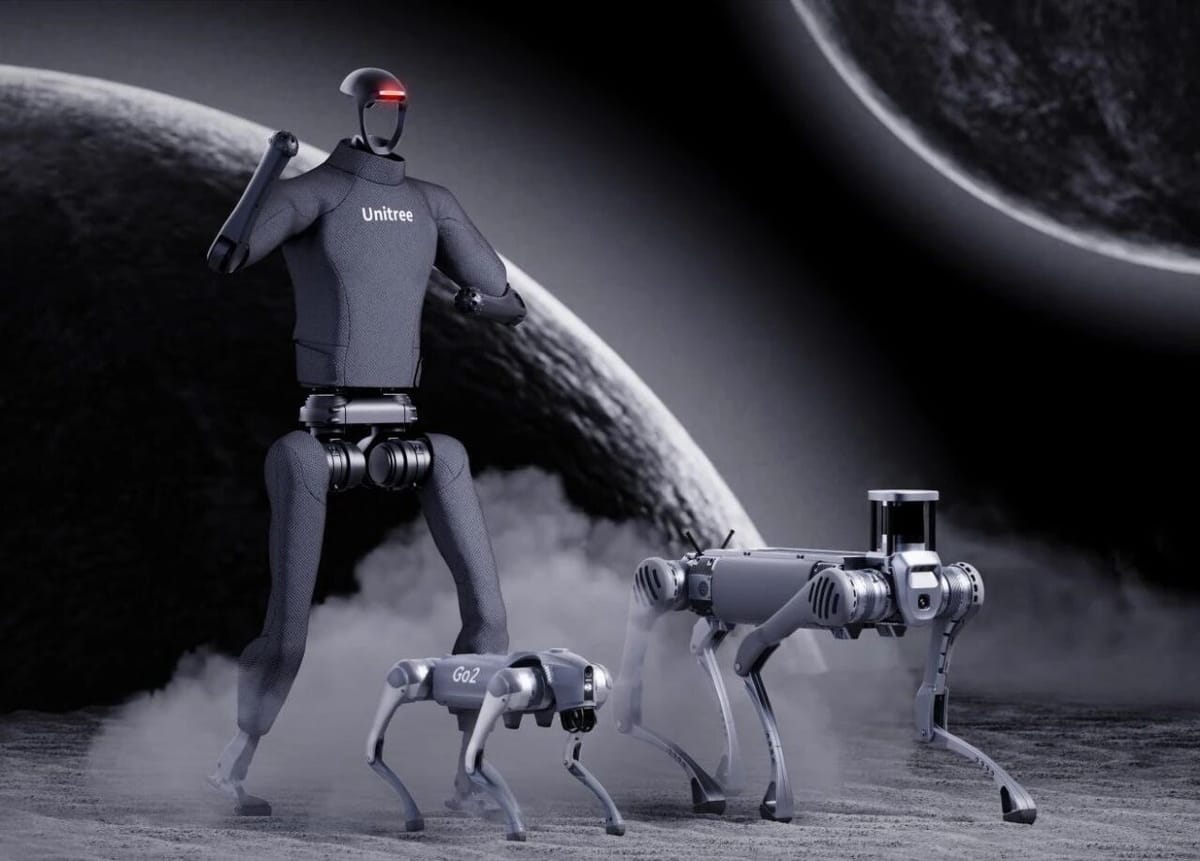
China's Ministry of Industry and Information Technology disclosed at an October 19 State Council Information Office briefing that domestic humanoid robot model variants surpassed 400 and first-half production exceeded 40,000 units, with full-year output projected to break 100,000. Yet the revenue composition of leading companies reveals the demand quality problem. Unitree Robotics, in its IPO prospectus responses, disclosed that for the nine months ended September 2025, science and education applications accounted for 73.6% of humanoid robot revenue, commercial consumption 17.39%, and genuine industrial application just 9.01%.
Zhiyuan's revenue profile shows a different but structurally similar dynamic: multiple investment partners and ecosystem participants purchase machines to secure collaboration opportunities or downstream orders, with government and state-owned entities serving as primary buyers. The company has secured more than ten state-backed project contracts, several exceeding RMB 10 million (US$1.39 million) each.
Galaxy General Robotics has taken the investor-as-customer model to its logical conclusion: Contemporary Amperex Technology serves simultaneously as the company's largest client and lead investor in its Series A round. On September 10, 2026, Galaxy General won a RMB 236 million (US$32.8 million) embodied-AI equipment procurement contract from CATL. "To some degree, in this industry, orders and revenue don't automatically equal market-driven demand," one sector participant told Tech Planet.
Survival Math: When Three Variables Cannot Simultaneously Hold
The Wujing case crystallizes a theorem that is now being validated across the sector: when enforceable orders, continuous external financing, and mature application scenarios cannot coexist simultaneously, cash-flow collapse becomes structurally inevitable—not a management failure, but an arithmetic outcome.
For companies caught in that bind, the prescription from capital-market professionals has become grimly pragmatic: contract sales expenditures, reduce headcount, tighten R&D and operating costs, and concentrate remaining resources on the narrowest set of activities capable of generating actual cash inflows. The era of high-multiple valuations underwritten by order announcements and founder pedigree has ended. What replaces it is a harder market—one that prices robots not on the promise of what they might do, but on the verifiable evidence of what they are already being paid to do.
Related Coverage:
15 Embodied AI Unicorns in 6 Months: China’s Robot Race Hits a Reality Check