
Apollo Go and Waymo Clash on London's Streets, Opening a $200B Right-Hand-Drive Frontier
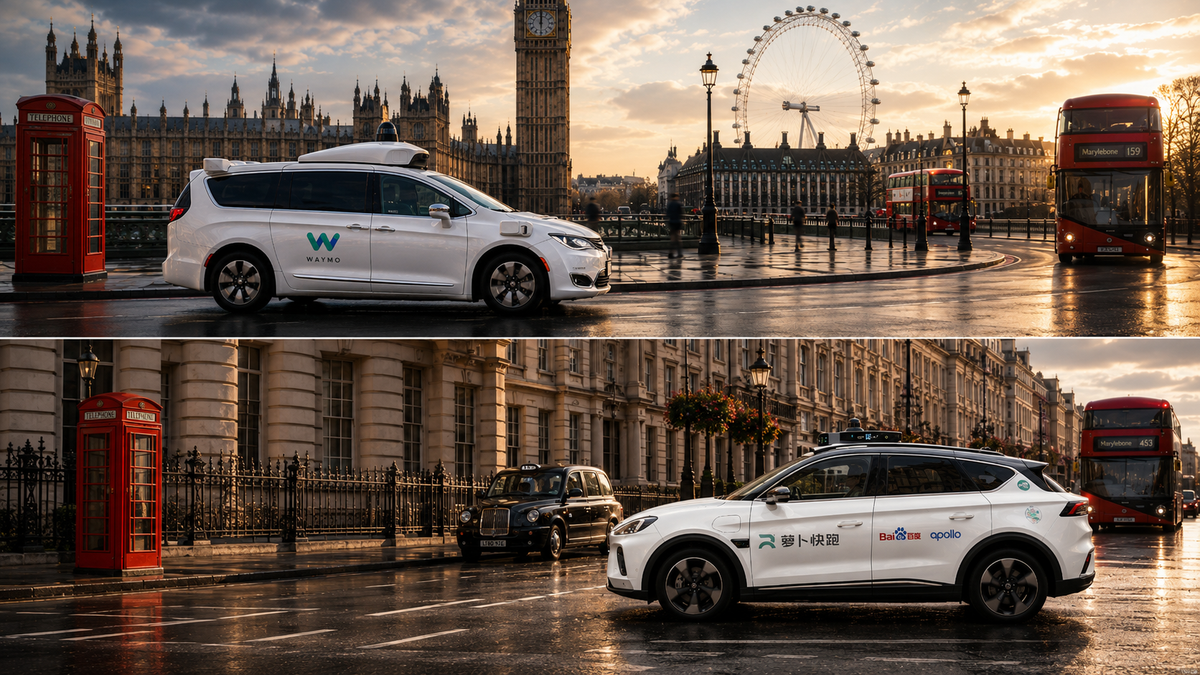
Apollo Go has become the first autonomous vehicle operator to achieve fully driverless commercial testing in a right-hand-drive market, partnering simultaneously with Uber and Lyft to challenge Waymo on London's notoriously complex streets — a strategic move that could unlock access to over 20 billion potential ride-hailing users across 70-plus right-hand-drive nations.
The convergence marks a structural inflection point in the global robotaxi race. For the first time, the two dominant autonomous driving platforms — one Chinese, one American — are operating under the same regulatory scrutiny, on the same road network, with no geographic buffer to obscure a direct performance comparison. London, with its medieval street grid, irregular roundabouts, and extreme weather variability, functions as a de facto stress test that neither operator can game with home-market data.
Market observers note the asymmetry in go-to-market strategy is already pronounced. While Waymo remains in a staff-only, safety-driver-required phase pending final approval from the UK Department for Transport, Apollo Go has arrived with two of the world's largest ride-hailing networks — Uber and Lyft — already committed as distribution partners, bypassing what industry analysts describe as the most capital-intensive phase of any mobility platform launch: cold-start user acquisition.
Hong Kong Proves the Right-Hand-Drive Blueprint Before London's Main Event
Apollo Go's London entry was not improvised. The Baidu subsidiary executed a deliberate two-stage validation strategy, treating Hong Kong as a technical rehearsal for the higher-stakes British market.
Over the past 18 months, Apollo Go completed five operational zone expansions within Hong Kong, progressively eliminating the safety officer from the vehicle cabin. The final step — fully driverless operation on public roads in a right-hand-traffic environment — was achieved earlier in 2026, representing a global first that predates Waymo's equivalent milestone in any right-hand-drive jurisdiction.
The choice of Hong Kong was not incidental. The city shares structural characteristics with London that go beyond the superficial commonality of left-lane driving: narrow carriageways, high pedestrian density, spiral roundabouts that require lane selection before entry, and a high-scrutiny regulatory environment shaped by international standards. Operational licenses and road-test datasets accumulated in Hong Kong carry direct credibility with UK transport regulators, compressing Apollo Go's compliance runway in London.
The technical barrier to right-hand-drive adaptation is substantially higher than the industry has historically acknowledged. Autonomous driving stacks built on left-hand-drive assumptions embed those assumptions at the level of perception models, high-definition map coordinate systems, and localization algorithms. Yield logic at roundabouts — where left-hand-drive systems assign priority to incoming traffic from the left, and right-hand-drive systems invert that entirely — cannot be resolved by a configuration switch. Trajectory prediction models, decision-making trees, and planning modules require systematic retraining on right-hand-drive behavioral data. Apollo Go's Hong Kong dataset represents the only material corpus of real-world right-hand-drive fully driverless operational data currently in existence.
Uber and Lyft's Dual Endorsement Reshapes the Competitive Calculus
The simultaneous partnership commitments from Uber and Lyft are commercially significant beyond the distribution advantage they confer. Both platforms evaluated multiple autonomous vehicle operators before selecting Apollo Go as their London technology partner. That dual endorsement functions as an independent validation of Apollo Go's technology maturity and operational reliability — a signal that carries weight with institutional investors and regulators alike.
Waymo's London strategy follows what the industry recognizes as a conventional sequencing: data collection, small-scale safety-driver testing, safety baseline confirmation, and only then a potential progression toward driverless operation. The timeline for that progression remains subject to UK Department for Transport approval, with no public target date confirmed. Waymo's current London operations are restricted to employee passengers.
The contrasting approaches reflect a fundamental difference in market entry philosophy. Apollo Go is deploying proven right-hand-drive driverless capability into a distribution network with an established user base. Waymo is rebuilding its operational baseline from the ground up in an unfamiliar regulatory jurisdiction. The gap in time-to-revenue, under current trajectories, is measurable in years rather than months.
Local operator Wayve, which has maintained a London presence for several years, has yet to achieve commercial scale or accumulate meaningful production deployment experience, leaving the competitive field effectively bifurcated between the two global leaders.
Right-Hand-Drive Economics Justify the Strategic Investment
The financial logic underpinning the London push is straightforward and compelling. Deutsche Bank data on global taxi fare benchmarks places London's average cost for a 5-kilometer journey at approximately RMB 160 (US$22.2) — ranking fifth globally, and representing a per-kilometer rate 1.6 times higher than San Francisco. Against China's domestic ride-hailing market, where per-kilometer fares range between RMB 1.5 and RMB 2.5 (US$0.21–0.35), London's unit economics represent a differential of more than tenfold.
That fare premium directly compresses the break-even horizon for robotaxi deployment. The capital expenditure profile of autonomous vehicle operations — vehicle acquisition, sensor maintenance, remote operations infrastructure, insurance — is largely fixed cost. Higher revenue per kilometer means each vehicle reaches positive unit economics faster, and the fleet-level return on capital improves correspondingly.
The structural opportunity extends well beyond London. Right-hand-drive markets collectively span more than 70 countries and territories, covering approximately 2 billion people. Annual right-hand-drive vehicle sales hold steady in the 17–18 million unit range, representing roughly one-quarter of global automotive volume. The addressable markets — the United Kingdom, Japan, Australia, Singapore, and their respective urban mobility ecosystems — share the characteristics that make robotaxi economics most favorable: high urban density, short average trip distances, elevated per-kilometer pricing, and mature regulatory frameworks.
Apollo Go's stated intent is to use Hong Kong and London as validation anchors for a replicable expansion template. A commercially proven model in these two cities provides the regulatory credibility and operational data required to accelerate entry into Australia, Singapore, and Japan without repeating the full validation cycle from scratch.
China's Autonomous Driving Industry Enters the Global Main Stage
The London deployment represents more than a single operator's international expansion. It marks a categorical shift in how China's autonomous driving sector positions itself relative to its American counterparts.
For the preceding decade, the global robotaxi competition was effectively two parallel contests: Chinese operators — Apollo Go, Pony.ai, WeRide — accumulating scale and data density in China's uniquely complex urban traffic environment; American operators — Waymo, Cruise (prior to its operational suspension) — building out in the comparatively structured environments of Phoenix, San Francisco, and Austin. The two cohorts were rarely measured against a common benchmark.
London eliminates that separation. Both Apollo Go and Waymo are now subject to identical road conditions, identical regulatory requirements, and identical passenger expectations. Performance divergence, in either direction, will be observable and attributable.
For investors tracking the autonomous driving sector, the competitive dynamic in London provides the first genuine apples-to-apples data point on relative capability between the leading Chinese and American platforms. Apollo Go's first-mover advantage in right-hand-drive driverless operation, combined with its distribution partnerships and the transferability of its Hong Kong dataset, positions it with a structural lead at the starting line. Whether that lead translates into durable commercial advantage will depend on operational execution over the next 12 to 24 months — a period during which London's streets will serve as the industry's most credible proving ground.
Related Coverage:
Baidu Robotaxi Halt Highlights Global Safety Standards Amid Scale Up
China's Robotaxi Players Expand Globally as Waymo and Tesla Scale Up