
Apple Turns to CXMT as AI Memory Crunch Reshapes the Global DRAM Market
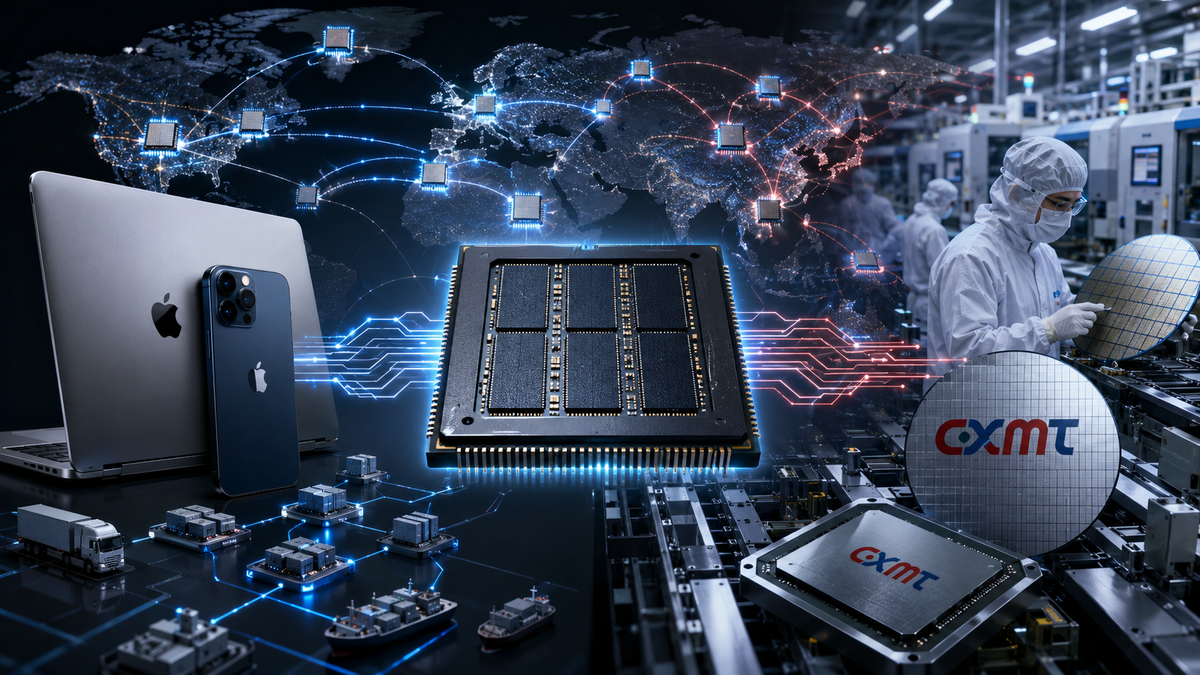
Apple is evaluating DRAM chips from Changxin Memory Technologies (CXMT) for use in iPhones and MacBooks, a move that would mark the first time the Cupertino company has sourced memory from a Chinese supplier — and signals how severely the AI compute boom has distorted the global semiconductor supply chain.
The Wall Street Journal first reported on August 9, 2026 that Apple has begun sample validation of CXMT's DRAM components and has held preliminary discussions with the Hefei-based chipmaker about supplying devices sold in mainland China. Before proceeding, Apple is seeking White House clearance — an acknowledgment that the deal sits in contested regulatory territory, even as export-control lawyers note that existing rules do not prohibit purchases of CXMT's off-the-shelf components. The news landed as bipartisan U.S. senators sent a letter to CEO Tim Cook demanding Apple commit, by August 21, to not sourcing from CXMT, citing national security concerns. Micron Technology has separately lobbied against the arrangement.
The regulatory backdrop is nuanced but consequential. CXMT was added to the Pentagon's Section 1260H "Chinese military company" list in January 2025, a designation that carries no binding procurement restrictions on private U.S. firms. The true constraint is the Commerce Department's Entity List: placement there would prohibit any American company from exporting controlled technology to CXMT — including the bilateral specification-sharing and test-standard exchanges that custom chip production requires. Export-control attorney Kevin Wolf of Akin Gump has stated that current rules permit Apple to purchase CXMT's standard catalogue products and negotiate pricing, but effectively foreclose a bespoke supply arrangement.
AI Demand Rewrites Memory Economics, Squeezing Apple's Margins
The trigger is straightforward: generative AI infrastructure has consumed memory capacity at a pace that has overwhelmed the three legacy DRAM suppliers — Samsung Electronics, SK Hynix, and Micron — all of which have pivoted production capacity toward high-bandwidth memory (HBM) for data-center customers, where margins are materially higher.
The downstream effect on consumer electronics has been severe. In Shenzhen's Huaqiangbei electronics market, 32GB DDR5 module prices climbed from approximately RMB 900 (US$125) in 2025 to nearly RMB 3,800 (US$528) by July 2026 — a more than fourfold increase. One-terabyte SSD prices rose from RMB 410 (US$57) to RMB 950 (US$132) over the same period. Memory's share of bill-of-materials costs for consumer devices has jumped from roughly 15% to above 35%, according to industry estimates.
Apple has already passed some of those costs to consumers: the company raised MacBook and iPad prices in June 2026. On its July 31 earnings call, Cook described current memory market conditions as a "once-in-a-century flood" — an unusually vivid characterization that underscored the severity of the supply dislocation. Apple analyst Ming-Chi Kuo has publicly stated that Apple's challenge has evolved from "rising memory prices" to the more acute problem of an "expanding supply gap."
CXMT Refuses to Discount — Upending Apple's Procurement Playbook
Apple's customary leverage in supplier negotiations — the implicit threat to redirect hundreds of millions of units of annual procurement — has failed to move CXMT. According to multiple reports, Apple sought below-market pricing in initial discussions; CXMT declined, insisting on rates at parity with or above Samsung and SK Hynix equivalents.
CXMT's negotiating posture reflects a structural shift in its market position. In Q1 2026, the company held a 7.7% global DRAM market share, ranking fourth worldwide. Counterpoint Research data shows CXMT's DRAM revenue grew more than eightfold year-on-year in Q2 2026. The company's first-half 2026 revenue is estimated at RMB 110–120 billion (US$15.3–16.7 billion), representing year-on-year growth of 612% to 677%.
Critically, CXMT's existing capacity is fully committed. Domestic customers including Huawei and Xiaomi have locked in supply through long-term contracts at elevated prices, leaving the company with negligible room to onboard new international clients in the near term. Hewlett-Packard and Acer have each secured limited allocations and are competing to lock in larger volumes for 2027 — illustrating that Apple is entering a queue, not a buyer's market.
CXMT's pricing parity with the incumbent trio also reflects its own cost structure: tighter supply relative to overseas peers and higher production costs have prevented the discount positioning that once characterized Chinese memory manufacturers.
A "China-Only" Strategy Attempts to Thread a Political Needle
Apple's proposed architecture — deploying CXMT chips exclusively in devices sold in mainland China while preserving the Samsung/SK Hynix/Micron supply chain for all other markets — is designed to limit political exposure in Washington while achieving two operational objectives: freeing up incumbent supplier capacity for higher-priority markets and establishing a price-competitive alternative that restores some procurement leverage.
The regional-isolation approach is not without precedent in Apple's China strategy, but applying it to a component sourced from a company on the Pentagon's military-linked list represents a qualitative escalation. The White House approval process Apple is pursuing has no defined timeline, and congressional pressure — with a stated August 21 deadline — introduces near-term uncertainty about whether any commercial arrangement can be formalized before the political window narrows.
Citibank and other institutional research notes have flagged that CXMT's appearance on Apple's potential vendor list is itself a market signal, independent of whether a supply deal is ultimately concluded.
Industry Structure Shifts Toward a Four-Pole DRAM Market
The episode crystallizes a structural transition that has been building since 2025. For more than a decade, Samsung, SK Hynix, and Micron controlled in excess of 95% of global DRAM output. CXMT's ascent to 7.7% market share — with Counterpoint Research projecting the company will more than double capacity by 2028 — marks the emergence of a credible fourth pole.
The AI-driven HBM supercycle has paradoxically accelerated this transition: by pulling the three incumbents toward premium data-center products, it created a structural vacancy in mid-range consumer DRAM that CXMT has systematically occupied. The company is no longer competing on price alone; it is competing on availability.
For Apple, the immediate calculus is cost and supply security. For the broader industry, the more significant implication is that the global memory market's pricing and allocation dynamics can no longer be analyzed as a three-player oligopoly. Whether or not CXMT chips ever appear inside an iPhone, the fact that Apple — the world's most valuable consumer hardware company — is at the negotiating table confirms that the competitive map has already been redrawn.
Related Coverage:
CXMT Rejects Apple's Discount Demand, Signaling a Chip Supply Shift