
AutoFlight’s Kazakhstan Bet: Turning a New Aviation Framework Into an eVTOL Launchpad
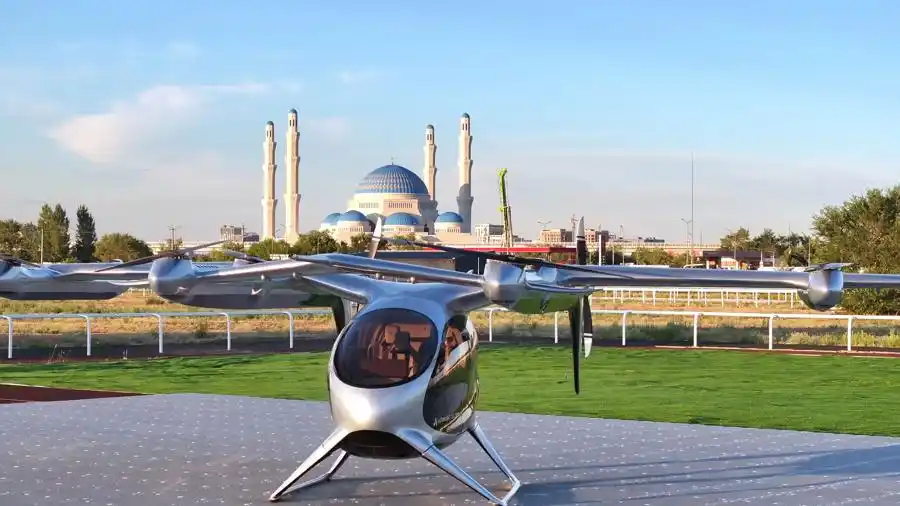
China's AutoFlight executed its first public electric air taxi demonstration in Kazakhstan's capital on July 24, transforming a regulatory milestone into a live commercial proof-of-concept before an audience of diplomats, aviation officials and investors from multiple nations.
The flight, conducted under special authorization from Kazakhstan's Civil Aviation Authority (CAA) and witnessed by over 300 attendees, arrived less than four weeks after Astana's landmark legislative amendment formally incorporated eVTOL aircraft and vertiport infrastructure into the national regulatory framework. The law, signed in June 2026 and effective July 2026, removes the single largest barrier that has kept advanced air mobility (AAM) operators on the sidelines across Central Asia. AutoFlight moved to demonstrate operational readiness almost immediately.
The timing is deliberate. By staging the flight as a headline event at the Games of the Future 2026 (GOTF2026)—an international phygital sports competition drawing athletes from more than 50 countries—AutoFlight secured a global broadcast platform that a standalone press event could not replicate. The company's 2-ton-class eVTOL will remain on official public display throughout the GOTF2026 competition period, extending commercial exposure well beyond a single demo day.
Regulatory Unlock Accelerates AutoFlight's Central Asia Timeline
Kazakhstan's amended transport legislation is the structural catalyst the eVTOL sector needed in the region. Prior to July 2026, no Central Asian jurisdiction had explicitly defined a legal category for electric vertical take-off and landing aircraft or the ground infrastructure required to operate them commercially. The gap forced operators into ad hoc special-permit arrangements—workable for demonstrations, but incompatible with scheduled commercial service.
AutoFlight's local partner, Alatau Advance Air Group (AAAG), has been central to navigating that regulatory transition. AAAG CEO Sergey Khegay described the Astana flight as "a key component of Kazakhstan's systematic deployment of urban air mobility," adding that parallel work on vertiport standards and air traffic management integration is already under way.
For AutoFlight, the regulatory shift compresses the commercialization timeline in a market where the company has been building presence since at least May 2026, when it completed the region's first eVTOL flight test in Almaty. Two operational milestones in roughly two months signals a deliberate acceleration, not exploratory testing.
Diplomatic Visibility Signals Belt-and-Road Aviation Ambitions
The guest list at the July 24 event was not incidental. China's Ambassador to Kazakhstan Han Chunlin, Kazakhstan Presidential Aide Kuanyshbek Yesekeyev, South Korea's Ambassador Jeong Ki-hong, and CAA Director General Michael Daniel were all present. The cross-governmental attendance frames AutoFlight's Central Asia push within a broader geopolitical context: China's low-altitude economy policy, which Beijing has prioritized as a strategic emerging industry, is finding its first meaningful international test bed along Belt-and-Road corridors.
AutoFlight Senior Vice President Xie Jia stated the company's ambition explicitly: "Globalization is not just about exporting aircraft—it is about exporting operational systems and airworthiness compliance capability." That framing positions AutoFlight not merely as a hardware vendor but as an end-to-end urban air mobility infrastructure provider, a distinction that carries significant implications for how future contracts in the region may be structured.
Mapping the Commercial Use Cases That Justify the Investment
Central Asia's geography makes the eVTOL value proposition unusually concrete. Kazakhstan spans 2.7 million square kilometers—the world's ninth-largest country by area—with a road network that leaves vast inter-city distances underserved. AutoFlight and AAAG have identified five addressable verticals: urban air commuting, inter-city regional transport, aerial tourism, cargo logistics, and emergency response.
Of these, cargo logistics and emergency response carry the shortest path to revenue given that neither requires the passenger certification standards that will take additional years to finalize. Urban commuting and tourism represent higher-margin long-term plays contingent on vertiport buildout and consumer acceptance curves that Kazakhstan is now, for the first time, legally empowered to pursue.
Competitive Positioning: China Moves While Western Rivals Consolidate
AutoFlight's Central Asia push comes as the global eVTOL sector undergoes a consolidation phase. Several U.S. and European AAM developers have delayed commercial launch timelines into the late 2020s amid certification hurdles and capital constraints. That competitive pause creates a window for Chinese operators—backed by domestic policy support and manufacturing scale—to lock in partnerships and regulatory relationships in emerging markets before Western rivals arrive with certified products.
Kazakhstan, with a functioning legal framework now in place and a government actively seeking international technology partnerships, represents precisely the type of market where first-mover advantages in operator agreements, vertiport site rights, and pilot training infrastructure could prove durable. AutoFlight's back-to-back operational milestones in Almaty and Astana within 60 days suggest the company understands the window is finite.
Related Coverage:
AutoFlight's V2000CG Breaks Global Barrier With First Overseas eVTOL Airworthiness Certificate