
AutoFlight's V2000CG Breaks Global Barrier With First Overseas eVTOL Airworthiness Certificate
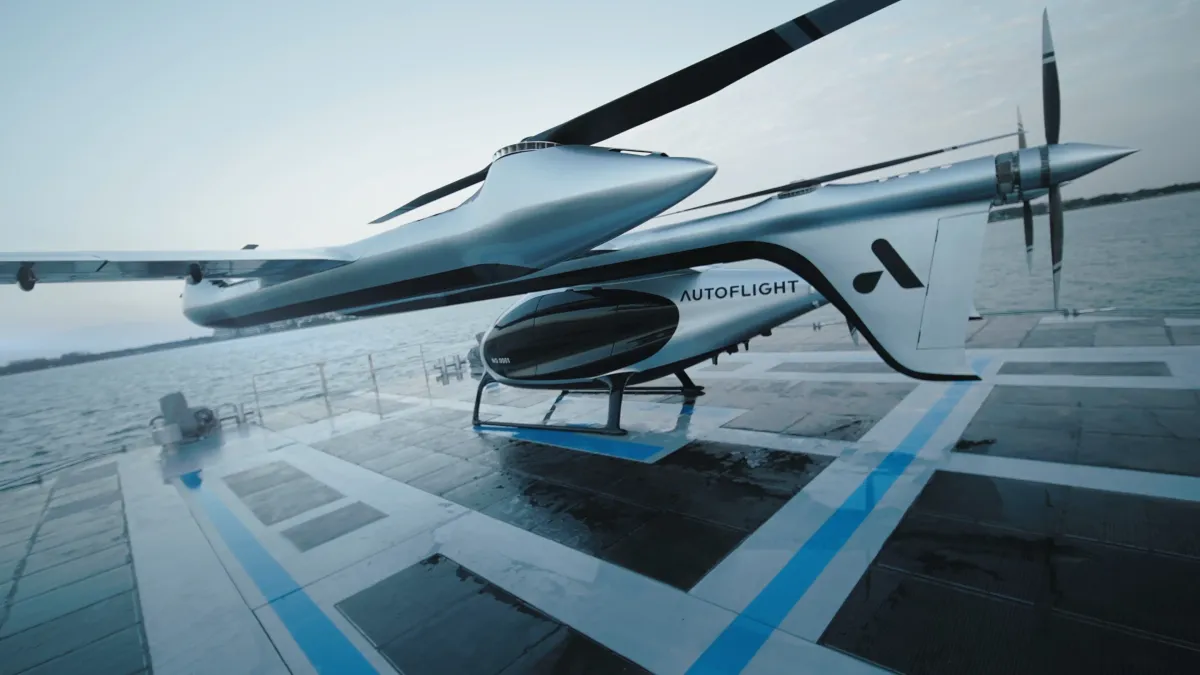
Indonesia's DGCA validation clears the 2-ton cargo drone for commercial operations across the archipelago's 17,000 islands — a regulatory first that signals China's eVTOL industry has crossed from domestic ambition to international commercial reality.
AutoFlight, the Shanghai-based electric vertical take-off and landing (eVTOL) developer, announced on June 22, 2026 that its V2000CG CarryAll cargo drone has received a Validated Type Certificate (VTC) from Indonesia's Directorate General of Civil Aviation (DGCA) — the first such overseas airworthiness validation ever granted to any eVTOL aircraft globally. The certificate, formally issued on June 3, 2026, authorizes nationwide commercial cargo operations across Indonesian territory.
The milestone arrives as the global eVTOL sector wrestles with a defining bottleneck: regulatory fragmentation has consistently outpaced technological readiness, leaving dozens of aircraft programs stranded between domestic certification and cross-border commercial deployment. AutoFlight's VTC breaks that logjam, establishing the first complete regulatory pathway from a Chinese civil aviation authority (CAAC) type certificate to a foreign jurisdiction's commercial authorization.
Certification Timeline Reveals a Two-Year Regulatory Marathon, Not a Shortcut
The Indonesian VTC did not emerge overnight. AutoFlight's V2000CG first secured its CAAC Type Certificate (TC) in March 2024, following tens of thousands of hours of compliance verification and multi-scenario flight testing. The company filed its VTC application with Indonesia's DGCA in July 2025 — an 11-month gap that reflects the deliberate sequencing of domestic credentialing before overseas expansion.
The DGCA's review process involved bilateral airworthiness standard comparisons, multiple rounds of technical consultation, comprehensive documentation audits, and an on-site inspection conducted by Indonesian aviation officials traveling to China. The full cycle from TC issuance to VTC award spans approximately 27 months, underscoring that the certification carries substantive technical weight rather than regulatory rubber-stamping.
Critically, the V2000CG now holds what AutoFlight describes as the only complete CAAC triple-certificate stack among ton-class eVTOL aircraft worldwide: the TC (Type Certificate, confirming design compliance), the PC (Production Certificate, authorizing batch manufacturing), and the AC (Airworthiness Certificate, permitting individual aircraft operation). This trilogy effectively eliminates the most common regulatory objections a foreign civil aviation authority would raise when evaluating a Chinese-origin aircraft.
Indonesia's Geography Creates a Structural Demand Case That Rivals Cannot Easily Replicate
The strategic logic behind targeting Indonesia as the first export market is difficult to fault. As the world's largest archipelago nation, Indonesia comprises more than 17,000 islands, creating a logistics infrastructure deficit that conventional aviation and maritime transport have chronically failed to resolve. Fixed-wing cargo aircraft require runway infrastructure that most remote islands lack; sea freight operates on timelines incompatible with perishables, pharmaceuticals, and emergency supplies.
The V2000CG's specifications map directly onto these constraints. The aircraft carries a maximum take-off weight of 2,000 kg, cruises at 200 km/h, and achieves a maximum range of 200 km — sufficient to cover the majority of inter-island routes in Indonesia's primary island clusters. Its all-electric, runway-independent vertical take-off and landing configuration eliminates the need for fixed ground infrastructure, reducing deployment costs to a fraction of conventional air cargo alternatives.
AutoFlight reports that the V2000CG has already accumulated operational experience in analogous environments domestically, including offshore logistics, island resupply missions, and emergency relief operations within China. That real-world track record, not merely simulation data, formed part of the technical evidence package submitted to the DGCA.
The addressable use cases in Indonesia — fresh agricultural produce, time-sensitive medical cargo, high-value goods, and disaster relief logistics — represent a market where the aircraft's cost-per-kilometer economics are structurally advantaged over both helicopter and fixed-wing alternatives.
First-Mover Certification Advantage Reshapes the Global eVTOL Competitive Map
For investors tracking the global eVTOL sector, the regulatory dimension of this announcement carries as much weight as the technical achievement. Companies including Joby Aviation, Archer Aviation, and Lilium's successor entities have concentrated their certification efforts on the U.S. Federal Aviation Administration (FAA) and the European Union Aviation Safety Agency (EASA) — regulators whose processes are rigorous but whose bilateral validation agreements with Southeast Asian authorities remain underdeveloped.
AutoFlight has effectively opened a second front in the global eVTOL commercialization race by targeting a high-need, infrastructure-constrained market where Chinese-origin aircraft face fewer geopolitical headwinds than in Western markets, and where the CAAC's bilateral aviation safety framework with DGCA provided a viable certification pathway.
The VTC framework itself is legally equivalent to a domestic TC in Indonesia, meaning AutoFlight's aircraft can operate under the same commercial aviation rules as locally-certified aircraft. This is not a provisional or experimental permit — it is full commercial authorization.
The broader implication for China's low-altitude economy policy agenda is significant. Beijing has positioned low-altitude aviation as a strategic industrial priority, and AutoFlight's Indonesian certification provides the first concrete evidence that the domestic regulatory infrastructure built around CAAC standards can serve as a credible foundation for international market entry — a proof-of-concept that competing Chinese eVTOL developers, including EHang and Xpeng AeroHT, will be watching closely as they pursue their own international expansion strategies.
What Comes Next: The Commercialization Execution Risk Remains
The VTC resolves the regulatory question but does not eliminate execution risk. Converting airworthiness authorization into sustained commercial revenue requires ground infrastructure partnerships, maintenance network development, pilot or remote-operator training programs, and cargo customer acquisition — all of which must be built from scratch in a foreign market.
AutoFlight has not publicly disclosed the identity of Indonesian logistics partners, the scale of initial deployment, or the commercial pricing structure for inter-island cargo services. Those details will determine whether this certification translates into a replicable international business model or remains a headline-generating regulatory milestone without near-term revenue substance.
What is unambiguous is that the V2000CG's Indonesian VTC establishes a documented, reproducible pathway for Chinese eVTOL aircraft to enter foreign commercial aviation markets through bilateral airworthiness validation — a template that did not exist before June 3, 2026.
Related Coverage:
Chinese Startup AutoFlight Unveils World's First 5-Ton eVTOL Aircraft With 10-Passenger Capacity