
China's AI Model Stocks Diverge Sharply as Markets Demand Commercial Proof Over Narrative
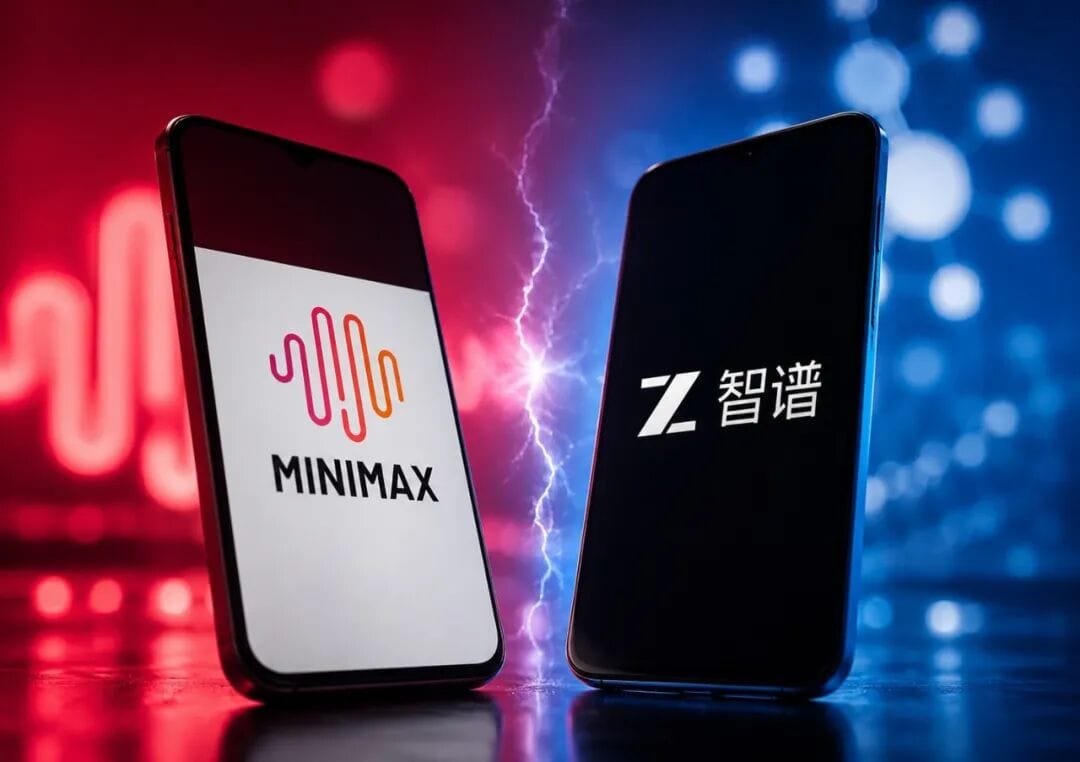
Zhipu AI surges to an all-time high on Hong Kong markets while MiniMax tumbles two-thirds from its peak — a split verdict that signals a fundamental repricing of China's large language model sector.
The divergence between the two companies, both listed on the Hong Kong Stock Exchange, crystallized on June 18, 2026, when Zhipu AI shares hit an intraday high of HK$2,094, surging more than 20%, and pushing its market capitalization above HK$930 billion (approximately US$129.2 billion). MiniMax, by contrast, closed that same day nearly 65% below its March all-time high — a chasm that cannot be explained by model benchmarks alone.
The divergence marks a structural inflection point: after two years of narrative-driven valuations, Hong Kong's capital markets are now applying a harder commercial filter to China's AI model companies.
GLM-5.2 Launch Captures Three Converging Tailwinds
Zhipu's catalyst was the June 15 release of GLM-5.2, its latest flagship model, which combined a 1-million-token context window, full public availability of its Coding Plan feature, MIT-licensed open-source access, and a confirmed API launch timeline. In its Hong Kong Exchange filing, Zhipu stated directly that the model is expected to drive increased call volumes on its open platform and API business — a rare instance of a Chinese AI company tying a model release explicitly to a near-term revenue mechanism.
Markets did not wait for verification. The stock surged 32% on June 15 alone, and within days had not only recovered a near-50% drawdown that followed a May 29 peak but exceeded it.
The timing amplified the signal. On June 13, the U.S. government issued an export control directive on national security grounds, forcing Anthropic to disable its newly launched Fable 5 and Mythos 5 models for all global customers within three days of release. Hours later, Zhipu announced GLM-5.2 was available to all users. The company's accompanying statement — "frontier intelligence should not belong only to a few, nor be revoked at any time by a handful of rules" — reframed a model launch as a geopolitical hedge.
The result was a three-layer premium embedded in Zhipu's share price: model capability expectations, API monetization expectations, and domestic substitution expectations. Each layer reinforced the others.
MiniMax Pricing Misstep Erodes Commercial Credibility at Critical Moment
MiniMax's M3 model, released June 1, carried specifications that should have generated comparable excitement: 1-million-token context, native multimodal capability, Agentic Workflow support, and integration with MiniMax Code, Token Plan, and API platforms. On paper, it was a flagship-tier release.
The execution undermined it. M3 launched at a premium price point — a signal the market initially read as confidence in the model's differentiation. Within days, MiniMax permanently cut M3 pricing by 50%, bringing it back to levels comparable to its predecessor M2.7. Simultaneously, the company switched its consumer subscription model from per-use billing to per-token billing, raising its monthly plan from RMB 29 to RMB 49 (approximately US$4.03 to US$6.81) without advance notice to existing users.
Developer communities responded immediately. User-generated calculations circulated showing that equivalent workloads under the new billing structure cost 257% more than before. The backlash recast MiniMax overnight from a technical standout to a company that had blindsided its most engaged users.
For capital markets, the logic was unforgiving: a model confident in its own value does not reverse its pricing within days of launch. The M3 release, which should have been a moment to consolidate commercial credibility, instead raised a pointed question about whether MiniMax's monetization strategy is coherent.
Lock-Up Mechanics Amplify the Divergence in Both Directions
Beneath the product narratives lies a structural explanation that CICC analysts have flagged as material to near-term price action.
MiniMax faces its first major post-IPO lock-up expiry around July 9. By Hong Kong share capital calculations, the unlocking tranche represents approximately 63% of Hong Kong-listed shares, with financial investors — whose primary objective is return realization — holding more than one-third of that block. With MiniMax shares still trading meaningfully above their IPO price despite the recent decline, the incentive to exit is direct. Markets began pricing in this supply shock weeks ahead of the actual expiry date.
Zhipu's lock-up profile is materially different. Its first tranche, expiring around July 8, represents approximately 11.6% to 11.9% of H-share capital, or roughly 5.8% of total company shares. Critically, the largest holders in that tranche are state-backed cornerstone investors, whose disposition toward near-term profit-taking is structurally lower. Constrained float, combined with the GLM-5.2 catalyst, transformed a technical limitation into a price accelerant.
The asymmetry is precise: Zhipu's rally is a low-float momentum trade layered with genuine product expectations; MiniMax's decline is a supply-fear trade compounded by a loss of pricing narrative.
Valuation Framework Shifts From Story Discounting to Commercial Verification
The Zhipu-MiniMax split illustrates a broader repricing underway across China's large model sector. Through 2024 and into early 2025, valuations were built on what analysts describe as narrative discounting — parameter counts, funding pedigree, benchmark rankings, user growth trajectories, and the ambient promise of becoming China's OpenAI.
By mid-2026, the questions markets are asking have changed materially. Can the model sustain state-of-the-art performance across successive generations? Do customers maintain usage volumes after price increases? Are API call numbers growing organically or being subsidized? Are Coding and Agent features generating real paid throughput or benchmark traffic? Have enterprise workflows genuinely embedded the product, or is adoption still shallow? Does open-sourcing build a commercial moat or erode it? Is gross margin improvement a sign of a working business model, or the result of headcount reductions and training budget cuts?
Neither Zhipu nor MiniMax has fully answered these questions. Both remain in a valuation reconstruction phase that will require multiple quarters of financial data to resolve. MiniMax's narrative problem is compounded by strategic diffusion: the company is simultaneously pursuing large models, multimodal, video, audio, AI companionship, international consumer products, Agent platforms, Coding, and API commercialization. With too many anchors, the market cannot identify which business line justifies the headline valuation.
The more consequential implication extends beyond these two companies. A new cohort of Chinese AI model firms is approaching public markets. Each will face the same interrogation: can the story survive contact with a commercial income statement?
Related Coverage:
Zhipu AI's 10x Rally Exposes Hong Kong's AI Narrative Premium Over MiniMax