
Zhipu AI Surges 1,900% as GLM-5.2 Challenges Closed-Source Frontier
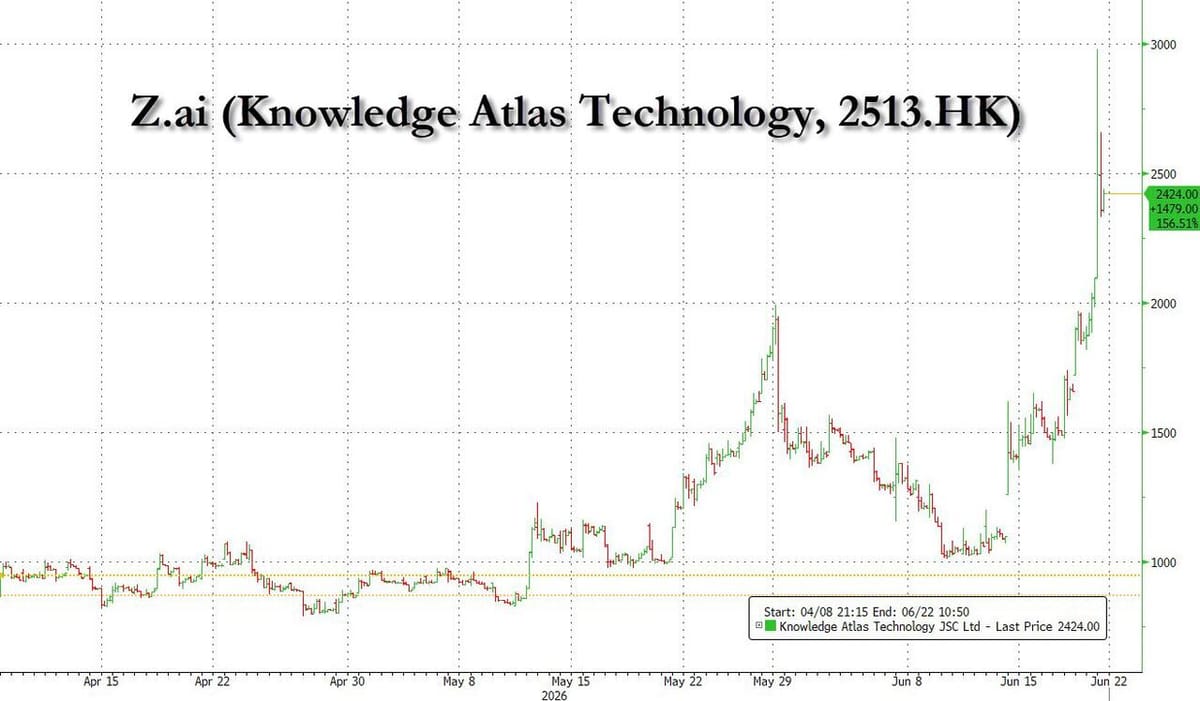
China's Zhipu AI has crossed HK$1 trillion (approximately US$128 billion) in market capitalization — up more than 1,900% year-to-date — as its newly released open-source model GLM-5.2 posts benchmark scores within one percentage point of Anthropic's flagship, at a fraction of the cost, while U.S. export controls simultaneously force Anthropic to pull two of its most advanced models from global access.
The convergence of these two events on June 22, 2026 has crystallized a narrative that global trading desks are now pricing in real time: open-source Chinese AI is entering the performance tier previously monopolized by closed-source Western labs, just as Washington's regulatory apparatus begins restricting the global reach of those same labs. JPMorgan has characterized the resulting capital flow as a "rotation trade" rather than a panic liquidation — a structurally distinct dynamic from the DeepSeek shock of early 2025 that briefly cratered Nvidia and U.S. AI equities.
Zhipu's Hong Kong-listed shares have already surpassed JPMorgan's most recently upgraded target price of HK$1,800, trading near HK$2,400 — a signal that market pricing has moved ahead of sell-side models.
GLM-5.2 Enters the Frontier Performance Radius for the First Time
The technical significance of GLM-5.2 lies not in incremental improvement but in a threshold crossing: for the first time, an open-weight model has entered the performance band previously held exclusively by Anthropic and OpenAI.
According to data released by Zhipu AI, GLM-5.2 carries 753 billion parameters under a Mixture-of-Experts (MoE) architecture, supports a stable 1 million-token context window, and is released under the MIT open-source license. On the FrontierSWE long-horizon coding benchmark, GLM-5.2 scores 74.4 — compared with Anthropic's Opus 4.8 at 75.1 and OpenAI's GPT-5.5 at 72.6. On PostTrainBench, which evaluates agent training capability on smaller models, GLM-5.2 ranks second at 34.3, behind Opus 4.8's 37.2 but well ahead of GPT-5.5's 28.4.
Independent AI research firm Artificial Analysis placed GLM-5.2 at 51 points on its Intelligence Index v4.1 — ahead of MiniMax-M3 (44), DeepSeek V4 Pro (44), and Kimi K2.6 (43) — positioning it between GPT-5.5 and Opus 4.8 and designating it the highest-ranked open-source model to date. Research firm Proximal described GLM-5.2 as "the first model to genuinely close the vast technical gap between Anthropic/OpenAI and other model providers."
Gaps remain material. On the SWE-Marathon benchmark — the hardest long-horizon coding evaluation — GLM-5.2 scores 13.0 against Opus 4.8's 26.0. Vision capability is absent from the current release. But on the engineering deployment dimension, GLM-5.2 introduces IndexShare, a technique that reuses sparse attention top-k indices across layers to substantially reduce inference compute on ultra-long contexts — a practical advancement that makes 1M-token deployments economically viable at scale.
Pricing Structure Reveals a Two-Tier AI Market Taking Shape
GLM-5.2's pricing relative to Anthropic's Opus 4.8 is where the investment thesis sharpens.
Input and output token prices for GLM-5.2 are approximately 72% to 82% below Opus 4.8 — a cost differential that, combined with near-parity performance on coding and agent benchmarks, creates direct substitution pressure on closed-source enterprise deployments. For context, Anthropic's Opus 4.8 is priced at the premium end of the global model market; a 72-82% discount at comparable capability represents a structural repricing event for enterprise AI procurement.
However, JPMorgan's analysis introduces a counter-intuitive data point: relative to its predecessor GLM-5.1, GLM-5.2 is actually a price increase. GLM-5.1 used tiered billing that allowed lower effective rates on a portion of usage; GLM-5.2 applies a unified higher pricing tier, raising the blended per-token cost for existing customers. Because the performance gains derive primarily from reinforcement learning and post-training optimization — rather than a proportional expansion in model scale — the cost base remains largely stable, which JPMorgan expects to drive margin improvement at Z.ai, Zhipu's API platform.
The bank's conclusion carries direct implications for how investors should value model-layer companies: "Mature intelligence compresses pricing, but GLM-5.2 demonstrates that frontier upgrades can achieve the opposite effect." JPMorgan frames the model market as bifurcating structurally — commoditized capabilities (basic dialogue, standard summarization, routine code completion) will face continued price compression, with DeepSeek as the primary deflationary force; frontier capabilities that unlock new workflows and improve task completion rates — particularly in coding, agentic systems, enterprise workflow automation, and long-context reasoning — can sustain or expand pricing as customers pay for task outcomes rather than raw token volume.
For equity investors, this distinction has direct valuation consequences: monetization trajectories for model-layer companies depend on their ability to continuously migrate toward harder, higher-value task categories rather than scaling existing capabilities horizontally.
Anthropic's Forced Takedown Converts Abstract Supply Risk Into Realized Disruption
Simultaneously with GLM-5.2's release, Anthropic became the first major AI lab to have frontier models forcibly removed from global access by U.S. government order — an event that transforms "closed-source availability risk" from a theoretical concern into a documented operational reality.
According to Bloomberg reporting, U.S. Commerce Secretary Howard Lutnick invoked Section 744.22(b) of the Export Administration Regulations, citing an "unacceptable risk" of exploitation by foreign military intelligence agencies, and ordered Anthropic to obtain a Commerce Department license before providing access to Fable 5 and Mythos 5 to any foreign national. Criminal and civil penalties were cited for non-compliance. Anthropic immediately suspended global access to both models and publicly stated the government response was "disproportionate," warning that if equivalent standards were extended across the industry, all new frontier model deployments could effectively be halted.
The reported technical trigger: Amazon researchers successfully jailbroke the Mythos model, and Fable 5 was found capable of identifying security vulnerabilities in at least four software packages under specific prompt conditions — findings cited by Orient Securities research as the proximate cause of regulatory intervention. Anthropic's technical team met with Commerce Department officials on Monday, June 22.
The downstream effects operate on two levels. First, enterprises and developers dependent on closed-source frontier models now face measurable business continuity risk — a factor that structurally increases demand for open-weight alternatives with local deployment capability. Second, GLM-5.2's release timing — providing near-frontier performance at dramatically lower cost, with full open weights enabling on-premise deployment — positions it as the most technically credible substitute currently available.
The regulatory action has triggered contingency assessments across the U.S. AI sector. OpenAI Chief Strategy Officer Jason Kwon notified staff that the company is evaluating the policy development, describing the situation as "rapidly evolving with many unknowns." OpenAI General Counsel Che Chang separately cautioned employees that antitrust rules preclude coordinated responses with industry peers.
Capital Flows Confirm Rotation Logic, Not Systemic De-risking
The market structure of this episode differs fundamentally from the DeepSeek shock of January 2025, and the distinction matters for positioning.
The DeepSeek event was an unanticipated black swan that triggered broad liquidation of U.S. AI equities on fears that compute efficiency gains would collapse Nvidia's data center revenue trajectory. GLM-5.2's release, by contrast, is a high-conviction, widely anticipated event — the market has had 18 months to absorb expectations around Chinese open-source competitiveness. The result is concentrated re-pricing of Chinese domestic AI assets, with no systemic pressure on U.S. AI equities to date. JPMorgan's characterization of this as a "rotation trade" rather than a "liquidation panic" reflects that capital is moving toward Chinese AI assets as an addition to — not a replacement for — existing U.S. AI exposure.
Orient Securities argues that with multiple Chinese models now occupying leading positions on global performance rankings — most of them open-source — and with Anthropic's two leading models removed from the market, API call volumes directed at Chinese models are likely to accelerate. The firm expects compute and token service demand underpinning Chinese AI infrastructure to maintain strong growth momentum.
Rich Privorotsky, cited in market commentary, identifies the central tension currently weighing on AI sector multiples: application adoption and compute demand are accelerating, but token deflation, uncertain monetization pathways, and continuous equity supply expansion are the variables markets are pricing more heavily in the near term. The medium-term bull case rests on the possibility that cost reduction and lower access barriers simultaneously expand token consumption volumes and compute demand — a dynamic in which open-source share gains and infrastructure capex growth become mutually reinforcing rather than contradictory.
Related Coverage:
Zhipu AI Shares Surge 33% After U.S. Export Controls Ground Anthropic's Latest Models