
Volant Aerotech Targets China's First eVTOL IPO Backed by RMB 47.5B Order Book
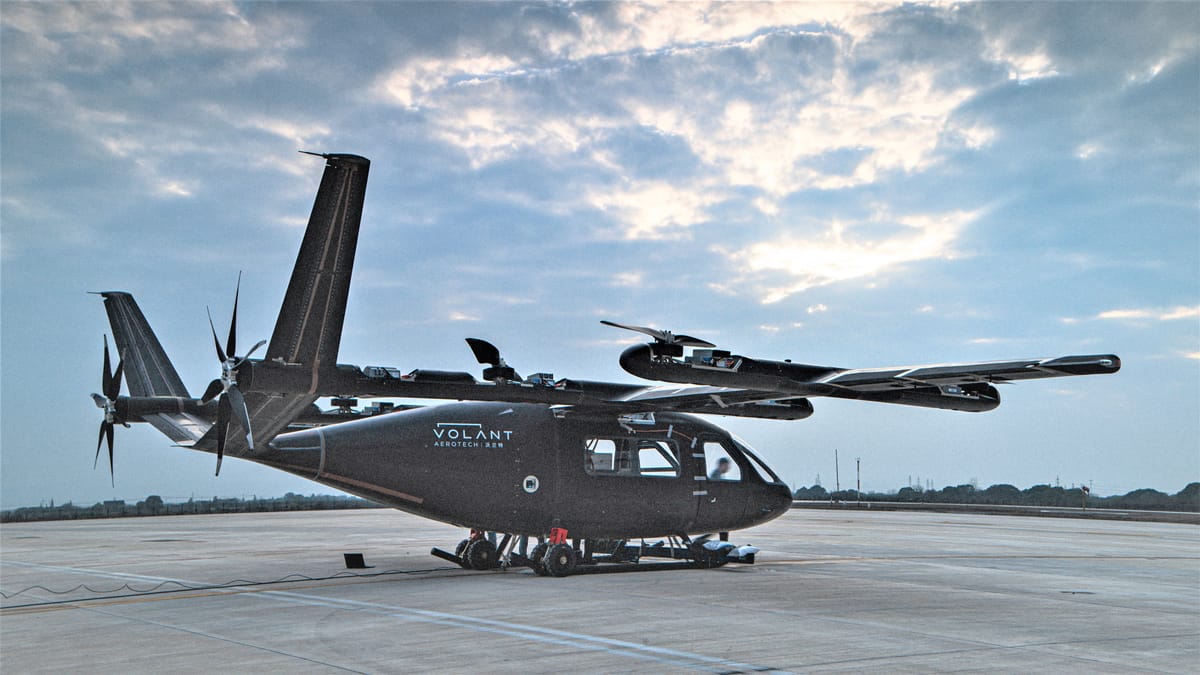
SHANGHAI VOLANT AEROTECH has converted into a joint-stock company and amassed a RMB 47.5 billion (US$6.6 billion) order book, positioning itself as the frontrunner to become China's first publicly listed electric vertical take-off and landing aircraft manufacturer.
The corporate restructuring, registered on July 10, 2026, saw Volant's registered capital surge nearly sevenfold — from approximately RMB 3.4 million to RMB 27.3 million — while the company simultaneously adopted a share-based legal structure mandated under China's A-share listing rules. The move follows two back-to-back financing rounds completed within roughly two months: a Series C and a Series C+ that together raised close to RMB 3 billion (US$416.7 million), lifting total cumulative funding above RMB 5 billion (US$694.4 million). That figure makes Volant one of the most heavily capitalized eVTOL developers in China by disclosed fundraising.
CEO Dong Ming told industry media that the company holds sufficient cash reserves and will launch a formal listing process "at the appropriate time," while keeping near-term focus on type certification. The distinction matters: in China's aviation regulatory framework, an airworthiness certificate is a prerequisite for commercial delivery, and without it, an order book — however large — remains contingent revenue.
Manned Tilt-Rotor Test Separates Volant From Domestic Rivals
The clearest technical differentiator underpinning Volant's valuation story emerged in late May 2026, when the company completed China's first manned conversion flight of its VE25-100 aircraft at Lantian Airport in Zigong, Sichuan. The test demonstrated a smooth, bidirectional transition between rotary-wing vertical lift and fixed-wing horizontal cruise — a maneuver that multiple domestic airframers had previously achieved only in unmanned configurations.
The milestone places Volant alongside U.S.-based Joby Aviation and U.K.-based Vertical Aerospace as the only three companies globally to have demonstrated manned tilt-rotor conversion flight. That is a narrow peer group, and the comparison carries direct capital-market implications: Joby Aviation currently trades on the New York Stock Exchange with a market capitalization exceeding US$5 billion, providing a rough public-market reference point for Volant's aspirations.
Volant filed its type certificate (TC) application for the VE25-100 with China's Civil Aviation Administration (CAAC) in September 2023. All specialized certification plans were signed off in 2025, and Dong Ming has stated a target of completing full type certification and initiating commercial deliveries in 2027.
Order Economics Reveal a Cost Structure That Challenges Helicopter Operators
The VE25-100's commercial case rests on a specific set of performance parameters: maximum take-off weight of 2.5 tonnes, cruise speed of 235 km/h, operational range of 200–400 km, and a six-seat configuration (one pilot, five passengers). Volant has accumulated orders for more than 1,900 aircraft, of which over 500 units originate from overseas customers — an early signal of cross-border demand that could complicate a purely domestic A-share listing narrative.
A joint cost analysis conducted with China Southern Airlines General Aviation calculated a per-seat operating cost of RMB 60 for a five-minute, 20-kilometer flight — equivalent to one-eighth to one-tenth the per-kilometer cost of a conventional helicopter. If verified at scale, that economics gap would structurally undercut the short-haul helicopter charter market and open urban air mobility routes that are currently uneconomic.
The caveat is scale dependency. Volant plans to deliver only five to ten aircraft against confirmed orders in 2026–2027, ahead of what it expects will be a full batch-delivery phase post-certification. Until production volumes reach triple digits, the RMB 60 per-seat figure remains a modeling output rather than an audited operating metric.
NIO Capital Entry Opens Automotive Supply Chain to Aerospace Manufacturing
The Series C+ round's strategic significance extends beyond the capital raised. The participation of NIO Capital — the investment arm affiliated with electric vehicle maker NIO — introduces a supply chain bridge between China's mature automotive components ecosystem and eVTOL manufacturing. Volant currently sources 30%–40% of its components from automotive suppliers, a proportion that could expand as the company scales production and seeks to compress unit costs.
Dong Ming's background reinforces the cross-industry logic. He grew up in an aviation and defense engineering family, began his career at an aeronautical research institute, spent five years at General Electric (GE), and contributed to both the ARJ21 regional jet and the C919 narrowbody programs before founding Volant in Shanghai in 2021. The company's 200-plus-person workforce draws its core engineering team almost entirely from China's commercial large-aircraft development system, with domestic component sourcing reaching 95% — a figure that aligns with national supply chain security priorities and may facilitate regulatory goodwill during the certification process.
Certification Timeline Remains the Critical Path for Investors
For any investor evaluating Volant's pre-IPO positioning, the 2027 certification target is the single most consequential variable. CAAC type certification for novel aircraft categories has historically run longer than initial projections, and the VE25-100's tilt-rotor configuration — while technically validated in flight — faces a more complex regulatory pathway than conventional multirotor eVTOL designs.
A delay beyond 2027 would push commercial revenue recognition further out, increasing the cash burn against which Volant's RMB 5 billion-plus funding base must be measured. Conversely, on-time certification would allow the company to begin converting its RMB 47.5 billion order book into recognized revenue ahead of any prospective A-share listing, materially strengthening its IPO prospectus.
The race for China's first eVTOL listing is not Volant's alone. Competitors including EHang, which already trades on Nasdaq and holds CAAC type certification for its autonomous air taxi, and AutoFlight, which targets fixed-wing eVTOL certification, are also advancing their capital-market positions. Volant's tilt-rotor technology and order scale differentiate it, but the finish line remains the CAAC certification office, not the stock exchange.
Related Coverage:
Volant Raises $138 Million as China’s eVTOL Race Shifts Toward Commercial Scale