
Automakers Seize the Robotaxi Narrative as Physical AI Race Reshapes Mobility Economics
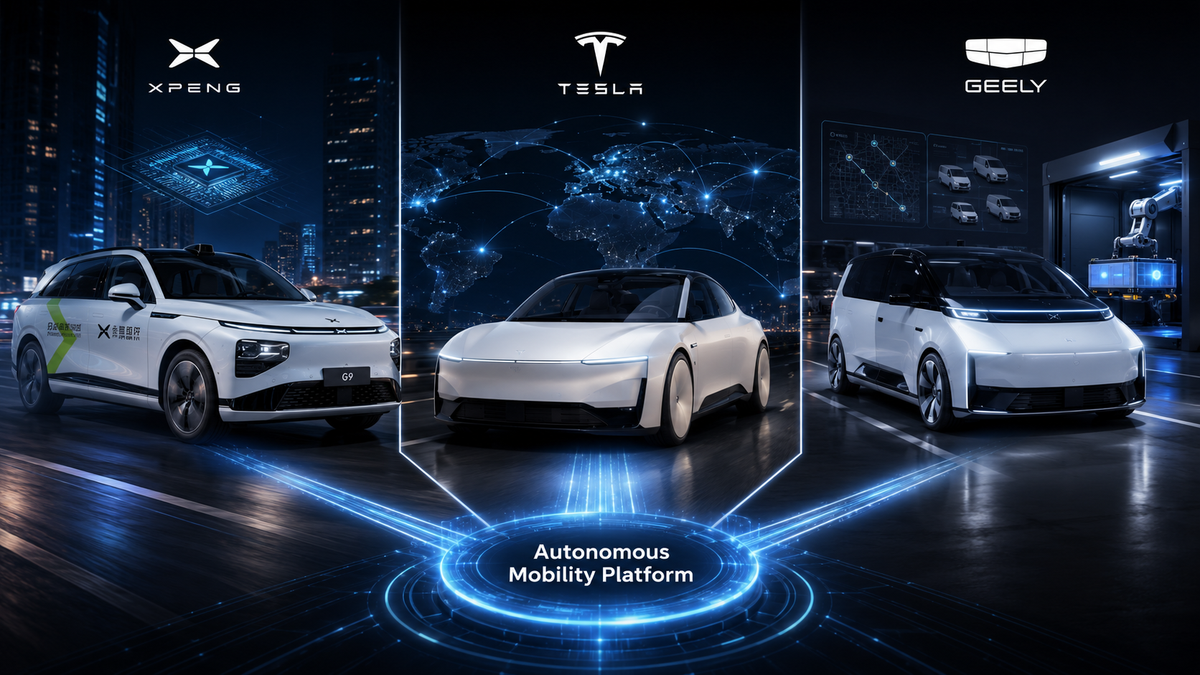
Tesla, Xpeng and Geely deploy three divergent strategies to challenge pure-play autonomous driving firms, betting that vehicle-platform leverage and asset-monetization models can redefine the unit economics of driverless mobility.
The robotaxi sector is undergoing a structural power shift: for the first time, established automakers are moving beyond their traditional role as hardware suppliers to claim full ownership of the robotaxi value chain, threatening the first-mover advantages held by dedicated autonomous driving operators that have spent nearly a decade building operational infrastructure.
The capital market signal is already visible, if counterintuitive. In 2025, the robotaxi sector recorded only three disclosed financing rounds totaling over RMB 5.7 billion (approximately US$792 million), while embodied AI attracted more than RMB 50 billion (US$6.94 billion) in the same period — a nearly 9-to-1 funding divergence that reflects investor appetite for narrative optionality rather than a verdict on robotaxi's commercial viability. The more significant development is not where venture capital is flowing, but what is happening on actual roads: Xpeng completed employee-facing driverless trials in July 2026, Tesla self-certified its Model Y fleet as L4 under new Texas regulations effective May 28, 2026, and Geely unveiled Eva Cab with a 100,000-unit deployment target by 2030.
Three Automakers Reframe Robotaxi as a Physical AI Proof Point
The strategic rationale shared by all three companies is more coherent than it first appears. Robotaxi is not primarily a mobility business for these firms — it is the highest-density stress test for autonomous driving capability, a data-loop asset that compounds over time, and a valuation re-rating mechanism that shifts the market's perception from hardware manufacturer to services platform.
Capital markets have long assigned higher earnings multiples to mobility service operators than to vehicle manufacturers. By operating robotaxi fleets, these three companies are not merely diversifying revenue; they are structurally repositioning their equity stories. The per-mile revenue model, with declining marginal costs at scale, functions as a recurring "toll" on transportation infrastructure — a fundamentally different income profile from one-time vehicle sales.
Critically, robotaxi deployment also validates full-stack autonomous capability in a way that L2+ driver assistance cannot. L2+ systems are engineered to tolerate occasional disengagement; an L4 robotaxi operating without a safety driver cannot. The corner-case density encountered in real urban operations far exceeds any controlled testing environment, making commercial robotaxi deployment the de facto certification benchmark for physical AI competence.
Xpeng Moves Fast, Betting Platform Economics Beat Purpose-Built Costs
Xpeng's approach is defined by capital efficiency. Rather than developing a purpose-built vehicle, the company adapted its flagship GX SUV platform — equipped with four proprietary Turing chips delivering 3,000 TOPS of compute and a Vision Language Action 2.0 pure-vision architecture — into its first robotaxi configuration. The full end-to-end orderbook and driverless routing loop was validated during July 2026 employee trials, with public passenger operations in Guangzhou targeted for Q3 2026 through a partnership with AutoNavi for network dispatch.
Two additional robotaxi variants are planned to address distinct market tiers, implicitly acknowledging the brand tension inherent in the current approach. The GX carries a premium positioning — zero-gravity seating, a 33-speaker audio system, AI-adjustable glass, a 17.3-inch center display and a 21.4-inch ceiling screen — that sits uncomfortably alongside the utilitarian economics of ride-hailing operations. Xpeng's stated resolution is to target the commercial premium segment: corporate transfers and high-end intercity transfers, where "luxury-as-a-service" pricing can absorb the elevated vehicle cost base.
The platform-sharing logic does reduce per-unit development expenditure and accelerates time-to-market, but it introduces a brand dilution risk that Xpeng has not fully neutralized. If mass-market consumers observe that their premium purchase shares a production line with a fleet vehicle, residual value and aspirational positioning could erode — a problem that the planned differentiated model lineup only partially addresses.
Geely Commits to Ground-Up Architecture, Targeting Operational Supremacy
Geely's Eva Cab represents the opposite philosophy: a clean-sheet vehicle designed exclusively for driverless commercial operation, with no concession to dual-use consumer positioning. The platform integrates an NVIDIA Thor U processor alongside a Qualcomm Snapdragon 8797 chip, delivering over 3,000 TOPS of total compute, and features what the company describes as the world's first mass-produced 2,160-line digital lidar for perception. The vehicle eliminates the steering wheel, accelerator and brake pedals entirely, adopting a face-to-face four-seat cabin layout that repositions the interior as a mobile meeting or social space.
The operational moat is equally deliberate. Geely's ride-hailing subsidiary Caocao Mobility, which carries approximately a decade of urban fleet operations data, serves as the direct deployment channel — eliminating the third-party network dependency that constrains Xpeng's rollout. Eva Cab also supports automated battery swapping and automated vehicle cleaning, with a designed service life two to three times that of a standard passenger vehicle, compressing the long-run cost per kilometer as the fleet scales.
The trade-off is timeline. Eva Cab is scheduled for mass production in 2027, with Caocao Mobility targeting cumulative deployment of 100,000 units by 2030. In a sector where operational data compounds, a two-to-three-year lag behind competitors carries real strategic cost. Geely is effectively wagering that purpose-built hardware superiority will outweigh the accumulated mileage advantage of first movers once the fleet reaches critical density.
Tesla Runs Parallel Tracks to Compress Regulatory and Technical Risk
Tesla's dual-track execution is the most explicitly risk-managed of the three. The Model Y robotaxi deployment in Austin — operating without a safety driver since January 2026 — serves primarily as a real-world FSD validation platform under live regulatory conditions. The Texas L4 self-certification, enabled by legislation effective May 28, 2026, establishes a legal precedent and operational template that can be replicated as other jurisdictions liberalize autonomous vehicle frameworks.
The Cybercab, now undergoing public road testing in Austin, is the commercial-scale vehicle: front-wheel drive, a 163kW single motor, 48kWh battery pack, and a 1,412kg curb weight optimized for fast charging cycles, low maintenance overhead and reduced consumable expenditure. Wireless charging compatibility allows autonomous repositioning to charging infrastructure without human intervention, directly addressing the fleet management cost structure that constrains existing robotaxi operators.
The sequencing is deliberate. By the time Cybercab reaches volume production, FSD capability will have been stress-tested across hundreds of thousands of real commercial trips, regulatory pathways will be partially mapped, and the operational playbook will be mature. Model Y is not a product — it is a proof-of-concept that depreciates Cybercab's launch risk.
Incumbents Face a Higher Bar as User Expectations Shift
The entry of automakers does not occur in a vacuum. In China, Apollo Go, Pony.ai and WeRide have collectively accumulated hundreds of millions of real-world operational kilometers across complex urban environments over nearly a decade. Waymo in North America holds a comparable position. These operators have already compressed the "technology novelty" premium out of the robotaxi proposition — users no longer evaluate driverless rides as a curiosity but as a functional transportation alternative judged on comfort, pickup convenience, routing efficiency and price.
This elevated baseline forces automakers to compete on dimensions beyond autonomous capability. The three vectors where vehicle manufacturers hold structural advantages are product design (the ability to rethink the cabin from first principles), operational architecture (embedding maintenance, charging and cleaning into hardware design rather than treating them as logistics overhead), and commercial model innovation — specifically the "dual-use asset" concept in which a privately-owned vehicle generates ride-hailing revenue during idle hours, converting a depreciating consumer asset into an income-producing platform.
The dual-use model carries the most disruptive long-term implication for the industry. If consumer vehicle owners become the supply-side of a robotaxi network, automakers can scale fleet capacity without balance-sheet exposure, while simultaneously deepening customer lock-in through platform dependency. The vehicle transitions from a one-time hardware sale to an ongoing revenue-sharing relationship — a business model transformation that would justify a sustained re-rating of automaker valuations toward software and services multiples.
Impact Assessment: What Investors Should Watch
The robotaxi landscape in 2026 is bifurcating rather than consolidating. Pure-play L4 operators retain advantages in accumulated mileage data, dispatch algorithm maturity and urban network density — assets that cannot be replicated quickly. Automakers bring platform economics, brand distribution, manufacturing scale and the dual-use monetization model.
The critical variables over the next 24 months are: Xpeng's ability to sustain premium pricing for its GX-based robotaxi without cannibalizing the consumer vehicle brand; Geely's execution on the Eva Cab production ramp and whether Caocao Mobility's operational data advantage translates into measurable unit economics improvement; and Tesla's pace of Cybercab volume production relative to competing pure-play operators' fleet expansion.
The deeper structural question — whether the "physical AI terminal" framing adopted by all three automakers generates durable valuation premium — will be answered by which company first demonstrates a commercially self-sustaining robotaxi operation at city scale. That milestone, more than any technology announcement, will define the competitive hierarchy of the next decade in autonomous mobility.
Related Coverage:
Xpeng Launches Robotaxi Unit for 2026 Commercial Rollout
China's Robotaxi Players Expand Globally as Waymo and Tesla Scale Up