
Autonomous Delivery Reaches Inflection Point as China Drives Mass Adoption in 2025
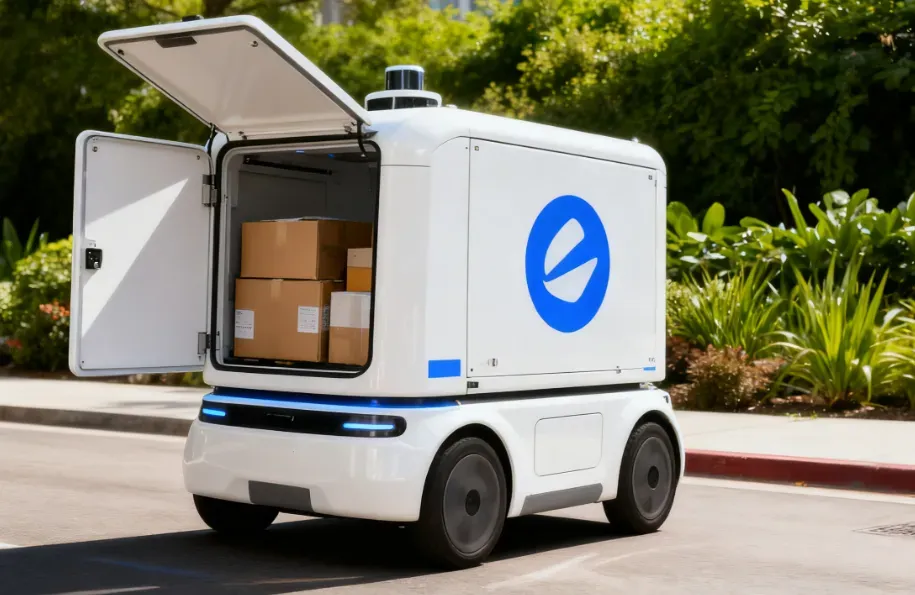
China's autonomous delivery sector is experiencing unprecedented growth as companies transition from pilot programs to large-scale commercial deployment, marking what industry experts believe is a critical inflection point for the technology. The sector is rapidly expanding from enclosed campuses to urban streets across even third-tier cities, outpacing broader autonomous driving adoption.
Industry participants widely view 2025 as the pivotal year for autonomous delivery's mass rollout, with the sector evolving from "pilot projects" to "industrial-scale forests." While autonomous driving faces ongoing regulatory debates over liability, autonomous delivery has already completed technical validation and business model verification in last-mile logistics.
Major Chinese companies are reporting dramatic scaling effects, with some manufacturers seeing monthly production volumes exceed their previous two-year totals. The combination of policy support, technological advancement, and compelling cost savings is driving rapid market expansion across multiple sectors including express delivery, fresh goods, and instant logistics.
Market dynamics suggest the technology could generate billions in cost savings for major platforms, with operational costs falling 70-90% compared to human delivery workers in certain scenarios.
Technology Validation Drives Commercial Breakthrough
The autonomous delivery market has reached technical maturity after nearly a decade of development, beginning with product development in 2016 and entering commercial pilots in 2023 as costs declined significantly.
Meituan has emerged as a major player, operating 53 drone routes with over 450,000 cumulative delivery orders by end-2024. The company's autonomous delivery vehicles have completed nearly 5 million deliveries with 99% autonomous driving coverage.
According to research from Tianfeng Securities, large-scale autonomous delivery implementation could save Meituan billions in delivery worker costs. A single drone's lifetime operational cost totals 84,500 yuan ($11,700), with monthly costs as low as 1,400 yuan, representing 75-90% savings compared to current delivery worker wages.
Investment Surge Signals Market Confidence
Capital markets have shown strong interest in the sector, with Chinese autonomous vehicle company Neolix securing prominent recognition in ARK Invest's "BIG IDEAS 2025" report as the second most competitive robotic delivery company globally.
In February 2025, Neolix completed a 1 billion yuan ($138 million) Series C+ funding round backed by logistics giants and financial investors including CICC Capital. The company delivered its 10,000th autonomous vehicle from its Zhejiang Tonglu facility in early 2025, marking explosive order growth.
Neolix founder and CEO Yu Enyuan revealed the company sold over 1,000 units in 2024 but now produces in one month what previously took two years. The company has delivered over 800 vehicles to DiDi Freight since the second half of 2024, expanding into real-time logistics scheduling.
Yu projects non-express delivery sectors including urban distribution and instant logistics will grow faster than express delivery, potentially exceeding 50% of sales volume. The expansion from planned logistics to instant logistics represents a market opportunity growing from 1 million to 30 million vehicles.
Regulatory and Operational Challenges Persist
Despite rapid growth, the sector faces significant challenges including cost reduction, legal compliance, scenario adaptation, and safety concerns. Public perception and safety incidents remain the greatest obstacles to widespread adoption.
Two incidents in April highlighted safety risks: a Xianyang autonomous vehicle dragged a fallen electric bike, and a Beijing vehicle fled after collision. Such incidents can undermine years of trust-building efforts and slow commercial deployment.
Regulatory fragmentation poses additional challenges. While over 100 cities have opened road access, some jurisdictions classify autonomous vehicles as "special equipment" with restricted main road access. Companies often face quarterly permit renewals in certain regions, directly impacting operational viability.
Cost economics also require scrutiny. While some companies achieve 70% per-package cost reduction in enclosed scenarios like universities, open-road operations still cost 15% more than human delivery. True cost savings depend on achieving scale.
Policy Support Accelerates Industry Development
Government backing provides crucial foundation for the sector's growth trajectory. In 2025, China's Ministry of Commerce and seven other departments issued the "Special Action Plan for Accelerating Digital-Intelligence Supply Chain Development," explicitly promoting intelligent warehouses, autonomous guided vehicles, and unmanned delivery vehicles.
Local governments are implementing specific deployment targets, with Jiangsu and Sichuan provinces setting autonomous vehicle rollout goals. Shenzhen launched China's first cross-district networked autonomous urban distribution pilot program.
Advanced AI technologies are driving breakthrough capabilities. Meituan's drones employ 4D millimeter-wave radar and binocular vision cameras for complex weather conditions. SF Express uses AI for route optimization, reducing traffic light wait times by 20%. ZTO's intelligent driving platform monitors vehicles across 40 cities with 95% risk warning accuracy.
The integration of 5G with logistics terminals enables "vehicle-road-cloud integration," allowing cloud-based AI models to analyze traffic conditions in real-time, with autonomous vehicles responding three times faster than human drivers.