
Pony.ai Robotaxi Revenue Surges 691%, Signaling Shift From Burn-to-Scale to Earn-to-Scale
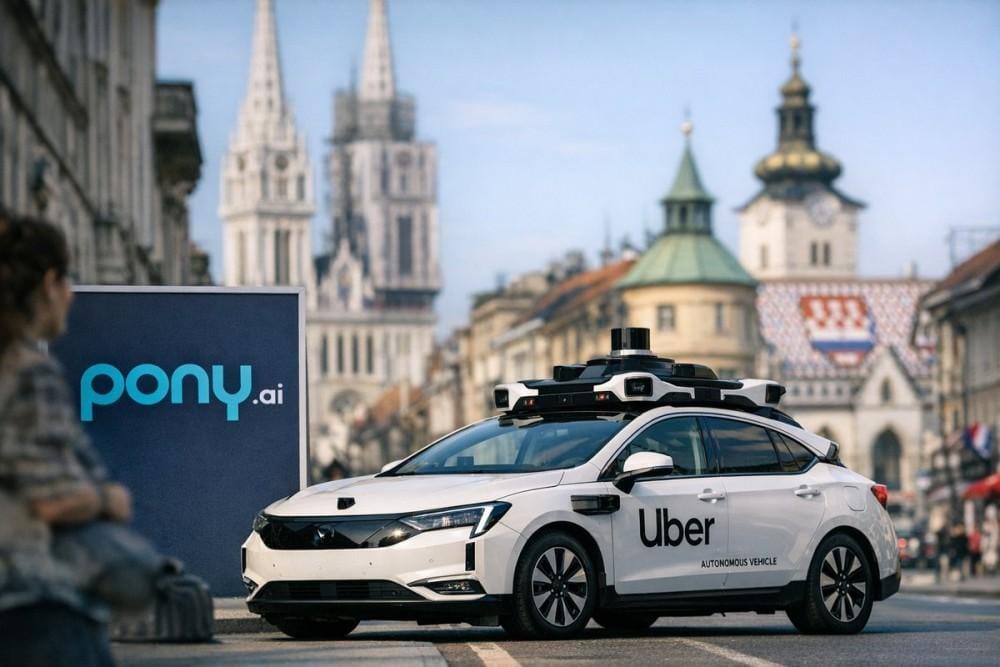
Pony.ai is rewriting the economics of autonomous driving: its second-quarter 2026 results show robotaxi revenue exploding 691% year-on-year while operating losses contracted by more than 100 percentage points, a rare combination in a sector historically defined by runaway cash consumption.
The Nasdaq-listed autonomous vehicle company reported Q2 2026 total revenue of RMB 246 million (US$34.2 million), up 68.8% year-on-year, and first-half cumulative revenue of RMB 478 million (US$66.4 million), nearly doubling the prior-year period. The results, released August 18, were accompanied by a strategic announcement four days earlier: an expanded partnership with Uber Technologies to deploy more than 2,000 robotaxis across five European cities — one of the largest such commitments on the continent to date. Combined with existing overseas pledges from Uber, Bolt, and Singapore's ComfortDelGro, locked international deployment commitments now exceed 4,000 vehicles.
Markets are watching whether Pony.ai can convert these headline numbers into a credible path to profitability. With RMB 9.435 billion (US$1.31 billion) in cash and short-term investments on its balance sheet as of June 30 — down from US$1.44 billion at end-Q1 but still among the deepest war chests in the global autonomous driving sector — the company has the runway. The question is whether operating leverage can outpace the accelerating deployment costs of the second half.
Three Business Lines Diverge Sharply in Growth Trajectory
Pony.ai's revenue architecture is splitting into distinct velocity tiers, and the gap is widening.
Robotaxi generated US$12.1 million in Q2, up 691.2% year-on-year. Passenger fare revenue — the purest signal of commercial traction, representing real users paying real money rather than vehicle-sale recognition — surged 849.3%, the highest single-quarter growth rate in the company's history. CEO James Peng described the segment as the company's "growth engine," a characterization the numbers support unambiguously.
Robotruck contributed US$13.3 million, up roughly 40% year-on-year, driven primarily by a freight services partnership with Sinotrans. The fourth-generation autonomous heavy truck entered mass production on schedule and commenced commercial mixed-fleet operations — autonomous trucks running alongside human-driven vehicles — at Mawan Port in Shenzhen in partnership with China Merchants Port.
Intelligent Solutions, once the company's most reliable revenue line, delivered US$10.8 million, up just 3.9% — a sharp deceleration from double-digit growth rates in the year-ago period. Management attributed the slowdown to timing fluctuations in autonomous driving domain controller (ADC) deliveries, characterizing it as transient. First-half Intelligent Solutions revenue totaled approximately US$26.3 million.
The divergence carries strategic significance. Robotaxi's share of total revenue is expanding rapidly, concentrating both growth upside and execution risk in a single segment. That concentration is a deliberate strategic choice, not an oversight.
Operating Leverage Begins to Materialize, Compressing Loss Ratios
The more consequential story in Pony.ai's Q2 print is not the top-line acceleration but the structural improvement in cost ratios — a signal that the company's investment cycle may be approaching an inflection point.
Total operating expenses grew 11.4% year-on-year in Q2, a fraction of the 68.8% revenue growth rate. Research and development expenditure rose 14.7% — again, well below revenue growth. CTO Lou Tiancheng attributed the decoupling to PonyWorld 2.0, the company's second-generation autonomous driving world model: "PonyWorld 2.0 enables the company to deploy fleets across multiple countries and cities simultaneously with fewer R&D resources, without proportionally increasing engineering headcount."
The impact on loss metrics is material. Under U.S. GAAP, net loss for Q2 2026 narrowed approximately 15% year-on-year to US$45.4 million. The operating loss margin compressed from 285.6% to 181.5% — an improvement of more than 104 percentage points in twelve months. The net loss margin narrowed from 248.3% to 125.2%, a reduction of over 123 percentage points.
Cash flow from operations showed a net outflow of US$44 million in Q2, widening from US$25.4 million in the year-ago quarter. CFO Wang Haojun framed the increase as a function of working capital timing — including seasonal accounts payable settlements and inventory build-up ahead of second-half fleet expansion — rather than structural deterioration. "We will continue to maintain a prudent cash management pace; the financial position remains sound," Wang said on the earnings call.
Co-Build Model Unlocks Asset-Light Path to Thousand-Vehicle Scale
The mechanism behind Pony.ai's overseas ambitions is a tripartite "co-build fleet" structure that redistributes capital requirements across the value chain — and it is increasingly central to how the company thinks about scaling without proportional balance-sheet expansion.
Under the model, Pony.ai functions as the technology provider, supplying its L4-level "virtual driver" software stack and operational expertise. Platform partners — Uber, Bolt, and ComfortDelGro — provide demand aggregation and hybrid mobility networks. Local operators handle day-to-day fleet management and maintenance.
The financial architecture is deliberately two-stage. "We first deliver vehicles to partners and recognize a vehicle-sale revenue item," CFO Wang explained. "Once the vehicles are on the road, we receive a continuous revenue share from every trip — the former is immediate cash, the latter is the core source of future high-margin, recurring income."
This structure means Pony.ai avoids the capital intensity of self-owned fleet expansion while still capturing the recurring economics of rides at scale. Currently, nearly half of all new vehicle additions are being deployed through the co-build model. As of June 30, the global robotaxi fleet stood at 1,975 vehicles — with more than 4,000 additional units locked through international deployment commitments.
The Uber relationship merits particular scrutiny. The expanded European partnership, announced August 14, targets more than 2,000 vehicles across five cities, building on an existing collaboration that already covers operations in China. Peng cited two factors in Uber's decision to deepen the partnership: demonstrated technology reliability at commercial scale, and a cost structure — anchored by a 70% reduction in autonomous driving kit bill-of-materials costs in the seventh-generation vehicle relative to its predecessor — that generates attractive unit economics for platform partners.
"Uber is looking for autonomous driving partners whose technology is mature and reliable enough for large-scale application, while also requiring a cost structure that delivers attractive economics," Peng said. "Those are precisely the two things we can offer."
PonyWorld 2.0 Drives Per-City Expansion Cost Toward Marginal Zero
Lou Tiancheng's technical briefing on the earnings call offered a rare quantitative window into the operational efficiency gains underpinning Pony.ai's expansion claims.
The most striking data point: each 100 robotaxis requires only three employees to sustain daily operations. The contrast with conventional taxi operations — which maintain a 1:1 driver-to-vehicle ratio — illustrates the structural labor cost advantage of fully autonomous fleets. Pony.ai vehicles autonomously handle charging and parking upon returning to depot, eliminating the need for manual intervention that accounts for a significant portion of traditional fleet operating costs.
Lou described PonyWorld 2.0's core capability as "self-evolution" — AI systems that autonomously diagnose edge-case failures, generate targeted solutions, and validate deployment readiness without human engineering review. "Previously, entering a new city required thousands of engineers manually reviewing, analyzing, upgrading, retraining, and validating deployments," Lou said. "Now the system completes this automatically, requiring only a small team to operate."
The world-model precision argument is technically specific: Lou described the challenge as matching the probability distribution of real-world traffic behavior at the city and intersection level — not approximating it. "99% accuracy is insufficient; 1% error rate is also insufficient. The model must match the actual probability itself."
This technical architecture, if the claims hold under real-world scaling, represents a meaningful competitive moat: the marginal cost of entering a new geographic market approaches zero as PonyWorld 2.0 automates the localization process that historically required linear engineering headcount growth.
Second-Half Guidance Points to Accelerating Revenue Recognition
Management guidance for the remainder of 2026 reflects confidence in execution across all three segments, though the growth profiles remain asymmetric.
For Robotaxi, the full-year target is revenue growth exceeding 3.5 times the 2025 base. Beginning in Q3, European deployments with Uber will commence, triggering vehicle-sale revenue recognition under the co-build model's first-stage economics, with per-trip revenue shares to follow as fleets ramp utilization.
For Robotruck, the fourth-generation autonomous heavy truck is in mass production, with Mawan Port serving as the flagship commercial deployment site. The company targets approximately 1,000 autonomous heavy trucks deployed within two to three years. An L4 autonomous light truck unveiled in April 2026 is currently in testing, with a target of 100,000 units deployed before 2030.
For Intelligent Solutions, management expects the ADC delivery timing disruption to resolve in the second half, with revenue growth resuming to a more normalized trajectory.
Domestic market expansion continues in parallel. Pony.ai's Guangzhou robotaxi service has expanded from Nansha District to four additional districts — Haizhu, Tianhe, Huangpu, and Panyu — adding more than 300 square kilometers of urban coverage and reaching a population of over 7 million. In Shenzhen, the network now serves Bao'an International Airport, Shenzhen Bay Port, and Shekou Cruise Terminal — high-value transport hubs that drive both utilization rates and average fare values. Registered users on the Pony.ai app in China surpassed 1.5 million as of August, up 50% from 1 million in March.
Peng's framing of the company's strategic position is unambiguous: "Pony.ai has the operational momentum, global opportunity, and financial resources to execute on our four-year targets and support sustainable growth." Whether the second half delivers on that assertion — particularly as European deployments move from commitment to commercial reality — will determine whether Q2 2026 marks a genuine inflection point or a high-watermark quarter in an industry still searching for its first profitable operator at scale.
Related Coverage:
Pony.ai and Uber Expand European Robotaxis to 2,000 Vehicles Across Five Cities
Pony.ai's Revenue Jumps 76% And Gross Margin Turns Positive, But Net Loss Explodes By 73%