
Brains vs. Brawn: China’s Top Humanoid Robot Rivals Forge Divergent Paths to Market
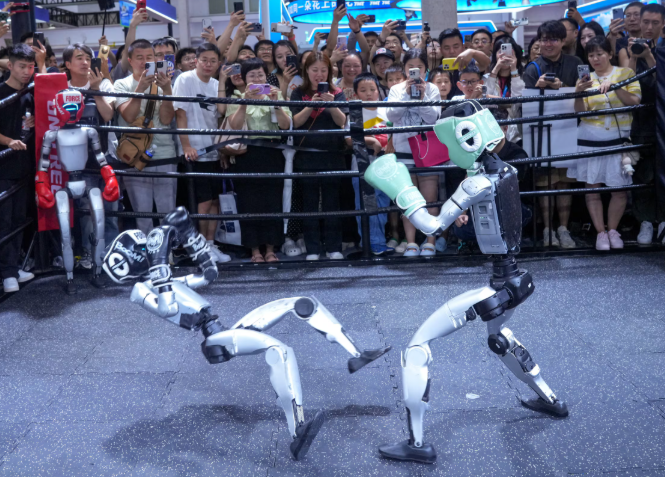
China’s two leading humanoid robot startups are pursuing starkly different strategies in their quest to dominate one of technology’s most anticipated frontiers. AgiBot, backed by a team with Huawei DNA, is building a comprehensive, AI-driven software ecosystem. In contrast, its main competitor, Unitree Robotics, is prioritizing hardware prowess and rapid commercialization through a more pragmatic, product-focused approach.
This strategic divergence was highlighted on Friday, when AgiBot hosted its first partner conference to unveil an ambitious "Huawei-style" ecosystem. The company announced plans to open-source its core technology, pursue a "be integrated" strategy with industry partners, and deploy capital to cultivate a vast network of collaborators. AgiBot aims to ship several thousand robots in 2025, with tens of thousands projected for next year, focusing primarily on business-to-business applications.
The rivalry has also intensified in the capital markets. In a significant strategic move, AgiBot recently acquired a controlling stake in a Shanghai-listed firm, securing a swift path to public funding ahead of Unitree, which formally initiated its own IPO process in July. This race for capital underscores the high stakes involved as both companies position themselves to become market leaders.
These contrasting blueprints—one building a deeply integrated, AI-first platform and the other championing agile hardware and immediate sales—are setting the terms of competition in the nascent humanoid robot industry. For investors, this split represents a fundamental choice between a long-term ecosystem investment and a bet on a nimble hardware manufacturer capturing early market share.
AgiBot’s ‘Huawei-Style’ Ecosystem Play
At its "Co-create and Innovate" partner conference, AgiBot laid out a three-pronged strategy it calls "open source, be integrated, and capital empowerment." The company is open-sourcing key software, including its AimRT middleware and a million-point dataset from real-world robots, alongside its embodied AI operating system, "Lingqu OS."
Its integration strategy aims to leverage the vertical expertise of partners in development, marketing, and delivery across eight major commercial scenarios, from industrial manufacturing and logistics to commercial cleaning and security patrols. The company has already formed partnerships with dozens of listed firms, including Lens Technology, Lijing Innovation, and Fulin Precision Industry Co., Ltd..
To fuel this ecosystem, AgiBot launched its "A-Plan" to incubate over 50 early-stage projects and build an industrial ecosystem valued at over RMB 100 billion within three years. The firm has already invested in 15 startups and established an embodied intelligence fund with Hillhouse Capital. CEO Deng Taihua also confirmed plans for a Series C funding round by year-end to attract more international industrial investors.
Unitree’s Focus on Hardware and Rapid Sales
Unitree Robotics has adopted a different commercialization model, positioning itself as a "hardware shovel seller." The company prioritizes physical performance, creating robots with impressive and agile motor skills. This approach, combined with a low-price strategy, has allowed it to generate significant online buzz and translate thatt raffic directly into sales.
The company's primary target markets are education, research, and entertainment, with industrial applications being a secondary focus. Founder Wang Xingxing has stated that entertainment and work are equally important applications, and the key is identifying which technologies mature first. This pragmatic approach has yielded impressive results, with annual revenue already exceeding RMB 1 billion yuan (US$138 million). Humanoid robots account for at least 30% of that revenue, with shipments surpassing 1,500 units in 2024 and expected to grow three- to four-fold in 2025.
A Fundamental Split: AI Brain vs. Physical Brawn
The differing business models reflect a deeper technological divide. AgiBot is pursuing a full-stack, "software-defined" approach centered on what it calls its "1+3" technical strategy: a core robot body powered by three pillars of intelligence—motion, interaction, and operation. CTO Peng Zhihui stated the goal is not just to build a few robots, but to create "a self-evolving, general-purpose embodied intelligence foundation." The company recently unveiled its Lingxi X2-W, a wheeled, dual-arm prototype designed for complex operational tasks.
Unitree, in contrast, is known for its hardware-first philosophy and has been more cautious in its AI investments. This "movement-first" approach has drawn comparisons to the early days of Boston Dynamics. However, the industry trend is increasingly shifting toward AI, with Boston Dynamics itself now collaborating with Toyota Research Institute on large behavior models (LBMs) to enhance its robots' cognitive capabilities.
IPO Race Heats Up With AgiBot’s Strategic Acquisition
The race to secure public funding is a critical battleground. In July, AgiBot gained a decisive edge by acquiring a 66.99% stake in SWANCOR HOLDING CO., LTD., a company listed on Shanghai's STAR Market. While officials state it is a strategic acquisition rather than a reverse merger, the move effectively makes AgiBot the "first A-share humanoid robot stock" and grants it immediate access to China’s public capital markets.
The move puts pressure on Unitree, which launched its own IPO process a week later. Investors are highly optimistic about Unitree's prospects, with some analysts projecting a valuation between RMB 50 billion and RMB 100 billion. The outcome of this race for capital will significantly influence each company's ability to scale production and R&D.
As both startups forge ahead, the ultimate winner will be determined not just by a successful IPO, but by the ability to achieve a sustainable commercial model based on meaningful technological breakthroughs. For now, the divergent strategies of AgiBot and Unitree offer a compelling test case for whether the future of robotics will be won by the builder of intelligent ecosystems or the seller of powerful machines.