
BYD Projects Global Sales Leadership by 2030 as Battery Ramp Takes Center Stage
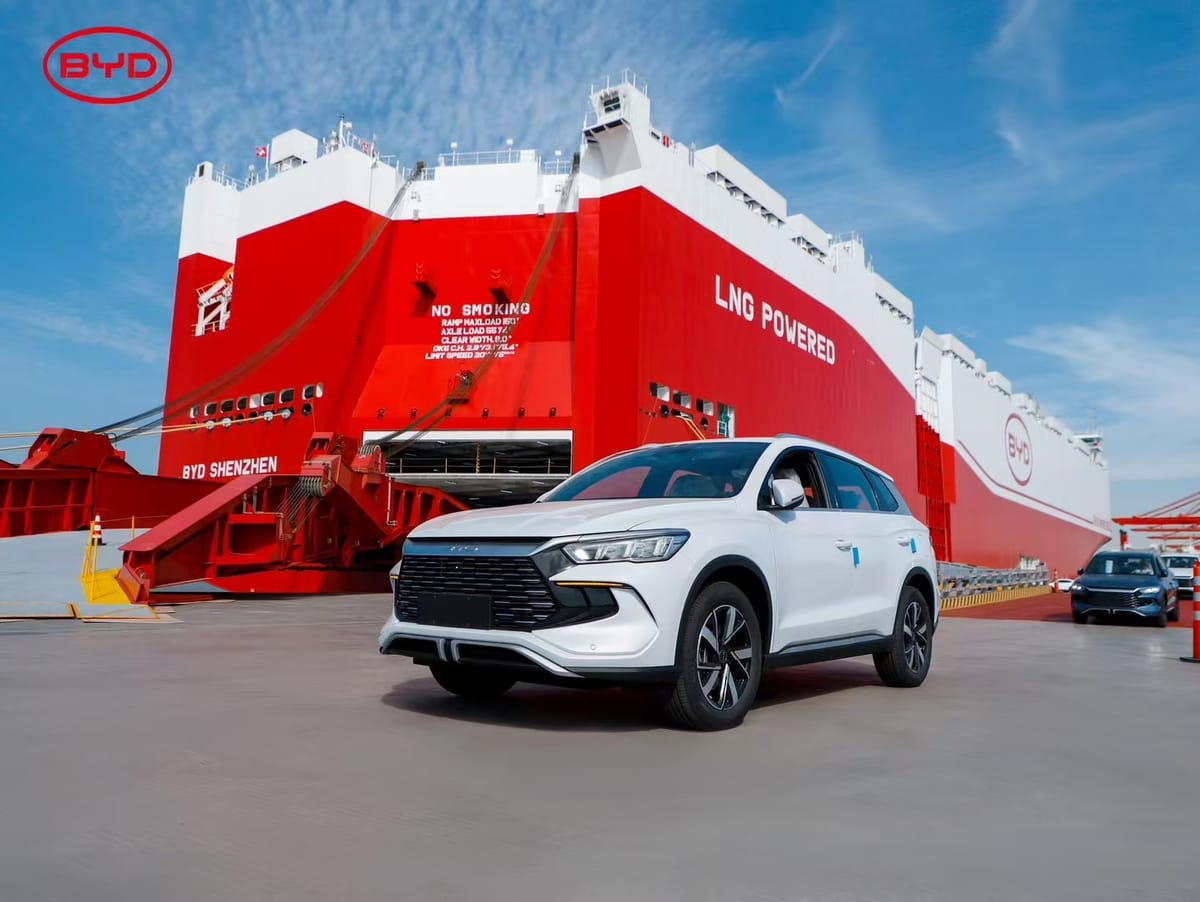
BYD Chairman Wang Chuanfu used the company's 2025 annual general meeting on June 9 to project global sales leadership by 2030, even as first-quarter domestic deliveries collapsed nearly 50% year-on-year and net profit fell 55% to RMB 4.085 billion (US$567 million) — a combination that drew tears from at least one shareholder on the floor.
The juxtaposition was stark. Wang's five-year ambition landed against a backdrop of BYD's A-share price (002594.SZ) sitting at roughly RMB 91, down nearly 34% from its May 2025 peak of RMB 137.67 and carrying a year-to-date return of -5.97% as of the meeting date. Hong Kong-listed shares (1211.HK) closed at HK$88.40, within striking distance of their 52-week low of HK$86.85. Morgan Stanley, which maintains an Overweight rating with a Hong Kong price target of HK$121.00, attended the AGM and noted management's continued emphasis on technology differentiation and overseas expansion as the twin pillars of the recovery thesis.
Capacity Crunch Reframes the Demand Narrative
Wang's most consequential disclosure was a supply-side reinterpretation of BYD's sales weakness — a pivot from the narrative he offered at a December 2025 extraordinary general meeting, when he attributed consecutive monthly domestic sales declines to "reduced technological lead and market commoditization." On Monday, he attributed the same pressure to a production-line transition bottleneck at the second-generation Blade battery.
The second-generation flash-charging Blade battery, unveiled in March 2026, achieves a 10%-to-70% charge in five minutes — a step-change in fast-charging performance that has generated pre-orders exceeding 100,000 units in the two weeks since the Datang EV, BYD's first flagship vehicle carrying the new cell, was announced ahead of its June 17 launch. The vehicle offers a rated range of 950 kilometers. Demand is not the problem; tooling is.
Wang told shareholders that second-generation Blade battery output would increase by 20,000 to 50,000 units per month on a rolling basis through year-end, with supply-side relief for premium models expected in the third quarter of 2026, according to supply-chain checks cited by Wall Street News. The practical implication: full volume recognition from the new platform is a 2027 story, not a 2026 one.
The shift in explanatory framework — from demand-side competitive erosion to supply-side production transition — is analytically significant. It is a more favorable narrative for investors because it implies pent-up orders rather than lost market share. But it also carries a verification burden: monthly delivery data in the second half of 2026 will either confirm or discredit the capacity-ramp story within two reporting cycles.
Domestic Market Loses Its Anchor Role
The first-quarter numbers expose how rapidly BYD's profit geography is shifting. Domestic deliveries in Q1 2026 totaled 381,000 units, down roughly 50% year-on-year. Total Q1 revenue came in at RMB 150.2 billion (US$20.9 billion) amplified the profit compression, but the volume contraction was structural, not accounting-driven.
Gross margin, however, edged back up to 18.8% quarter-on-quarter — a data point that suggests BYD is not buying volume through price cuts at the expense of unit economics, even as rivals accelerate. Leapmotor posted monthly sales exceeding 80,000 units in May 2026, up more than 80% year-on-year. Xiaomi stabilized above 30,000 monthly units. Geely (0175.HK) reached 153,000 domestic units in a single month. The market has structurally shifted from a one-dominant-player configuration to multi-front competition across every price band.
May 2026 offered the first inflection signal: BYD's monthly deliveries recovered to 383,500 units, ending eight consecutive months of year-on-year decline. Crucially, overseas exports hit a record 160,000 units — representing roughly 42% of total monthly volume. The domestic component was only 220,000 units. The profit center of gravity is moving offshore.
Overseas Ambition Accelerates Beyond Original Targets
Wang confirmed that BYD's original 2026 overseas sales target of 1.5 million units is now considered a floor, with management expecting the final figure to exceed that threshold. Morgan Stanley's analysts project overseas deliveries in a range of 1.6 million to 1.8 million units for the full year.
Regionally, BYD expects to claim the top market-share position in Australia within months and continues to pursue the number-one ranking in Brazil. Wang referenced established training centers for autonomous driving data collection across Europe, South America, Southeast Asia, and the Middle East — infrastructure investments that serve a dual purpose: localizing the product and accumulating the regional driving-data sets required for future L3 and L4 autonomous systems.
Wang was careful to frame international expansion with diplomatic restraint. He indicated BYD should avoid making competitors "overly nervous" — an acknowledgment that protectionist responses, including the European Union's additional tariffs on Chinese electric vehicles, remain a material risk to the overseas growth trajectory. Morgan Stanley's bear-case scenario for BYD explicitly flags "lack of progress in overseas expansion amid rising protectionism" as a primary downside risk.
AI and Autonomous Driving Position BYD for the Next Technology Cycle
Wang devoted significant floor time to BYD's autonomous driving and artificial intelligence positioning — an area where the company has historically been perceived as trailing pure-play software peers. He disclosed that BYD currently has 3.15 million intelligent-driving-capable vehicles operating globally, generating 200 million kilometers of daily driving data. That data flywheel, he argued, provides the training foundation for higher-level autonomy.
BYD has prepared chip design, algorithm development, data infrastructure, and regional training ecosystems in anticipation of L3 regulatory approval. Wang stated: "Once regulations are in place, BYD will take off rapidly." Morgan Stanley noted that management provided limited new disclosures on in-house chip specifics or autonomous driving timelines, but assessed that BYD's integrated hardware-software capabilities and scale advantages position it competitively for the L3/L4 transition whenever the regulatory window opens.
Wang also framed vehicle intelligence as a form of embodied AI — a conceptual alignment with the broader AI investment narrative that may help BYD attract a different category of institutional investor beyond traditional auto-sector allocators.
Wall Street Holds the Line, But Anchors Recovery to Execution
Goldman Sachs set an A-share price target of RMB 137 in April 2026 and projects full-year 2026 total deliveries of 5.05 million units. Morgan Stanley's Overweight rating on the Hong Kong-listed shares carries a HK$121 target, implying roughly 37% upside from the June 9 close. Both institutions anchor their bull cases to overseas volume acceleration and domestic capacity normalization — not to a recovery in domestic market-share dynamics.
The valuation framework Morgan Stanley employs blends a discounted cash-flow model (14.3% WACC, 3.0% long-term growth) with scenario-weighted price-to-earnings multiples ranging from 12x in the bear case to 40x in the bull case. The wide spread reflects genuine uncertainty about whether the capacity-ramp narrative holds, whether overseas markets absorb the volume being displaced domestically, and whether BYD can sustain gross margins above 18% as competition intensifies.
Wang's 2030 global-volume-leadership pledge provides a long-dated anchor for patient shareholders. The nearer-term test is considerably more prosaic: can BYD's second-generation Blade battery production lines reach sufficient scale by the end of 2026 to restore monthly domestic deliveries to a trajectory that justifies current valuations? The answer will be visible in the data before year-end.
Related Coverage:
BYD's Ultra-Fast Charging Battery Puts Nio's Swap Model Under Pressure in 2026