
China's Top-10 Best-Selling Cars Turn Fully Electric as ICE Models Exit the Rankings
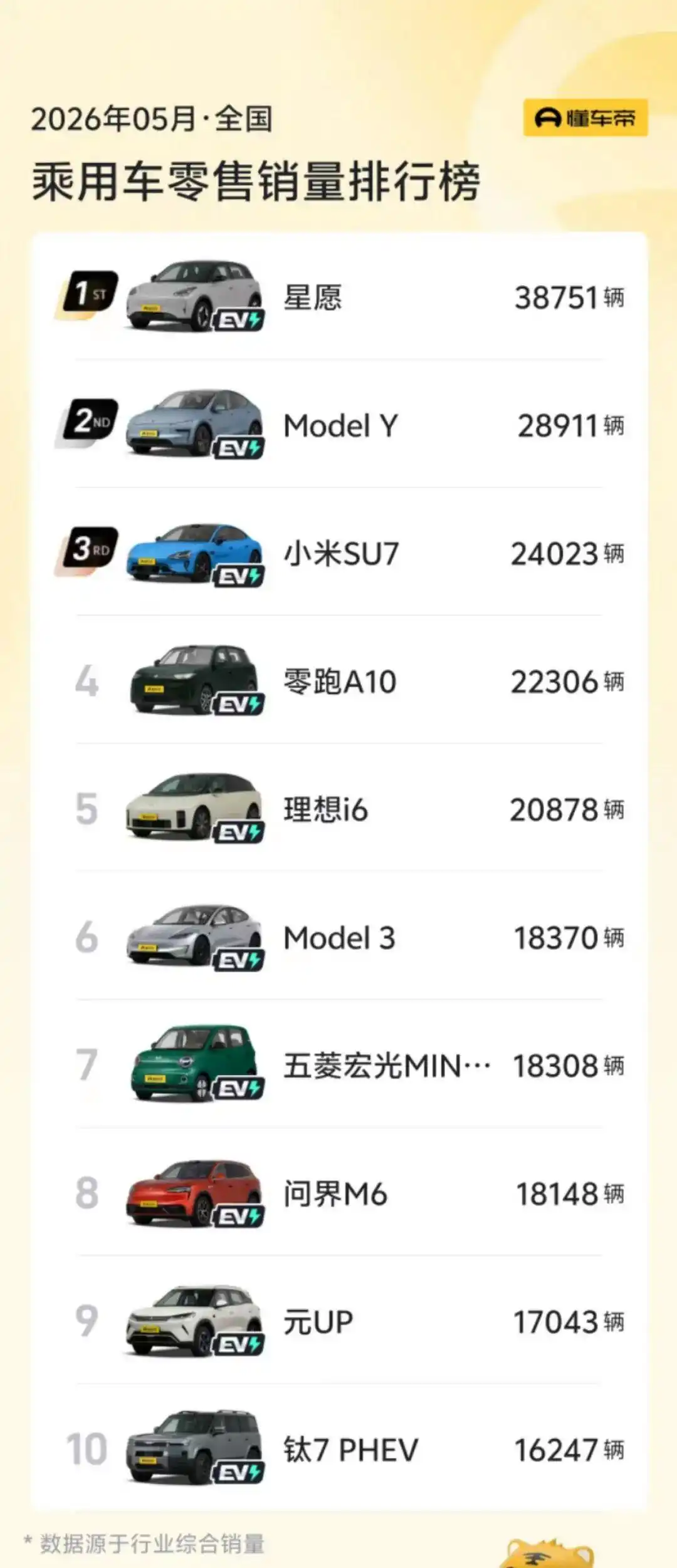
In a milestone that no major automaker forecast arriving this soon, not a single internal combustion engine vehicle appeared in China's top-10 passenger car retail rankings for May 2026 — a complete sweep by new energy vehicles that took less than 150 days to materialize from a position of 70% dominance.
The data, published by Dongchedi, China's leading automotive data platform, shows the transition accelerating far beyond even the most aggressive industry projections. As recently as January 2026, ICE models still held seven of the ten top-selling slots. By March, that count had fallen to five amid a fresh wave of price cuts and rising fuel costs. April left a single holdout — Geely's Binyue — before May erased the final entry. The velocity of that collapse — from 70% representation to zero in under five months — signals not a gradual erosion but a structural repricing of consumer preference at scale.
Market participants are now reassessing timelines for legacy automakers' electrification pivots, with the May data functioning as a hard deadline rather than a distant warning.
Geely and Xiaomi Lead a Diversified NEV Podium
The May top-10 list is notable not only for who is absent, but for the breadth of what replaced them. Pure battery electric (BEV), extended-range electric (EREV), and plug-in hybrid (PHEV) models all secured positions, demonstrating that NEV dominance is no longer contingent on a single powertrain format.
Geely Xingyuan claimed the top spot with 38,751 units sold, validating the micro-EV segment as a high-volume entry point into China's mass market. Tesla Model Y held second with 28,911 units, sustaining its grip on the mid-size premium electric SUV category despite intensifying domestic competition.
Xiaomi SU7 secured third place, dispelling concerns that its initial sales surge was a launch-window anomaly. The model now appears to have entered a stable high-delivery phase — a critical inflection for Xiaomi's nascent automotive unit as it builds toward profitability. Leapmotor A10 and Li Auto i6 rounded out fourth and fifth, both anchored by strong demand from family-oriented buyers in China's vast Tier 2 and Tier 3 city markets.
Pricing Power Shifts Deliver the Decisive Blow to ICE
The proximate cause of ICE vehicles' exit from the top-10 is a pricing war initiated by leading NEV manufacturers in early 2026. The campaign did not merely undercut ICE models on sticker price — it dismantled the total-cost-of-ownership argument that had kept combustion vehicles competitive in the mass market.
PHEV and EREV models, in particular, have reached price parity or better with equivalent ICE vehicles at point of sale, while delivering dramatically lower per-kilometer running costs. For China's largest consumer cohort — first-time buyers and trade-up purchasers in the RMB 100,000–200,000 (US$13,900–US$27,800) segment — the rational calculus has shifted decisively.
Simultaneously, the definition of a "good car" in China has been rewritten. Consumers now benchmark vehicles against smart cockpit integration, advanced driver-assistance systems (ADAS), and software-defined vehicle architectures. Legacy ICE platforms, absent a breakthrough hardware iteration cycle, are structurally disadvantaged in this new evaluation framework, ceding what analysts describe as "product definition authority" to NEV-native manufacturers.
ICE Survival Narrows to Structural Niches
The disappearance of ICE vehicles from the top-10 does not constitute an imminent industry extinction event. China's passenger vehicle market is large and heterogeneous. Combustion vehicles retain a durable base in remote regions with incomplete charging infrastructure, high-altitude and extreme-cold climates where battery performance degrades, and high-mileage commercial use cases demanding rapid refueling cycles.
However, these are defensive redoubts, not growth markets. The strategic implication for traditional automakers — both joint-venture players such as Toyota, Volkswagen, and Honda, and domestic ICE-reliant manufacturers — is that the volume and margin engine that funded R&D and factory utilization for decades is contracting at an accelerating rate.
Legacy Automakers Face Binary Strategic Choices
Industry observers expect the competitive response to bifurcate sharply. On one track, ICE manufacturers will intensify terminal discounting — effectively a "volume-for-survival" strategy — to maintain factory capacity utilization above breakeven thresholds. On the other, the May data will accelerate the reallocation of capital and engineering resources away from internal combustion development toward electrification platforms, compressing transition timelines that were previously measured in years.
For global automakers with significant China exposure, the May rankings serve as a quantifiable stress test. China represents the world's largest single passenger vehicle market. A structural shift in consumer preference at the top-10 level — where mainstream purchasing intent is most legibly expressed — carries direct implications for production planning, joint-venture strategies, and long-term earnings visibility.
The May 2026 top-10 list is a data point, not a death certificate. But the speed at which it arrived has reset the industry's clock.
Related Coverage:
China Auto Market Slumps in May as Fuel Vehicles Fall 40%, Exports Offset Weakness