
BYD's In-House Autonomous Driving Chip Set for 2027 Production Debut on Denza Models
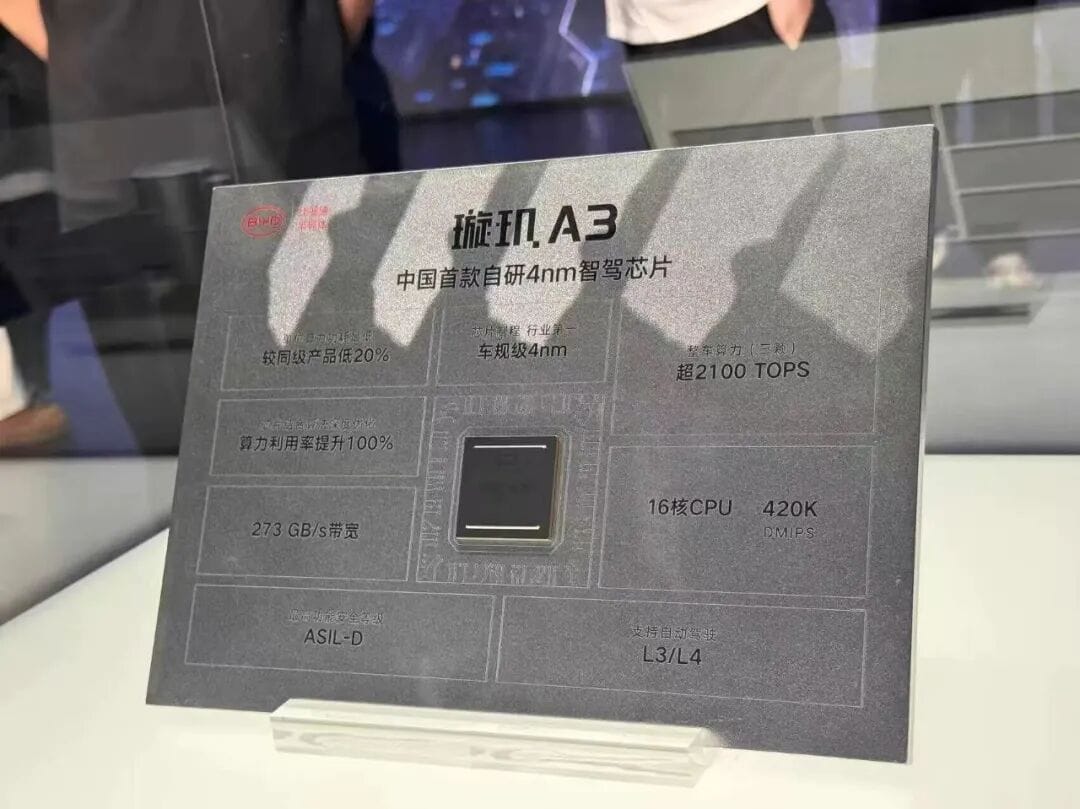
BYD is on track to deploy its proprietary autonomous driving chip in a mass-production vehicle for the first time in 2027, marking a significant milestone in the Chinese automaker's push to vertically integrate its intelligent driving technology stack, according to an exclusive report.
According to LatePost Auto's exclusive report published on June 29, 2026, the first vehicle to carry BYD's self-developed Xuanji A3 chip is expected to be a new model under its Denza brand.
The Xuanji A3 is a 4-nanometer chip delivering over 700 TOPS of computing power per unit, with a three-chip configuration reaching a combined 2,100 TOPS — sufficient to support L3 and L4 autonomous driving. BYD claims the chip consumes 20% less power per unit of compute than comparable products, and that its proprietary algorithm optimization doubles effective compute utilization. The company officially unveiled the chip in May 2026, with Chairman Wang Chuanfu declaring at the launch event: "The first half of the EV era was defined by batteries; the second half of the intelligent era will be defined by chips."
The timeline, while ambitious, reflects the inherent complexity of bringing a custom chip to market. An industry insider cited in the report noted that the process from tape-out to vehicle integration typically requires at least one year, as the chip itself, algorithm deployment, and full-vehicle compatibility must each be independently validated — leaving little room to accelerate the schedule.
BYD's foray into chip design is not new. The company established an IC design unit as early as 2002, which later evolved into BYD Semiconductor. Over the following two decades, it expanded into power semiconductors, MCUs, and power management ICs. The company currently claims a chip R&D workforce of over 7,000 engineers across four research centers and five wafer fabrication facilities.
The autonomous driving chip push is part of a broader internal restructuring. In the first half of 2024, BYD consolidated two separate intelligent driving teams under its New Technology Research Institute, which has since absorbed software, cockpit systems, domain controller hardware, and underlying software operations. As of February last year, BYD's autonomous driving engineering headcount had surpassed 5,000.
The report also exclusively revealed that Zhou Yan, a former director at OPPO's chip subsidiary Zeku who focused on SoC IP design, left BYD in April and has since joined a chip startup. BYD did not respond to LatePost's request for comment.
The 2027 deployment, if realized, would signal BYD's transition from a battery-centric hardware supplier to a full-stack intelligent vehicle platform — a shift that could intensify competitive pressure on both domestic rivals and established chip vendors supplying China's EV market.
Related Coverage:
BYD Launches 4nm Self-Developed Smart Driving Chip, Commits to L3/L4 Safety Liability