
CapCut Embeds Video Editing Inside ChatGPT, Targeting the Workflow Before the Timeline
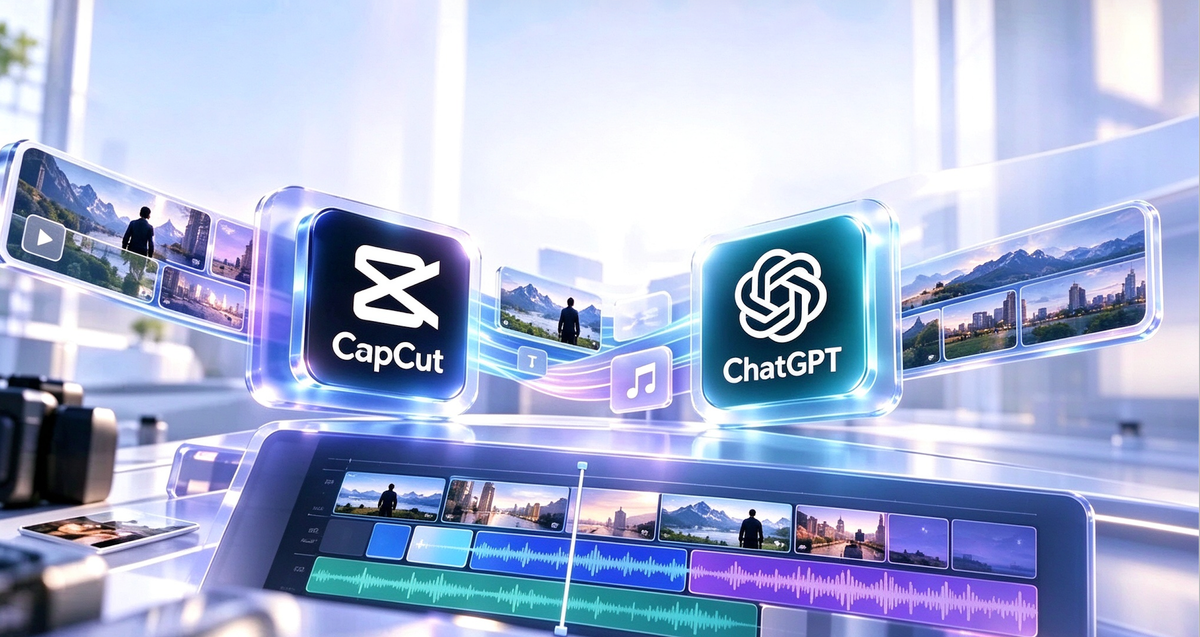
ByteDance's global creative tool moves to capture user intent at the source, not just at the export stage
CapCut, ByteDance's internationally deployed video editing platform, announced at its CapCut World LA event on Oct. 24 at the Audrey Irmas Pavilion in Los Angeles that its AI-powered video editing and generation capabilities will be integrated directly into ChatGPT as a plugin—a move that reframes the competitive calculus for every major creative software vendor operating at scale.
The integration, slated to enter open beta across mobile, desktop, and web in November 2026, marks a strategic repositioning: CapCut is no longer waiting for creators to open an editor. It is embedding itself into the moment a creator first articulates what they want to make.
Initial market response among creator-economy observers has been pointed. The demo shown in Los Angeles—where a user uploaded five football clips and issued a single natural-language instruction to produce a 12-second vertical highlight reel with a "GOAL!" title card—was deliberately chosen for its mundanity. That ordinariness is the point.
Revisiting a 2023 Bet That Arrived Too Early
CapCut's relationship with ChatGPT plugins is not new. In July 2023—three years ago—ByteDance launched a first-generation ChatGPT plugin for CapCut that accepted a text prompt and returned a fully assembled video: script, voiceover, background music, subtitles, and stock footage stitched together automatically.
That product solved a specific, narrow problem: lowering the barrier to video creation from zero. Users supplied a topic; the system supplied a draft. Actual editing still required a return trip to the CapCut application.
The 2026 integration addresses a fundamentally different task. Users now upload their own raw footage. The system is asked to comprehend, select, and sequence real material—not synthesize generic content from a prompt. The workflow distinction is structural:
- 2023: AI generates a video from nothing.
- 2026: AI processes an existing pile of footage into a usable cut.
The former reduced the entry cost of content creation. The latter enters the production pipeline itself—the stage where professional time is actually consumed.
Mapping the Division of Labor That Changes Everything
The demo workflow revealed at Audrey Irmas Pavilion articulates a three-node architecture:
- ChatGPT handles intent parsing, requirement refinement, and task orchestration.
- CapCut executes asset handling, timeline construction, effects application, and final rendering.
- The creator validates direction, iterates on output, and publishes.
Critically, the handoff is bidirectional. After ChatGPT generates an initial cut, the project can be transferred back into CapCut's web editor for granular refinement—color grading, caption styling, platform-specific aspect ratio adaptation—before distribution.
This architecture gives CapCut something more valuable than a single API call: ownership of the full arc from stated intention to exported file.
Automating the Repetitive, Preserving the Judgment
From a labor-market and workflow perspective, the capabilities CapCut is embedding into ChatGPT target a specific tier of editorial work: high-frequency, low-discretion operations that nonetheless consume disproportionate production hours.
Tasks now addressable by the integration include:
- Scanning footage libraries to flag usable clips
- Sequencing shots against a script or narrative template
- Cutting dead air, hesitations, and duplicate takes
- Reformatting 16:9 source material into 9:16 for short-form platforms
- Auto-generating subtitles and multi-language caption tracks
- Batch-producing variants calibrated to platform-specific duration and dimension requirements
- Matching footage to library music, transitions, and effects by mood and pacing
These are operations a skilled editor performs fluently but does not consider the creative core of their work. The implication for the broader editing software market—including Adobe (ADBE) Premiere Pro and its Firefly AI suite, as well as DaVinci Resolve—is that the competitive moat is shifting. Feature depth matters less if users never reach the feature menu.
What remains structurally difficult to automate: evaluating whether a cut feels accurate, natural, and credible to a specific audience. The editor's value migrates from button proficiency to result definition and result judgment.
The Strategic Risk CapCut Is Neutralizing
CapCut's platform advantage has historically rested on more than its editing toolset. Its integrated ecosystem—templates, licensed music, effects, stickers, transitions, and a large creator content library—creates switching friction. Users who enter CapCut tend to complete the full production cycle inside it.
Generative AI disrupts that gravity by inverting the entry sequence. A creator who drafts a content concept, writes a script, and plans a shot list inside ChatGPT has already formed their creative intent before touching any editing tool. In that scenario, CapCut risks being reduced to a rendering endpoint: technically capable, but downstream of the decisions that matter.
The plugin strategy is a direct counter to that displacement. By placing CapCut's execution layer inside the environment where intent forms, ByteDance ensures the platform is present at the moment a project is conceived—not merely consulted when it needs to be finished.
CapCut's official framing at CapCut World LA made the repositioning explicit: the platform now positions itself not as a video editor but as a creative environment for designing, generating, directing, and collaborating. The plugin is the operational expression of that claim.
Competitive Implications for the Creative Software Stack
The integration places pressure on a market where AI capability announcements have outpaced genuine workflow integration. Adobe has embedded Firefly generative tools into Premiere Pro and After Effects; Runway and Pika have pursued standalone AI-native video generation. None has yet claimed a deep integration with the dominant large-language-model interface that hundreds of millions of users open as a default work environment.
CapCut's move—leveraging ByteDance's distribution scale and its existing ChatGPT plugin infrastructure—positions it to claim that territory first, at least in the creator and prosumer segment.
The beta launch timeline of November 2026 means user data on retention, session depth, and workflow completion rates could begin surfacing in ByteDance's internal metrics within the current quarter. Whether the integration drives measurable increases in CapCut's daily active user base—which ByteDance has not disclosed separately—will be a key indicator of whether embedding AI editing inside a chat interface converts intent into habit.
Related Coverage:
ByteDance Launches Seedream 5.0 Image Model with Search Capabilities
Seedance 2.0 Powers Volcano Engine's 10x MaaS Revenue Ambition