
China's AI Chip Arms Race Shifts from Software to Silicon as XHEART Closes Strategic Round
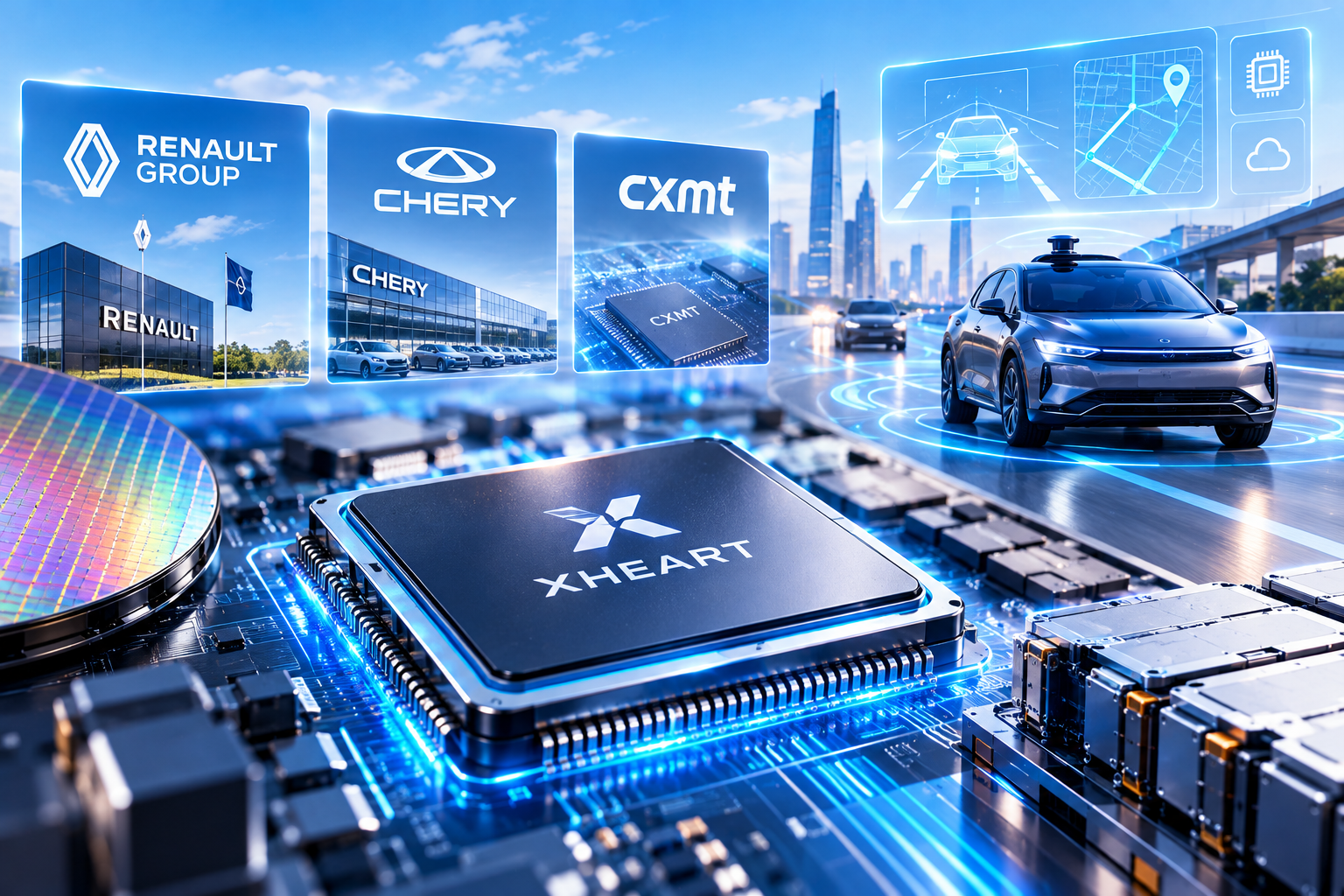
Physical AI chipmaker XHEART has secured a cumulative RMB 5 billion in funding, with Renault Group, Chery Automobile, and memory giant CXMT joining its cap table—a constellation of investors that reveals how China's autonomous driving industry is abandoning pure-software strategies to fight for control at the chip layer.
The October 16 disclosure marks a structural inflection point, not merely another funding milestone. The investor mix—a European OEM, a Chinese export-oriented automaker, and the country's leading DRAM producer—signals that smart-driving chip competition has evolved into a multi-dimensional contest over supply chain control, regulatory access, and hardware margin capture. Industry observers note that XHEART's X7 chip is already in series production on the SAIC Volkswagen ID.ERA 9X, with pipeline coverage extending to SAIC MG, Roewe, GM Cadillac, and select Chery EV and ICE models.
At the 2026 Physical AI & World Model Conference on October 20, Momenta CEO Cao Xudong described the relationship bluntly: XHEART is Momenta's "sibling company," and its roadmap targets a tenfold performance gain at equivalent cost and power envelope, with the next-generation X9 chip designed to expand on-device model scale by a further 100x. He framed the trajectory as an "intelligent driving Moore's Law"—a formulation that carries significant implications for how investors should value the software-hardware stack going forward.
Three Investors, Three Strategic Calculations Converging on One Thesis
The XHEART funding round is best understood not as a valuation story but as a supply chain positioning exercise by three parties with divergent motivations.
CXMT, China's leading DRAM manufacturer, gains a captive customer with automotive-grade volume potential. More importantly, XHEART confirmed that the investment is expected to yield pricing and supply advantages at a time when memory costs are rising—a hedge that converts a vendor relationship into an equity-aligned partnership. For CXMT, backing an automotive SoC company represents a vertical integration play into one of the highest-growth memory consumption verticals.
Renault Group, entering as a first-time XHEART investor, is executing a supplier diversification strategy. With NVIDIA and Horizon Robotics dominating the current Chinese smart-driving chip landscape, Renault's equity stake gives it a third option—one with series-production credentials and co-development influence—while testing whether a Chinese chip vendor can meet European functional safety standards. The partnership with BlackBerry QNX on the jointly announced autonomous driving platform, which layers Momenta's full-stack algorithm, XHEART's X7 SoC, and QNX's safety OS, appears purpose-built to address exactly those regulatory requirements.
Chery Automobile, adding to a prior position, is playing a different game entirely. As China's most internationally active domestic OEM, Chery is seeking definitional control over its smart-driving architecture. Deep equity alignment with its chip supplier converts a procurement relationship into co-development leverage—Chery gains a seat at the table when silicon roadmaps are set, reducing the risk of being locked into a competitor's hardware stack.
Why Momenta Had to "Go Foundational": The Margin Math Behind the Silicon Push
XHEART was incorporated in December 2023 in Suzhou. Its chairman, Li Jun, is a former Momenta chip lead; Momenta founders Cao Xudong and Xia Yan hold indirect equity through the controlling shareholder. There is no direct corporate subsidiary relationship, but the operational DNA is identical—XHEART was created by spinning the chip project out of Momenta to attract independent capital.
The business logic behind this structure is straightforward, and the numbers explain it. Smart-driving chip gross margins run 40%–50% industry-wide; NVIDIA's automotive chip segment reportedly exceeds 60%. By contrast, algorithm-only software vendors face chronic margin compression as OEMs consolidate procurement and demand price concessions. Momenta, which has delivered more than 1.3 million units with cumulative mileage approaching 20 billion kilometers, hit the ceiling that CEO Cao himself has articulated: pure software economics require 4 million vehicles in production to achieve scale efficiency.
Owning the chip closes that gap structurally. When the SoC is architected around a specific algorithm's memory access patterns and compute primitives, the same hardware budget yields measurably better inference performance. That performance delta becomes negotiating leverage with OEMs—not a replaceable software license, but an integrated solution where swapping out the chip would require re-certifying the algorithm stack. The bundle commands higher per-vehicle revenue and dramatically raises switching costs.
An engineer at a Beijing-based smart-driving supplier put it directly: the shift is not about excess compute. General-purpose compute still has structural gaps; the competitive axis has moved to efficient scheduling and optimization—precisely the problem that algorithm-native chip design solves.
A Wave of "New Silicon Challengers" Tests Institutional Logic
XHEART is not an anomaly. In 2026 alone, three comparable entities have disclosed major funding events, each incubated within a larger automotive or technology group before seeking independent capitalization:
- Anhui Shenjue, NIO's chip subsidiary, closed a RMB 2.257 billion (US$313 million) Series A in February 2026, valuing the entity near RMB 10 billion (US$1.39 billion), with NIO retaining a 62.7% stake.
- Ecarx, incubated within the Geely (ecosystem, raised over US$200 million in the first half of 2026.
- Mach Heart Technology, Li Auto's chip unit, closed a RMB 1.625 billion (US$226 million) Series A in October 2026; if all additional subscription rights are exercised, post-money valuation reaches RMB 17.1 billion (US$2.38 billion), with Li Auto holding 74.01%.
The founding teams of these companies share a profile: former algorithm engineers, OEM technology executives, or internet platform chip architects—not traditional semiconductor veterans. All previously served a single parent-company customer. All are now pursuing external revenue.
Horizon Robotics Vice President Su Jing articulated the structural constraint driving this pattern: chip development is an infinite game of recurring tape-out, IP licensing, and fabrication costs. Without a downstream broad enough to amortize fixed expenses, fully captive chip development is financially fragile. He cited Apple and HiSilicon as the counterfactual: Apple's self-designed silicon works because iPhone, iPad, Mac, and Watch collectively ship at nine-figure volumes; HiSilicon survived because Huawei's product portfolio spans telecom equipment, handsets, servers, and cloud.
A single OEM's vehicle lineup cannot replicate that cost-spreading function. External commercialization is not optionality—it is the financial precondition for the R&D investment to be rational.
Market Penetration Rates Signal the Window Is Now
The timing concentration of 2026 funding rounds reflects a specific demand catalyst. Urban NOA (Navigate on Autopilot) penetration reached 20.9% in the first half of 2026. Vehicles priced at RMB 90,000 (US$12,500)—including the BYD Dolphin and Leapmotor A10—now support city-level NOA, collapsing the price barrier that previously confined advanced smart-driving to premium segments. Horizon Robotics' Journey chip series added 5 million units of shipment over the trailing 12 months, for the first time surpassing NVIDIA's automotive chip market share in China.
These data points collectively indicate that automotive-grade AI chip demand has crossed a scale threshold sufficient to support the independent commercialization model. Yuan Chengyin, Secretary-General of the China Automotive Chip Industry Innovation Strategic Alliance, has noted that the independent fundraising activity signals a directional industry consensus: competitive advantage is migrating from algorithmic capability to silicon-layer positioning.
The window logic is unforgiving. Once the supplier landscape consolidates—a process that industry participants expect to play out over the next two to three years—latecomers without established shipment volume will find no remaining market position. The same constraint applies to OEM-captive chip units: if internal silicon cannot scale quickly enough, it not only delays the parent company's smart-driving roadmap but risks stranding the R&D investment entirely.
For XHEART, the sub-three-year path from incorporation to series production—faster than the three-to-four-year industry norm for automotive chip development—combined with a validated OEM customer list and a capital structure that now includes memory supply chain, European OEM, and Chinese export market exposure, represents a more defensible position than most peers at equivalent funding stages. Whether the X9 chip's promised 100x model scale expansion materializes on schedule will determine whether that position converts into durable market share.
Related Coverage:
Li Auto's Mach Cores Hits $2.3B Valuation as EV Makers Build Chips In-House