
CATL’s 30MWh Sodium Battery System Signals Industry Shift — But Killer Apps Remain Elusive
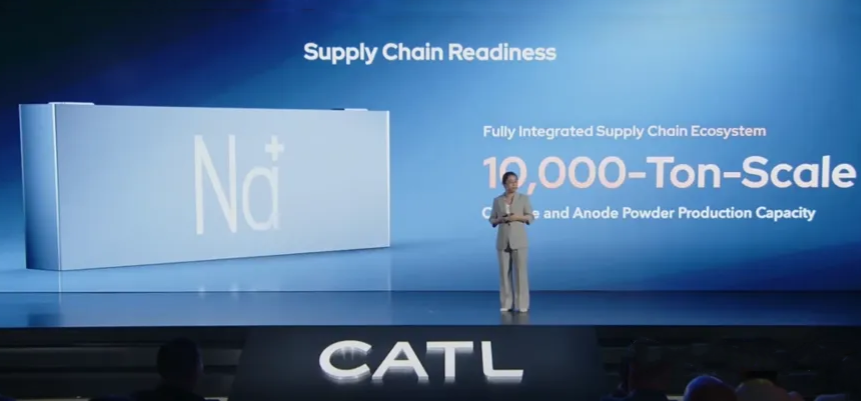
Contemporary Amperex Technology (CATL) has unveiled a sodium-ion energy storage system that clears every technical benchmark critics once used to dismiss the chemistry — yet the path to mass-market adoption still hinges on a single, elusive variable: a breakout application that resets industry expectations the way Tesla's Model 3 did for lithium iron phosphate.
The TENER sodium storage system, disclosed in June 2026, delivers a rated capacity exceeding 30 MWh per unit, requires only 34 units to outfit a 1 GWh grid-scale station, and sustains 15,000 charge cycles — implying a 25-to-30-year service life. A capacity retention rate above 92% at -20°C directly addresses the low-temperature weakness that has historically constrained sodium-ion deployment in northern China and high-altitude markets. More strategically significant is a power-energy decoupling architecture that allows flexible discharge durations of 1, 2, 4, 6, or 8 hours without hardware modification, a feature that positions the system competitively across peak-shaving, frequency-regulation, and AI data-center (AIDC) backup markets simultaneously. CATL targets first domestic deliveries in September 2026, a 1 GWh milestone by year-end, and global shipments by June 2027.
The announcement arrives roughly five years after CATL unveiled its first-generation sodium-ion cell on July 29, 2021 — a half-decade during which the technology has remained perpetually "on the verge" of commercial scale without achieving it.
LFP History Teaches That Technology Alone Does Not Pull the Trigger
The commercialization trajectory of lithium iron phosphate (LFP) batteries offers the clearest analogue. For years, LFP was confined to buses and light commercial vehicles, its energy density deemed insufficient for mainstream passenger cars. Market share languished near 30% as recently as late 2020. Within twelve months it had surged past 60% — not because the chemistry changed, but because Tesla began mass-installing LFP in the Model 3 Standard Range in late 2021, followed by BYD scaling its Blade Battery platform and SAIC-GM-Wuling Automobile embedding LFP in the Hongguang MINI EV. Three concurrent "killer apps" collapsed market skepticism faster than any technical paper could.
The electric vehicle industry itself followed the same script. China's EV penetration rate stood at 4.7% in 2019 — the year NIO nearly filed for bankruptcy and its co-founder Li Bin was widely mocked as the year's most beleaguered entrepreneur. Tesla's Gigafactory Shanghai coming online in late 2019 and the subsequent popularity of the domestically produced Model 3 acted as the sector's iPhone moment, lifting EV penetration to 25.6% by 2022 and to approximately 50% by 2025. The technology had been ready; what it needed was a flagship product that made the value proposition undeniable to mainstream consumers.
CATL's 60GWh Supply Agreement Hints at Where the Catalyst May Emerge
The most concrete signal that sodium-ion may finally be approaching its own inflection point came on April 27, 2026, when CATL signed a three-year, 60 GWh sodium-ion supply agreement with Highstar Energy Storage. By any measure, this is the largest single sodium-ion procurement contract on record, and it points toward utility-scale stationary storage — rather than EVs or two-wheelers — as the probable arena for the first breakout application.
The logic is compelling. Grid-scale storage buyers are less sensitive to energy density per kilogram than EV manufacturers, making sodium-ion's relative deficit on that metric less disqualifying. Conversely, sodium's advantages in raw-material cost stability (no lithium, cobalt, or nickel price exposure), thermal safety, and cold-climate performance are directly monetizable in long-duration storage procurement. If the CATL-Highstar pipeline delivers at scale and at cost, it would constitute exactly the kind of real-world validation — across thousands of charge cycles, in live grid environments — that erases residual buyer hesitation.
Penetration Math Defines the Stakes for Investors
Sodium-ion's current installed base is negligible relative to the broader energy storage market. The analytical framework that proved accurate for LFP suggests a non-linear adoption curve once penetration crosses approximately 5%, with a potential "singularity" effect above 10% that accelerates supplier qualification cycles and drives component cost reductions through volume. For context, China's grid-connected battery storage market installed roughly 100 GWh of new capacity in 2025; a 5% sodium-ion share would imply 5 GWh annually — a threshold CATL's Tiangheng roadmap could plausibly reach by 2027 if the Highstar contract executes on schedule.
The investment implication is asymmetric. Sodium-ion supply-chain equities — spanning cathode material producers using Prussian blue or layered oxide chemistries, hard carbon anode suppliers, and electrolyte formulators — have historically de-rated sharply during periods of sodium hype followed by commercial disappointment. A confirmed GWh-scale "killer app" would likely trigger a re-rating cycle analogous to the one LFP cathode producers experienced in 2021.
What Could Still Go Wrong
The analogy to LFP is instructive but not perfectly transferable. LFP benefited from a pre-existing, mature manufacturing ecosystem; sodium-ion must build its supply chain largely from scratch, particularly for hard carbon anodes where domestic production capacity remains constrained. Cost parity with LFP at the cell level has been claimed by multiple producers but not yet demonstrated at sustained GWh volumes. And while the Tiangheng system's specifications are impressive, independent third-party cycle-life verification at commercial scale has not yet been published.
The absence of a breakout application after five years of development is itself a data point. Whether that reflects immature technology, insufficient cost competitiveness, or simply a mismatch between sodium-ion's strengths and the dominant demand segments of the 2021–2025 cycle remains an open analytical question. The answer will likely become clear within the next 18 months.
Related Coverage: