
China's Top 10 Unicorns in 2026: What the Rankings Reveal About the New Economy
What Is a Unicorn — and Why Does China's List Matter?
A "unicorn" is a privately held startup valued at $1 billion or more. China's unicorn ecosystem is one of the world's largest, and the composition of its top-ranked companies functions as a reliable proxy for where capital, talent, and policy attention are flowing in the broader economy.
The 2026 top-ten list is notable not because it names ten successful companies, but because of what kinds of companies made the cut — and what their relative valuations say about structural priorities in China's technology and industrial landscape.
Who Made the Top 10 — and at What Valuations?
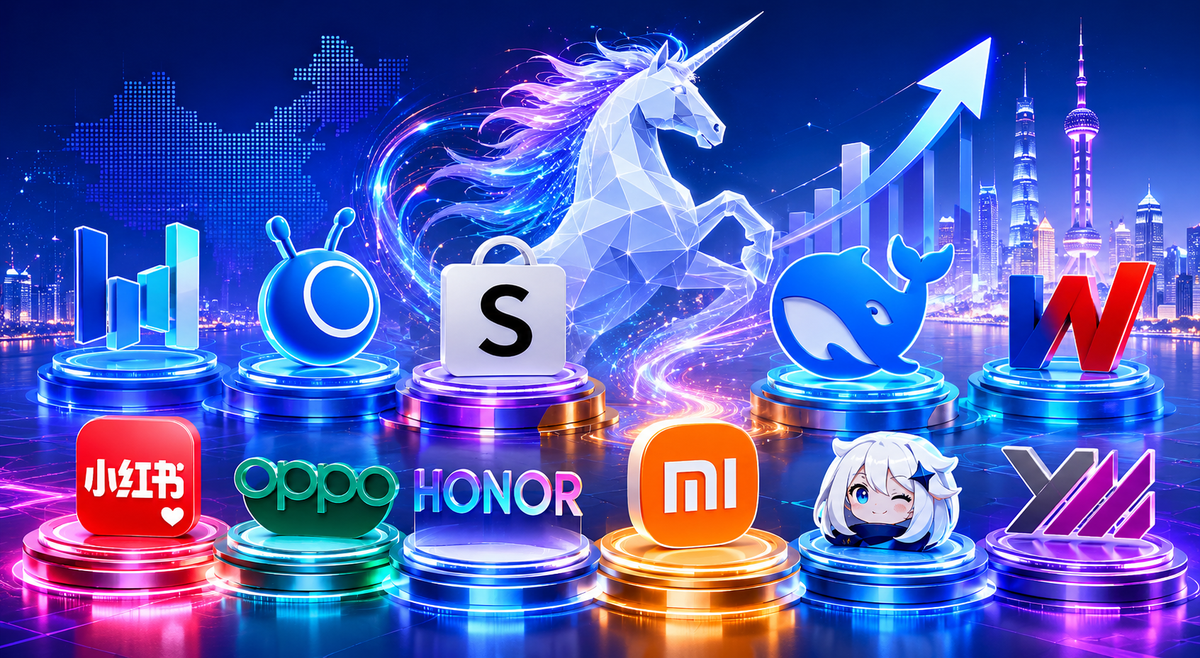
The 2026 ranking, measured in RMB (¥100 million units), breaks down as follows:
| Rank | Company | Valuation (¥100M) | Sector |
|---|---|---|---|
| 1 | ByteDance | 33,600 | AI / Content / Platforms |
| 2 | Ant Group | 6,350 | Fintech |
| 3 | Shein | 3,650 | Cross-border E-commerce |
| 4 | DeepSeek | 3,065 | AI / Foundation Models |
| 5 | WeBank | 2,350 | Digital Banking |
| 6 | Xiaohongshu | 1,820 | Social Commerce |
| 7 | OPPO | 1,800 | Consumer Electronics |
| 8 | Honor | 1,700 | Consumer Electronics |
| 9 | miHoYo | 1,600 | Gaming / Entertainment |
| 10 | YMTC | 1,600 | Semiconductor / Storage |
The most striking feature of this list is the valuation gap at the top. ByteDance's estimated valuation of ¥33,600 billion dwarfs second-ranked Ant Group by more than ¥27,000 billion — a gap that reflects not just business scale, but ByteDance's successful pivot into full-stack AI while simultaneously operating one of the world's largest consumer content platforms.
Why Does the Sector Mix Matter?
A decade ago, China's unicorn rankings were dominated by e-commerce, ride-hailing, and mobile payments. The 2026 list tells a more complex story across at least six distinct sectors:
AI and foundation models appear in two forms: ByteDance as an incumbent deploying AI across existing products, and DeepSeek as a pure-play AI startup founded in 2023 that reached a ¥3,065 billion valuation in under three years. DeepSeek's rise — built on open-source, cost-efficient large language models — signals that China's AI race is not solely a story of well-capitalized incumbents.
Fintech remains structurally important. Ant Group and WeBank both reflect a model in which financial services are delivered through digital infrastructure rather than physical branches. WeBank, China's first internet-only private bank (launched 2014, backed by Tencent), serves individuals and small businesses that traditional lenders historically underserved — a model sometimes described as "inclusive finance at scale."
Cross-border commerce is represented by Shein, whose valuation rests on a distinctive operating model: small-batch, fast-turnaround manufacturing tied to algorithmic demand sensing. Shein effectively exports China's garment supply chain efficiency directly to end consumers in Europe, North America, and Southeast Asia — bypassing traditional retail intermediaries.
Consumer electronics claims two spots (OPPO and Honor), both of which are competing in a global smartphone market that has matured but not consolidated. Honor's inclusion is particularly notable: it was spun out of Huawei in 2020 under supply chain pressure and has since rebuilt its distribution and product lines as an independent entity.
Gaming and IP is represented by miHoYo, whose Genshin Impact franchise demonstrated that Chinese studios could build globally competitive original IP — not just adapt existing content for export.
Semiconductor manufacturing appears through YMTC (Yangtze Memory Technologies), the only chip manufacturer in the top ten. YMTC focuses on 3D NAND flash storage and represents China's strategic push to reduce dependence on foreign memory chip suppliers.
What Does Geography Reveal?
The geographic distribution of these ten companies is not random:
- Guangdong (4 companies): Shein, WeBank, OPPO, Honor — reflecting the province's dominance in consumer electronics manufacturing, cross-border trade infrastructure, and digital finance.
- Zhejiang (2 companies): Ant Group, DeepSeek — fintech rooted in Alibaba's Hangzhou ecosystem, and AI development centered in Shanghai with registration in Hangzhou.
- Shanghai (2 companies): Xiaohongshu, miHoYo — both content and consumer-facing platforms.
- Beijing (1 company): ByteDance — the national capital's role as a hub for large-scale internet and AI platforms.
- Hubei (1 company): YMTC — reflecting deliberate industrial policy to build semiconductor capacity in inland China.
This distribution suggests that China's tech economy is not a single-city phenomenon. Different regions have developed distinct competitive advantages, often shaped by local policy, manufacturing ecosystems, and proximity to specific talent pools.
What Are the Structural Factors Behind These Rankings?
Several underlying forces explain why these particular companies reached the top tier:
Scale of domestic market as a testing ground. Companies like Ant Group and Xiaohongshu were able to refine business models at massive scale domestically before (or instead of) expanding internationally. China's 1.4 billion consumers provide a uniquely large base for iterating on product-market fit.
Supply chain proximity. Shein and OPPO both benefit from deep integration with China's manufacturing base in the Pearl River Delta. The ability to move from design to production to delivery at speed is a structural advantage that is difficult to replicate elsewhere.
Policy alignment. YMTC's presence on this list is inseparable from China's national semiconductor strategy. State-backed investment in domestic chip manufacturing has accelerated the company's development in ways that market forces alone might not have.
Open-source as a competitive strategy. DeepSeek's rapid valuation growth is partly attributable to its open-source model release strategy, which generated global developer adoption and attention at a fraction of the marketing cost that a closed-model approach would require.
Platform-to-AI conversion. ByteDance's dominant position reflects its ability to leverage existing user data, distribution, and engineering talent to build AI products (including the Doubao LLM) on top of an already-profitable content business.
Why Are Several of These Companies Still Unlisted?
The fact that all ten remain privately held — despite valuations that would qualify most for major stock exchange listings — reflects a combination of factors:
- Regulatory environment: Ant Group's suspended IPO in 2020 cast a long shadow over fintech listings. Several companies on this list operate in sectors that have faced regulatory scrutiny.
- Valuation expectations: Companies with high private-market valuations often delay listings when public market conditions would imply a lower price.
- Strategic flexibility: Private status allows companies to make long-term investments without quarterly earnings pressure.
ByteDance has discussed potential listing structures for years without completing one — a situation that illustrates how the largest private tech companies can sustain operations and growth without accessing public capital markets.
What to Watch Going Forward
Several variables will shape how this ranking evolves over the next two to five years:
AI monetization. DeepSeek's valuation is based on potential rather than proven revenue at scale. Whether open-source AI models can generate sustainable commercial returns — through enterprise contracts, API licensing, or adjacent services — remains an open question across the industry.
Semiconductor advancement under constraint. YMTC operates under US export restrictions that limit its access to certain manufacturing equipment. Its ability to advance to more competitive memory chip specifications will depend on domestic equipment development and process innovation.
Shein's regulatory exposure. Cross-border e-commerce platforms face increasing scrutiny in key markets, including the EU and US, around customs treatment, product safety standards, and labor practices in supply chains. How Shein navigates these pressures will affect both its valuation and its operating model.
Consumer electronics consolidation. OPPO and Honor compete in a global smartphone market where the top five players control the majority of volume. Both companies are investing in AI-integrated device features — a differentiation strategy that will be tested as competitors make similar moves.
Social commerce maturity. Xiaohongshu sits at the intersection of content discovery and purchase intent. Its ability to convert that position into durable advertising and commerce revenue — without degrading the user experience that drives its engagement — is the central business model question.
The Bottom Line
China's 2026 unicorn top ten is not simply a list of successful companies. It is a snapshot of which business models, technologies, and industrial strategies have generated the most private-market conviction at a specific moment in time. The presence of a three-year-old AI startup alongside a decade-old fintech giant and a state-backed chip manufacturer in the same ranking reflects the breadth — and the internal tensions — of China's current new-economy landscape.
The structural story is one of simultaneous maturation and disruption: established platforms extending into AI, manufacturing-rooted companies building software layers, and new entrants using open-source strategies to compress the timeline from founding to scale.
Related Coverage:
China’s ByteDance Challenges GPT-5 with Low-Cost Doubao 2.0 Model
Ant Group's AI Strategy Gains Ground as Rivals Battle for General-Purpose Dominance
DeepSeek Weaponizes Compute Costs to Force Global AI Consolidation in 2026
miHoYo Commits RMB 100 Billion to AI, Repatriates Silicon Valley LLM Team
Apple Eyes Chinese Memory Chipmakers CXMT and YMTC to Diversify Supply Chain, Counter Rising Costs