
Ant Group's AI Strategy Gains Ground as Rivals Battle for General-Purpose Dominance
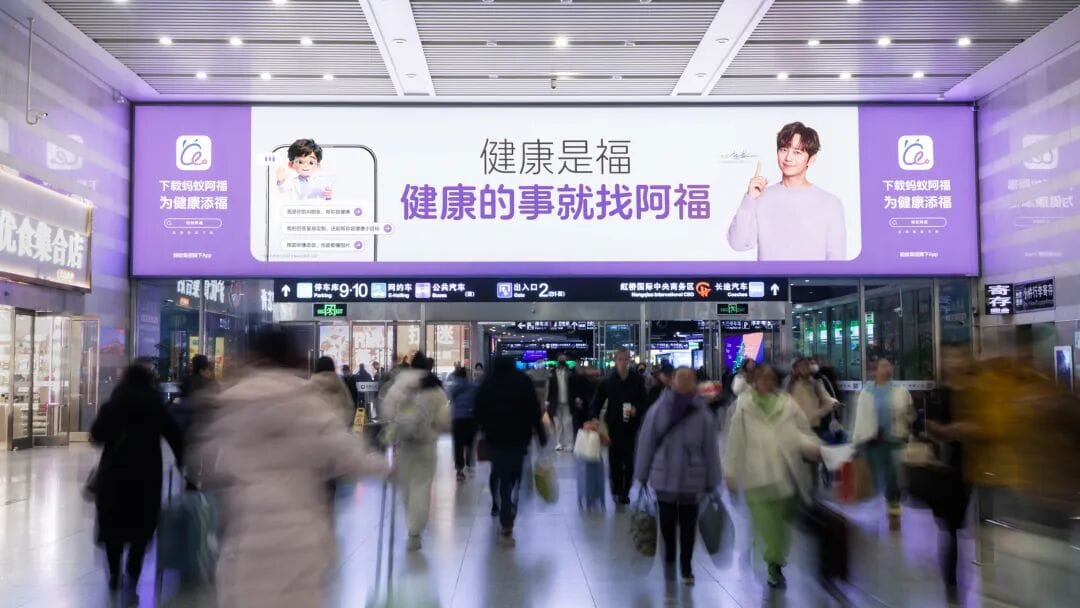
Ant Group has emerged as an unexpected winner in China's Spring Festival AI battle, with its specialized health and payment applications each surpassing 100 million users while competitors poured billions into marketing campaigns for general-purpose AI assistants.
The financial technology giant disclosed on Feb. 23 that its "AQ" payment service became the world's first AI-native payment product to exceed 100 million transactions and users during the holiday period. Meanwhile, Ant's standalone health AI app, Alipay, also crossed the 100 million user threshold, establishing itself as the world's largest health-focused AI application.
The milestone marks a strategic divergence in China's intensifying AI competition. While Alibaba Group, ByteDance, and Tencent deployed more than 4.5 billion yuan ($620 million) in red envelope campaigns to promote their general-purpose AI chatbots during the week-long holiday, Ant focused on building specialized AI services in healthcare and payments.
Ant's health app maintained fourth place on Apple's App Store download rankings as of Feb. 23, ahead of Alibaba's Yuanbao assistant which fell to 31st position. ByteDance's Doubao and Alibaba's Qianwen occupied first and second positions respectively.
Specialized AI Captures Market Share
The performance validates Ant's "two flowers" strategy, which CEO Han Xinyi has described as using AI to protect users' wealth and health—ensuring they have "money to spend" and "life to spend it."
During the Spring Festival period, 52% of new users for Ant's health app came from third-tier cities and below, highlighting AI's potential to address China's uneven distribution of medical resources. The app enables users to access digital versions of top-tier hospital specialists, with one sleep expert's AI avatar conducting over 1,000 consultations with a single elderly patient struggling with insomnia.
Obstetrician Duan Tao's AI assistant on the platform has answered more than 700,000 questions for 160,000 users over six months, far exceeding the 20 patients the doctor can physically see each day.
The payment breakthrough arrived as Alibaba's Qianwen chatbot promotion drove 120 million AI-enabled transactions through Alipay, demonstrating early adoption patterns similar to the ride-hailing and online-to-offline subsidy wars that established mobile payments a decade ago.
Technical Infrastructure Supports Vertical Focus
Ant simultaneously released version 2.5 of its Bailing large language model during the holiday period, including Ring-2.5-1T, a trillion-parameter reasoning model, and opened-sourced four models from its embodied intelligence unit Lingbo Technology.
The company's technical roadmap centers on exploring artificial general intelligence through open-source approaches while extending from foundational models into general applications and embodied interaction. Its Ming-Flash-Omni 2.0 multimodal model surpassed Google's Gemini 2.5 Pro on several key benchmarks, according to official performance evaluations.
Ant's decade-long investment in healthcare digitization provides structural advantages competitors cannot easily replicate, Han said in previous media interviews. Alipay has achieved complete coverage of hospital online payments, with over 800 million users linking medical insurance information to the platform. The 2025 acquisition of Haodf.com further strengthened the service ecosystem.
Bloomberg noted in recent coverage that while competitors including Tencent and DeepSeek are expanding healthcare expertise, Ant established its foothold significantly earlier.
Differentiated Approach to AI Competition
The strategy mirrors Microsoft Corp.'s approach to AI competition, where both companies leverage existing business moats rather than competing directly for general-purpose entry points. Microsoft embedded AI into its Office suite and positioned Copilot as an AI operating system, with artificial intelligence contributing 16% to Azure growth in its fiscal fourth quarter of 2025.
Ant's focus on high-barrier sectors with structural demand—financial payments and healthcare—offers long-term commercial viability beyond the current marketing battles. China's online healthcare market is projected to reach 480 billion yuan ($69 billion) in 2025, while AI-enabled payments position Ant as infrastructure for the emerging agent economy.
The specialized approach demonstrates that AI competition extends beyond capturing general-purpose entry points, with vertical sectors offering innovation opportunities measured in decades rather than product cycles. Trust-based services in health and finance create user stickiness difficult for competitors to dislodge, particularly when integrated into comprehensive service chains from consultation through insurance and payment.
As generative AI technology gaps narrow among major players and product features converge, Ant's bet on solving concrete social problems through specialized AI applications presents an alternative path to sustainable commercial value creation in China's crowded AI landscape.