
Changan’s EV Unit Deepal Secures $844 Million Lifeline as Losses Mount
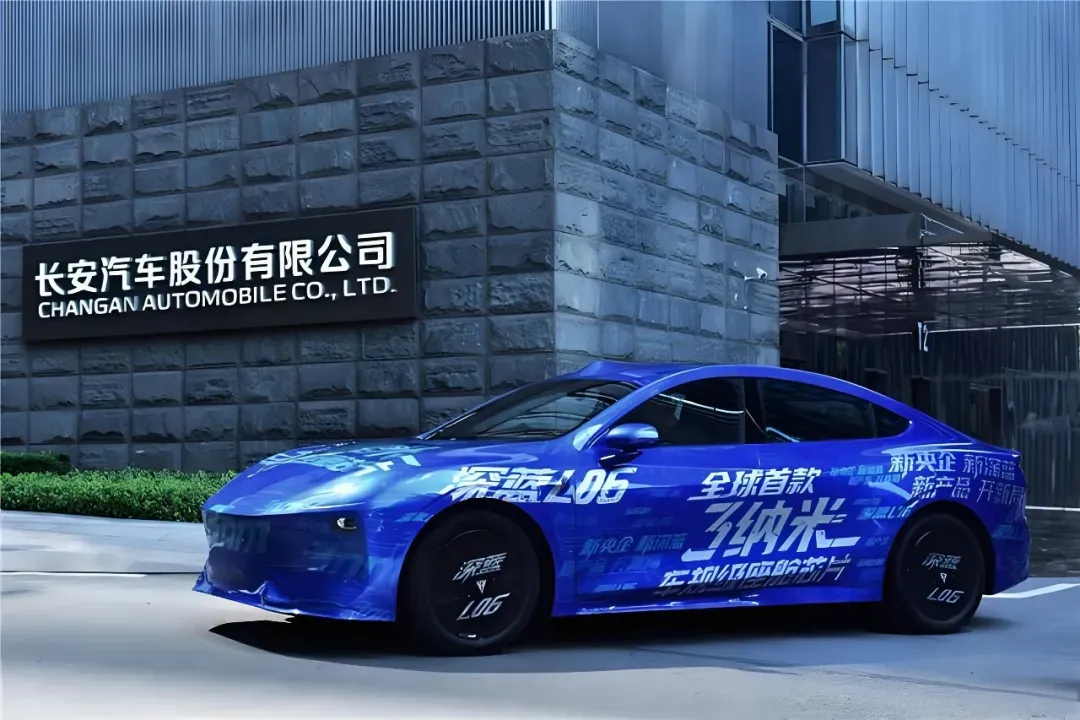
Deepal Automobile Technology Co., Ltd., the electric vehicle subsidiary of Changan Automobile, has secured a significant capital injection to bolster its balance sheet. However, the funding arrives as the automaker grapples with persistent insolvency, widening financial gaps, and missed sales targets in a hyper-competitive market.
The company announced on Dec. 25 the completion of its Series C financing round, raising RMB 6.122 billion (US$844 million). The round was led by parent company Changan Automobile, alongside state-backed Chongqing Yufu Holding Group and CMB Financial Asset Investment. Following the transaction, Deepal’s registered capital increased from roughly RMB 328 million to RMB 466 million, with Changan retaining a controlling stake of approximately 51%.
The deal follows Deepal's recent regulatory milestone of becoming one of China's first automakers to obtain official license plates for L3 autonomous driving. Despite this technical achievement and the fresh capital, the injection serves primarily as a stabilizer for a company that has reported negative net assets for three consecutive years. The move highlights the intense pressure on China’s second-tier EV makers to demonstrate financial viability beyond mere scale.
While the influx of cash provides a temporary reprieve, it does not immediately resolve fundamental structural issues. With cumulative losses approaching RMB 9 billion and fierce internal competition within Changan’s brand portfolio, Deepal faces an urgent need to pivot from aggressive expansion to sustainable profitability before its financial window closes.
Capital Injection Meets Balance Sheet Distress
The structure of the financing reveals a mix of cash and asset transfers rather than a pure liquidity infusion. Changan Automobile contributed RMB 3.122 billion to the round, comprising RMB 2.079 billion in cash and intangible assets valued at RMB 1.043 billion. These assets include patents and software copyrights for Deepal’s S05 and G318 models. The remaining cash contributions came from Chongqing Yufu and CMB Financial, investing RMB 2.5 billion and RMB 500 million, respectively.
Despite the strong backing from state-owned assets and banks, Deepal’s financial health remains critical. As of Oct. 31, 2025, the company reported total assets of RMB 31.47 billion against total liabilities of RMB 35.98 billion, resulting in a negative net asset position. This marks the third consecutive year the company has been technically insolvent.
Since operating independently in 2022, Deepal has accumulated losses of RMB 8.89 billion. The company recorded a net loss of RMB 3.19 billion in 2022 and RMB 3.10 billion in 2023. While losses narrowed to RMB 1.57 billion in 2024, the deficit for the first ten months of 2025 reached RMB 1.025 billion. Although Deepal Chairman Deng Chenghao stated at the 2025 Guangzhou Auto Show that the company achieved "phase-based profitability" in certain months, the overall trend indicates that the break-even point remains elusive despite monthly sales stabilizing around 30,000 units.
Sales Misses and Product Mix Challenges
Beyond financial metrics, Deepal is struggling to meet its growth projections. The brand has missed its annual sales targets for three consecutive years. In November 2025, global sales fell 8.2% year-on-year to 33,060 units. As of late November, cumulative sales for 2025 stood at approximately 302,000 vehicles, leaving a gap of nearly 60,000 units to meet its already downward-adjusted target of 360,000.
The composition of these sales is also a concern for margins. The brand relies heavily on lower-priced models, with the compact SUV S05 accounting for nearly half of November's volume. Conversely, higher-margin attempts to move upmarket have faltered. The S09, priced between RMB 229,900 and RMB 299,900, sees monthly sales below 2,000 units, while the G318 off-road model is selling only a few hundred units per month.
Consumer trust also took a hit in May 2025 following a controversy over mandatory full-screen advertisements displayed during vehicle startup, which prompted a public apology from CEO Deng Chenghao.
Market Saturation and Brand Overlap
Deepal is operating in a Chinese EV market that has shifted from incremental growth to a zero-sum game. Market leaders like BYD Co. and Geely Automobile Holdings Ltd. are squeezing second-tier competitors through aggressive pricing and channel dominance.
Compounding the external pressure is internal cannibalization within the Changan ecosystem. Deepal’s positioning overlaps significantly with sibling brands Avatr and Qiyuan. For instance, the Avatr 06 enters the market with post-incentive pricing around RMB 191,900, directly competing with Deepal’s core price brackets. While Changan’s strategy nominally segments the brands—Avatr for high-end, Deepal for mid-to-high, and Qiyuan for mass market—pricing realities have blurred these lines, leading to resource dispersion.
A Race Against Time
The RMB 6.1 billion financing is earmarked for R&D in high-level intelligent driving, electric platforms, and global expansion. The L3 autonomous driving license plates obtained in December—allowing for "hands-off" driving in designated areas—provide a potential differentiator. However, the commercialization of L3 technology is a long-term play that is unlikely to generate immediate revenue to offset current burn rates.
Crucially, the capital structure of the deal means that while RMB 5 billion in cash will aid operations, the majority of funds will be recorded as capital reserves, which does not directly erase accumulated historical losses. The financing buys Deepal time to restructure its costs and prove its value, but without a rapid turnaround in sales mix and operational efficiency, the company risks remaining a drag on its parent’s financials.