
China Assembles ‘National Team’ to Shape Future of Humanoid Robotics
China has unveiled a 65-member national standardization committee for humanoid robots, marking a decisive move to systematize its push into one of the next decade’s most strategic technologies. The new body, led by the Ministry of Industry and Information Technology (MIIT), is designed as a state-backed but industry-led “national team” to define technical norms, coordinate innovation and contest international rule‑making.
The committee’s formation at the end of 2025 comes as Tesla’s Optimus and US start-up Figure AI’s partnership with OpenAI intensify a global race to build humanoid platforms that merge advanced AI with general‑purpose robotics. Beijing is signaling it intends not only to keep pace with these efforts but to leverage its industrial scale and policy coordination to shape how the sector evolves.
Regulators have already flagged 15 national standards for humanoid robots as a near‑term priority, with early rules expected to focus on safety, drive systems and data use. For investors and companies across robotics, components, AI and downstream industries such as autos, home appliances and logistics, the new framework sets clearer expectations on technology pathways, interfaces and compliance.
The move is likely to accelerate consolidation around common domestic standards, reduce technical fragmentation and open a path for Chinese proposals at bodies such as the International Organization for Standardization (ISO) and the International Electrotechnical Commission (IEC), potentially influencing global supply chains and export markets if Chinese specifications gain traction abroad.
A Pyramid‑Style Command Structure
The Humanoid Robot Standardization Technical Committee is organized as a pyramid. At the apex, a senior MIIT official serves as chair, ensuring that national industrial policy objectives can be implemented without bureaucratic bottlenecks. Vice‑chairs and the secretary‑general come from the China Electronics Society and four leading industry players, including Unitree Robotics and Zhiyuan Innovation Technology, alongside national innovation centers in Beijing and Shanghai.
This configuration underscores a deliberate shift from government‑only rule‑making toward a model where enterprises and research institutions help drive standards that will govern commercial deployment. The committee brings together government agencies, elite universities such as Tsinghua University and Shanghai Jiao Tong University, institutes under the Chinese Academy of Sciences, core component manufacturers and emerging cross‑sector players.
The aim is to build what officials often describe as a “tech–industry–finance” loop: the state sets direction, industry executes, academia supplies theory and talent, and capital accelerates scaling. The committee effectively acts as the institutional hub for this system, coordinating interests that would otherwise compete or move in parallel.
Regional Triangle: Beijing, Yangtze River Delta, Greater Bay Area
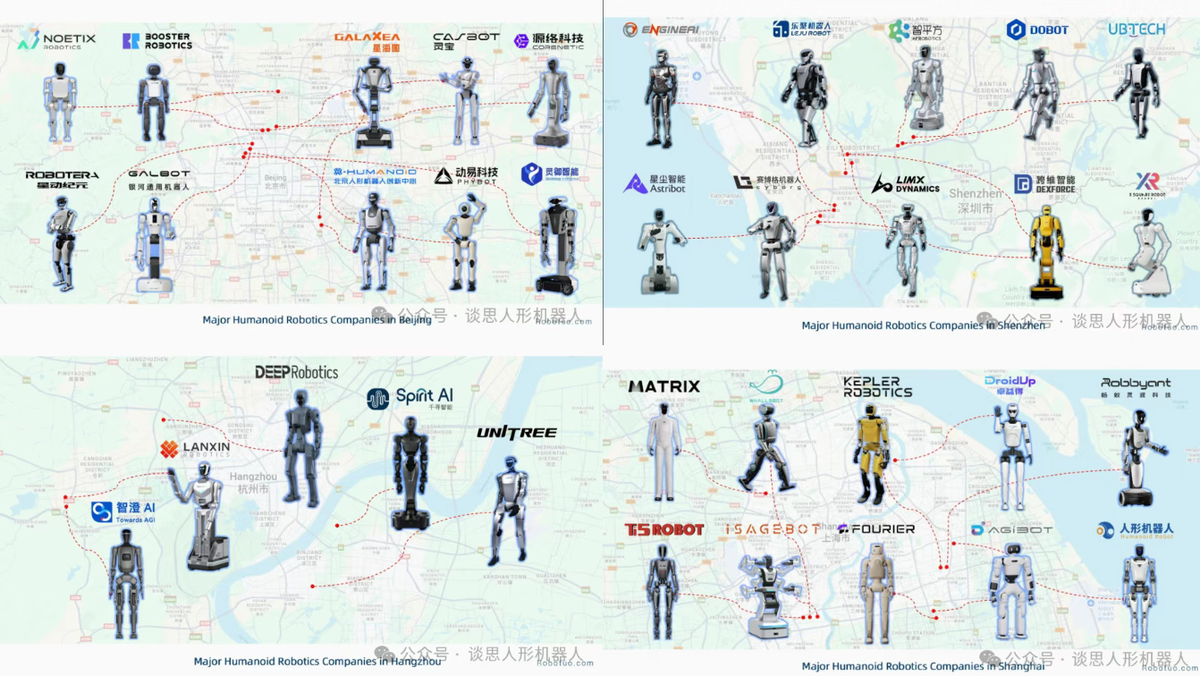
The membership map reinforces a three‑pole innovation structure centered on Beijing, the Yangtze River Delta and the Guangdong–Hong Kong–Macau Greater Bay Area.
Beijing is tasked with leading standards design, foundational research and platform building, leveraging its concentration of regulators, national labs and AI institutes. Cities such as Shanghai, Hangzhou and Shenzhen, by contrast, are positioned as hubs for agile R&D and commercialization, drawing on strengths in advanced manufacturing, electronics and private‑sector innovation.
Rather than operating as isolated clusters, these regions are linked through the committee into a functional chain: Beijing anchors rule‑setting and core technology directions; the Yangtze River Delta focuses on rapid prototyping and system integration; the Greater Bay Area pushes scale production and industrialization. For investors, this suggests geographically differentiated opportunities along the value chain, from algorithms and control systems in Beijing to full‑stack platforms and applications in the coastal manufacturing belts.
Standard‑First Strategy: Securing Definition Power
China’s market regulator has confirmed that 15 national standards for humanoid robots are under intensive development. Pushing standards before the market reaches maturity reflects a pre‑emptive strategy on two fronts.
Domestically, it is intended to prevent a “warring states” scenario of incompatible technical routes and interfaces. Unified standards are expected to reduce R&D duplication, lower cooperation costs and ease integration across suppliers and application scenarios. For start‑ups, this could narrow technical choices but offer clearer product roadmaps and compliance targets.
Internationally, China is seeking to convert its domestic framework into leverage in global rule‑making. With no entrenched global standard system for humanoid robots yet in place, Beijing is aiming to codify its preferred architectures and practices early, then feed them into ISO, IEC and other bodies. Should that succeed, Chinese firms could gain a regulatory edge in export markets and cross‑border projects, while foreign suppliers may face a “China‑first” compliance baseline in one of the world’s largest potential robotics markets.
Embodied Intelligence as Core Technical Route
The committee’s roster reveals China’s chosen technical direction: combining “AI brains” with robotic “bodies” into what is commonly called embodied intelligence.
Members include institutions specialized in motion control and mechanical subsystems—the “cerebellum” and limbs of robots—as well as frontier AI research centers such as Beijing Academy of Artificial Intelligence and Beijing Institute for General Artificial Intelligence, focused on large models and advanced decision‑making.
The foundational national standard now under drafting, “Humanoid Robot Technical Requirements – Part 1: General Principles,” spans the full chain from environmental perception and planning to motion control. The inclusion of companies like Qingneng Dechuang Technology, a core component supplier, indicates a policy emphasis on de‑risking and upgrading domestic capabilities in integrated joints, sensors and other bottleneck parts.
For component makers, this opens a window to define performance metrics that match their roadmaps and to secure a clearer route into OEM supply lists as standards harden into purchasing criteria.
Building a ‘Robot+’ Application Ecosystem
Perhaps the most striking element in the committee list is the presence of large firms from unrelated sectors, including Chery Automobile, XPeng, Hisense, JD and China Southern Power Grid.
Their inclusion signals that policy focus is shifting from “making a good robot” to using robots to reshape existing industries. Standards are the connective tissue in this strategy. By specifying performance, safety and interface norms, regulators aim to make humanoid robots “plug‑and‑play” modules that can be inserted into automotive plants, smart homes, logistics networks and power systems.
Automakers can provide testbeds for locomotion and large‑scale manufacturing; consumer electronics and ICT companies can embed robots into home and device ecosystems; utilities and logistics groups supply high‑value use cases in hazardous or labor‑intensive operations. For these incumbents, humanoids represent both a cost‑efficiency tool and a platform for new services, with early involvement in standards giving them a say in tailoring requirements to real‑world workflows.
A Coordinated National Campaign
The committee also formalizes a “whole‑of‑nation” approach to competing with global players such as Tesla, which can integrate hardware, software and data at scale within a single corporate structure.
China’s answer is an “innovation consortium” in which firms that might otherwise compete—robot manufacturers, component suppliers, end‑users and research labs—are drawn under a common strategic umbrella. The goal is to shift from fragmented, duplicative efforts to joint breakthroughs on shared technical pain points.
Executives such as Unitree Robotics’ CEO Wang Xingxing have highlighted China’s deep base in manufacturing and hardware as a comparative advantage. The committee is designed to amplify that advantage through tighter coordination, pooling of expertise and state‑backed prioritization of key projects.
Winners, Risks and Key Indicators to Watch
The immediate beneficiaries are likely to be leading robot OEMs such as Unitree Robotics and Zhiyuan Innovation Technology, which now sit at the table where rules are written. Their designs and interfaces have a higher chance of being reflected in national norms, reinforcing their first‑mover status.
Core component suppliers stand to gain from clearer, standardized performance benchmarks that could accelerate import substitution and encourage OEMs to lock in domestic vendors. Large cross‑sector participants get policy and technical cover to integrate humanoids into their operations, potentially unlocking new business models or productivity gains.
For start‑ups, the environment cuts both ways: standards will reduce uncertainty and provide direction, but also raise the bar on compliance and alignment with mainstream architectures. Those that bet on divergent proprietary systems may find market access constrained.
Three early indicators will be critical:
- Scope of the first standard batch: Early focus is expected on safety baselines, drive technologies and data use, with particular attention to integrated joint interfaces and other shared bottlenecks.
- Performance of regional innovation centers: Dedicated humanoid robot innovation hubs in Beijing and Zhejiang will test whether the “national team” can convert coordination into tangible common‑technology breakthroughs and broad diffusion.
- Translation into international proposals: How effectively China can repackage domestic standards into ISO/IEC submissions will show whether it can move from a follower to a rule‑setter in global intelligent manufacturing.
Start of the ‘Intelligent Body’ Race
The formal launch of MIIT’s humanoid robot standardization committee marks a watershed. It signals that China’s humanoid robotics push is moving from dispersed, bottom‑up experimentation to a structured, organized phase of development.
At stake is far more than building agile, capable machines. The contest will shape who writes the next generation of intelligent manufacturing standards, who provides productivity solutions in aging societies, and who defines the operating rules for the physical carriers of AI in the real world.
China’s “national team” is now assembled, combining state strategy, market dynamism and academic expertise. The list of 65 institutions is only a starting point; the larger industrial wave—driven by the standards, alliances and applications they craft—will determine how value, influence and risk are distributed in the global humanoid robotics race.