
China Unveils 'Robotic Wolf' Swarms in Push for AI-Enabled Warfare
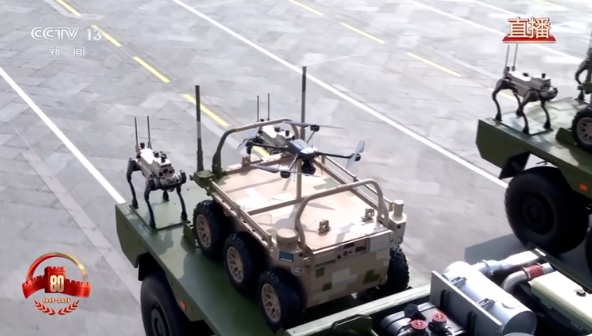
China has showcased a new generation of quadruped combat robots, signaling a significant strategic shift from single intelligent units to coordinated swarms in its pursuit of advanced unmanned military capabilities. The systems, developed by a subsidiary of the state-owned China South Industries Group Corporation, are designed for modularity and autonomous collaboration, reflecting the country’s focus on translating its technological prowess into battlefield advantages.
The "Robotic Wolf" units made their public debut in the Land Unmanned Combat Formation during a military parade on September 3, 2025. Official state media commentary described the new equipment as a "new breakthrough" in manned-unmanned collaborative combat, capable of remote control, autonomous action, and flexible grouping for tasks including assault, clearing mines, and supporting infantry squads.
The core innovation highlighted by developers is the system’s transition to "swarm intelligence." Unlike standalone drones, these robotic units can be dynamically reorganized and elastically grouped in the field. This allows the combat swarm to reconfigure its composition of reconnaissance, strike, and support units in real-time to adapt to evolving battlefield conditions and mission objectives.
This unveiling marks a tangible outcome of China's national strategy to convert "new quality productive forces" into "new quality combat capabilities." The deployment of intelligent unmanned swarms provides a clear indication of how the country’s investments in robotics, artificial intelligence, and domestic technology are being integrated to create novel military applications with significant implications for investors and the global defense industry.
From Prototype to Parade
The "Robotic Wolf" platform’s journey from concept to deployment has been rapid. The base quadruped robot was first displayed publicly less than a year ago at the Zhuhai Airshow in November 2024. Earlier this year, in August 2025, a state media documentary featured footage of the robot in a combat-ready configuration, armed with an assault rifle and operating in tactical coordination with a human soldier, demonstrating its ability to provide suppressive fire while advancing.
The 'Wolf Pack': A Breakdown of Capabilities
The system is designed around a "man-vehicle-wolf" architecture that enables information sharing and dynamic, autonomous coordination between units. A full combat group consists of a carrier or control vehicle that transports multiple "Robotic Wolves" to the operational area. Once deployed, they form an independent combat team with specialized roles:
- The "Alpha Wolf": Positioned at the front of the pack, this unit is responsible for reconnaissance, gathering target information, and transmitting imagery back to the control system from up to two kilometers away.
- The "Shooter": Equipped with rifles or other strike payloads, this robot uses data from reconnaissance units to engage and neutralize targets with precision.
- The Support Unit: Designed for logistics, this robot can carry approximately 20 kilograms of supplies, ammunition, or medical equipment to support frontline operations.
The modular design allows for a single, universal robotic platform to be quickly adapted for these different functions by attaching specialized payloads, optimizing efficiency and tactical flexibility.
Technical Specifications and Domestic Tech
The underlying quadruped robot is built with domestically produced, independently controllable chips. For situational awareness, it is equipped with two LiDAR sensors and five cameras, providing 360-degree perception. The platform can carry a maximum payload of 20 kg, has an operational range of approximately 10 kilometers, and can run for about 2.5 hours, with the ability to swap batteries in 30 seconds. Its design allows it to navigate complex terrain, including climbing 40-degree slopes and moving effectively through rubble by clearing obstacles up to 30 centimeters high.
A Glimpse into Future Warfare
Military experts see the "Robotic Wolf" as a key enabler for future combat, particularly in complex environments. According to expert Li Li, these swarms can enter narrow or dangerous areas inaccessible to humans, making them highly effective in urban warfare scenarios while minimizing risk to soldiers. They can establish integrated combat groups for reconnaissance, attack, and logistical support.
The development is also viewed as part of a broader trend toward unmanned and intelligent systems on the battlefield. Expert Fu Qianshao noted that the "Robotic Wolf" is just one platform among a growing family of ground robots, including bipedal humanoids, wheeled vehicles, and tracked unmanned tanks. When integrated with aerial drones, these systems can form a comprehensive, multi-domain firepower network. This emerging model of "intelligent corps," blending manned and unmanned systems in seamless collaboration, is poised to fundamentally reshape the paradigms of future warfare.