
China's AI Giants Bet on Hardware to Solve a Retention Crisis
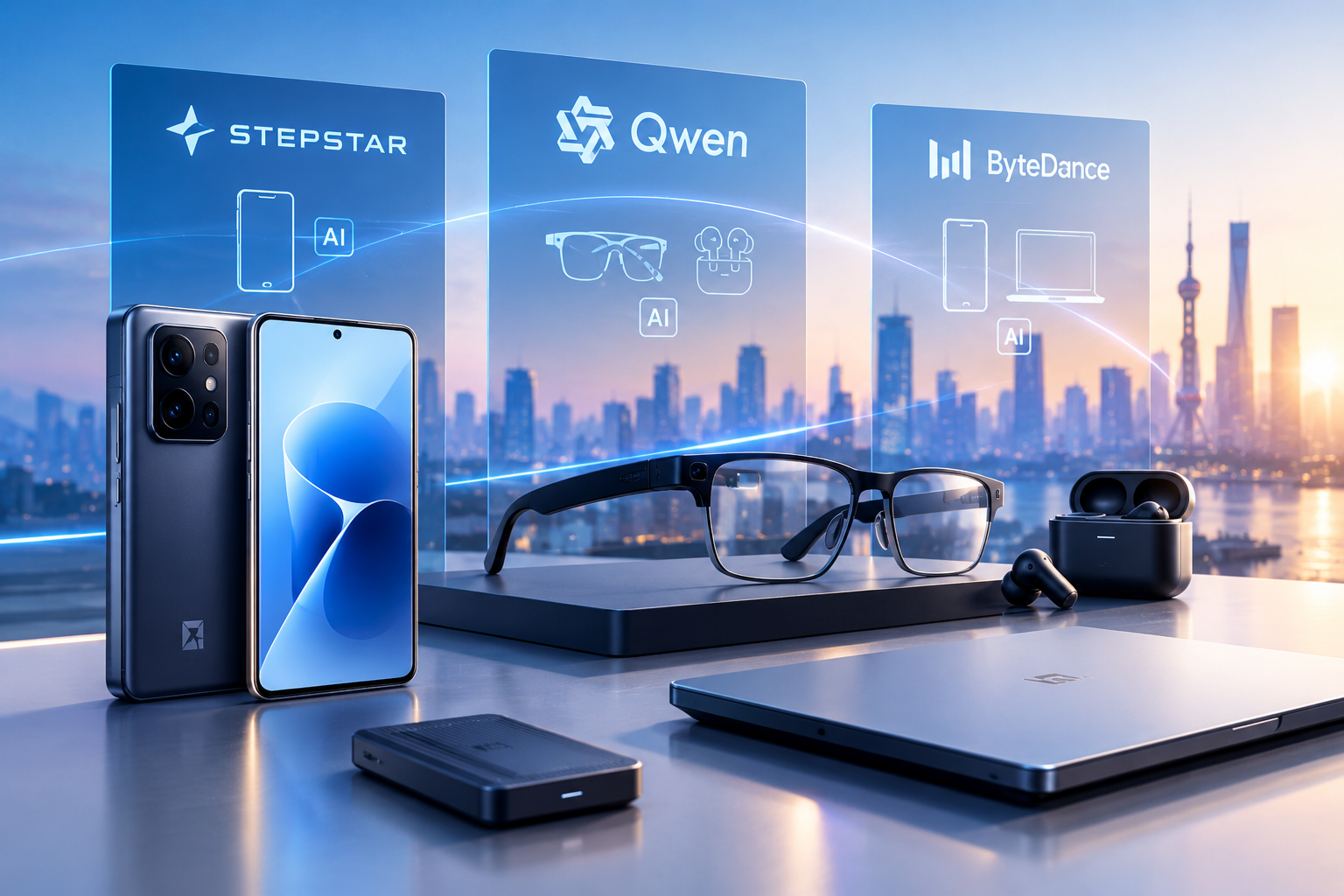
China's leading large language model developers are abandoning their software-first playbooks, racing into consumer hardware in a high-stakes bid to solve a retention crisis that threatens to undermine the country's AI monetization story.
On October 13, 2026, Stepstar and Alibaba's Qwen simultaneously unveiled AI-native consumer devices — a smartphone and an AI glasses-and-earphone combo respectively — in what industry observers say was no coincidence. The twin launches crystallized a strategic pivot that has been building across China's LLM sector throughout 2026: when software alone cannot hold users, build the hardware that makes switching costly.
The urgency is data-driven. According to QuestMobile, while China's mainstream AI applications post a first-day retention rate of 65%, that figure collapses to 18% by day 15 and just 12.8% by day 30 — a leakage rate that makes sustainable monetization structurally difficult and has sent LLM developers scrambling for a durable user mooring.
Intensifying Competition Erodes User Loyalty
China's AI sector looks formidable from the outside. Data from the Cyberspace Administration of China show that by July 2026, the country had registered 1,509 large models — the highest count globally — while AI-sector financing in the first half of 2026 reached RMB 454.49 billion (approximately US$63.1 billion), nearly double the figure for the same period in 2025.
Yet the headline numbers mask a brutal internal dynamic. According to statistics compiled by Xinzhiyua, ten major developers — including ByteDance's Doubao, Alibaba's Qwen, and DeepSeek — collectively released at least 28 flagship models between January and September 22, 2026, averaging one new release every 9.5 days. Pricing discipline has collapsed in parallel: the industry underwent six rounds of price cuts in the first half of 2026 alone, with the cumulative reduction exceeding the total price decline recorded across all of 2024 and 2025 combined.
For end users, the result is rational but commercially damaging behavior — continuous migration toward whichever model ranks highest on capability benchmarks at any given moment. Switching costs on pure software applications are effectively zero, leaving LLM developers with large gross user numbers but shallow engagement and limited pathways to monetization through value-added services such as personalized commerce recommendations or AI-powered productivity tools.
Hardware Pivot Targets Switching Costs as the Core Fix
The strategic logic driving the hardware push is straightforward: physical devices impose friction that software cannot. A user who purchases a smartphone or AI glasses built around a proprietary model is significantly less likely to defect than one accessing an app on a commodity handset.
Stepstar CEO Yin Qi articulated the thesis bluntly at the company's October launch event: "AI that stays at the app layer is always a tenant. Only by building hardware can AI become a native resident."
The company's STEPX Neo — priced at RMB 3,999 (approximately US$555) and launched on October 13 — is the commercial expression of that philosophy. The device houses Amoo, Stepstar's proprietary personal AI agent capable of cross-application task orchestration spanning ticketing, office productivity, video editing, and local lifestyle services.
Alibaba's simultaneous Qwen hardware launches — the Qwen AI Glasses N1/N1 Pro and an AI clip-on earphone — reflect the same logic applied to wearables. According to LatePost, Alibaba Cloud's Wuying team is additionally developing a QwenBook AI tablet device positioned as a native-agent computer, with a full release targeted for late 2026 or early 2027.
ByteDance moved earlier. In December 2025, Doubao partnered with ZTE's Nubia to launch the nubia M153, a Doubao-integrated smartphone. By September 2026, a dedicated Doubao handset reached market, generating over 360,000 pre-orders on JD.com. ByteDance has since extended the hardware portfolio — jointly with China Mobile — to include AI laptops, AI voice recorders, and AI PCs under a "Lingxi Xinghuo" product line.
Financial Strain and Hardware Incumbents Cloud the Outlook
The hardware thesis is strategically coherent but operationally demanding, and the financial profiles of several key players raise questions about execution capacity.
Consumer hardware development introduces supply chain management, component procurement, and manufacturing coordination — resource demands that sit awkwardly alongside the near-daily model iteration pace that currently defines competitive survival in China's LLM market. For independent LLM developers operating at significant losses, the capital burden is acute.
Even ByteDance, which faces no comparable funding constraint, opted for a co-development partnership with Nubia rather than pure in-house hardware development — a telling signal about the complexity of the undertaking for leaner players like Stepstar.
The second structural challenge comes from the opposite direction: established hardware manufacturers are building competitive AI model capabilities into their own ecosystems, removing the software differentiation that LLM developers are counting on to justify their hardware. Xiaomi's MiMo-V2.6-Pro scored 46 points on the Artificial Analysis Intelligence Index in September 2026 — surpassing Kimi K3 and GLM-5.3 to rank first among global open-source models and first among domestic models. MiMo is already embedded across Xiaomi's hardware line, including the Xiaomi 18 Fold and Xiaomi 18 Pro, which feature an upgraded Super Xiao Ai 2.0 powered by the on-device MiMo model. Xiaomi's first AI-native smartphone, internally codenamed "Lobster," has entered closed beta testing.
Winning Requires More Than an Entry Point
The October 13 dual launches mark a visible inflection in China's AI competitive landscape: the battleground has formally expanded from model benchmarks and token pricing to consumer device ecosystems. But capturing hardware distribution is only the opening move in a more complex endgame.
The 2026 terminal device race is, on the surface, a contest over form factors — phones, glasses, earphones. In substance, it remains the same competition it has always been: which platform can make users genuinely unable to leave. Converting a hardware entry point into habitual use, and habitual use into a defensible ecosystem, is what ultimately determines commercial survival — and on that measure, the outcome remains entirely open.
Related Coverage:
Kimi's Compute Crisis Exposes the Fault Line Beneath China's AI Surge
Doubao AI Assistant Sparks Struggle for System Control with Major Chinese Apps