
China's Battery-Swap Race Heats Up as Geely, Huawei and CATL Validate NIO's Decade-Long Bet
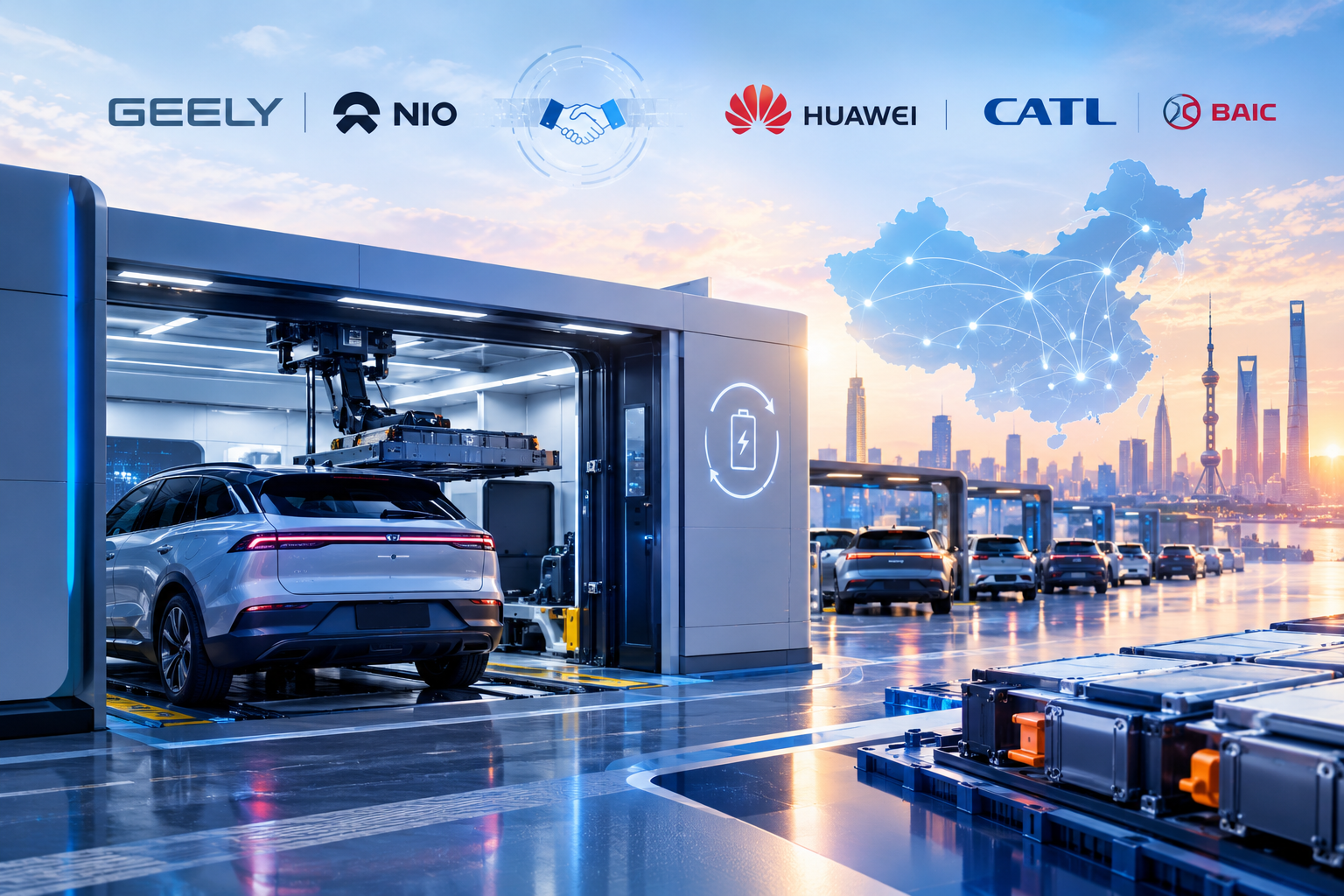
China's battery-swap sector — long dismissed as a capital-heavy oddity championed almost exclusively by NIO — is abruptly turning into a multi-player strategic battleground, as Geely, Huawei and CATL converge on the space within a single month, validating a model that has consumed more than RMB 20 billion (US$2.78 billion) of NIO's capital over the past decade.
The inflection point arrived in rapid succession. On September 28, Zhejiang Geely Holding Group injected the 100% equity of Yi Yi Hulian plus RMB 640 million (US$88.9 million) in cash into NIO Energy, securing a 30% stake and committing to unify battery-swap technology standards for private-vehicle users across both groups. Less than four weeks later, on October 19, Huawei's Yinwang unit joined forces with Contemporary Amperex Technology and its battery-services subsidiary Shidai Dianfu to propose an integrated solution linking autonomous driving with swap infrastructure — targeting a 99-second full swap cycle with vehicles capable of locating stations and docking without driver intervention. On October 22, BAIC Group separately signed a million-unit strategic cooperation agreement with CATL to connect multiple BAIC brands to CATL's "Chocolate" swap network.
The cluster of deals signals that battery swapping is crossing a threshold: from a single-brand service model into a shared infrastructure play, with implications for EV supply chains, battery-asset valuation and consumer purchasing calculus alike.
Economics Force the Pivot Toward Swap Infrastructure
Three structural drivers are pulling major OEMs toward swap networks in 2026. First, despite rapid advances in fast-charging speeds, swap technology offers a qualitatively different proposition for fleet operators, long-haul drivers and urban residents without dedicated charging access — the swap cycle runs in minutes rather than the 15–30 minutes required even by the fastest current DC chargers. Second, vehicle-battery separation converts what has been a fixed, depreciating asset embedded in the car into an independently managed resource that can be centrally charged, health-monitored and dispatched — creating optionality for battery upgrades, second-life applications and potential grid-balancing participation. Third, and most critically for economics, swap-station asset utilization scales sharply with vehicle throughput: a station servicing 150 vehicles per day operates on a fundamentally different unit-economics basis than one handling 30, making cross-brand interoperability the single most important variable for network viability.
NIO Energy's Balance Sheet Reflects the Cost of Pioneering
NIO has absorbed the full pioneer's premium. As of October 23, cumulative investment in charging and swap infrastructure exceeded RMB 20 billion (US$2.78 billion), with 4,191 swap stations operational nationwide and more than 125 million completed swap transactions on record. The fifth-generation swap station now supports three brands simultaneously — NIO, Ledao and Firefly — covering different vehicle segments and price points. Managing thousands of stations, tens of thousands of battery packs and nine-figure swap volumes has produced a proprietary operational dataset encompassing equipment reliability curves, battery state-of-health management algorithms, dispatch logistics and user-service protocols that cannot be replicated quickly. NIO Energy's stated target calls for cumulative swap stations to reach 10,000 by 2030.
Cross-Brand Interoperability Unlocks the Network Effect
The Geely transaction is structurally the most significant of the three deals because it directly addresses the network-effect bottleneck. Historically, swap infrastructure built to serve a single brand has been constrained in utilization by that brand's sales volume — a ceiling that limits both station returns and the pace of further network investment. By aligning swap technology and standards between Geely and NIO's combined brand portfolio, the partnership materially expands the addressable daily swap demand at each station. Huawei and CATL's October 19 proposal takes a parallel approach through the "Chocolate" platform, aiming to aggregate demand from CATL's existing OEM partners. If standardization progresses, the question of which technical specification becomes the dominant interface — NIO's or CATL's — will carry significant commercial stakes for battery manufacturers, station operators and potentially grid-services providers.
What the Shift Means for Investors and Consumers
For investors tracking China's EV supply chain, the consolidation of swap activity around a small number of platform operators — NIO Energy, CATL's Shidai Dianfu and potentially Huawei's Yinwang — suggests that battery-asset management and station-network operation are emerging as distinct, monetizable businesses rather than afterthought services. Network utilization rates and battery-fleet operational efficiency will be the key performance metrics to monitor as cross-brand vehicle volumes begin flowing through shared infrastructure. For consumers evaluating EV purchases, the rapid institutionalization of the swap sector adds a new dimension to the comparison framework: alongside range and peak charging power, swap-network coverage density, vehicle-battery separation contract terms and long-term per-swap costs merit rigorous scrutiny alongside conventional specifications.
Related Coverage:
From Battery King to One of Many: How China’s EV Makers Are Reducing Their Dependence on CATL
The Battery Kingdom: How China Built an Empire to Power the World