
China's "AI Six Dragons" Are No More: How the Country's Top AI Startups Diverged
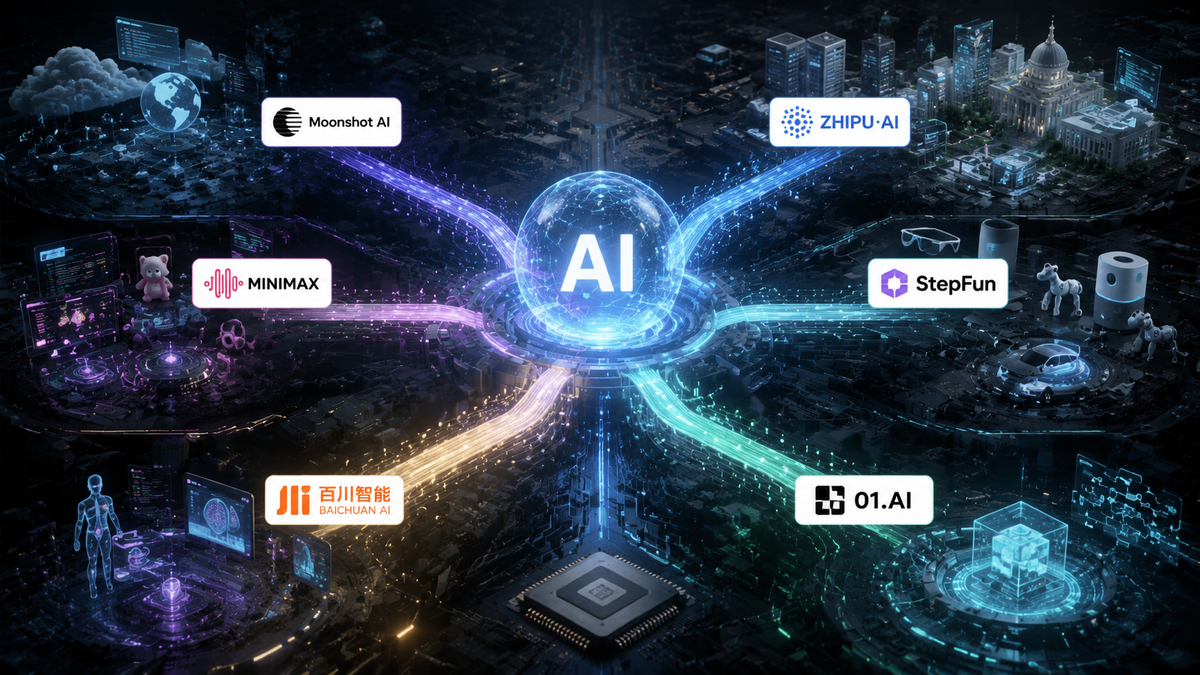
Three years ago, six Chinese AI startups were grouped together as rivals racing to become China's OpenAI. Today, they have taken six completely different paths — and the divergence reveals how the entire industry is being repriced.
What Were China's "AI Six Dragons"?
Between 2023 and 2024, six Chinese AI startups — Zhipu AI, MiniMax, Moonshot AI, StepFun, Baichuan Intelligence, and 01.AI — were collectively labeled the "AI Six Dragons" by Chinese media and investors. The label stuck because all six shared a similar profile: founded by elite researchers or serial entrepreneurs, racing to build large language models (LLMs), and competing to attract the largest funding rounds at the highest valuations.
The implicit premise behind the label was that they were all playing the same game — and that one of them might eventually emerge as China's answer to OpenAI.
That premise has not held up.
By mid-2026, the six companies have diverged so sharply in strategy, financial health, and market positioning that grouping them together no longer makes analytical sense. The "Six Dragons" label has become a historical artifact — a snapshot of an industry before commercial reality set in.
Why Did They Diverge? The Structural Forces at Work
The divergence is not primarily a story of individual company decisions. It reflects three structural shifts that hit all six companies simultaneously, but which each was differently equipped to handle.
1. The cost structure of LLM competition does not favor independents.
Training and running frontier models requires enormous and recurring capital expenditure. Unlike classic software businesses, inference costs scale with usage rather than declining toward zero. As model capabilities converge — partly driven by open-source releases from Meta, DeepSeek, and others — the marginal value of any single company's proprietary model erodes quickly.
Cloud platform operators (Alibaba, Tencent, Baidu, ByteDance) have structural advantages: existing cash flows, chip procurement leverage, captive customer bases, and distribution infrastructure. Independent LLM startups must outspend these incumbents on R&D while simultaneously building commercial pipelines from scratch.
2. Capital markets impose a different discipline than venture capital.
In private markets, valuations are negotiated between a small number of investors who share an optimistic thesis. In public markets, valuations are set continuously by thousands of independent actors who weigh current financials against future expectations. When Zhipu AI and MiniMax listed on the Hong Kong Stock Exchange in January 2026, they became subject to this different logic — and the transition was turbulent.
3. The definition of "winning" has shifted.
In 2023, the primary metric was model capability (parameter count, benchmark scores) and fundraising speed. By 2026, investors — both public and private — are asking different questions: What is the revenue quality? What is the gross margin trajectory? How concentrated is the customer base? How fast is cash burning? These are questions that favor companies with clear commercial focus over those still pursuing general-purpose model supremacy.
The Two That Listed: What Public Markets Revealed
Zhipu AI
Zhipu AI, affiliated with Tsinghua University, completed its Hong Kong IPO on January 8, 2026. The listing was initially celebrated as a landmark — the company's market capitalization briefly exceeded HK$1 trillion (approximately US$130 billion), and 451 employee shareholders saw paper wealth averaging over RMB 100 million each.
But the financial disclosures told a more complicated story. Zhipu's 2025 revenue was RMB 724 million — while its net loss reached RMB 4.718 billion, a loss-to-revenue ratio of 6.5x. For every renminbi earned, the company burned 6.5.
By July 2026, when the initial lock-up period expired and early investors became free to sell, Zhipu's market cap had retreated to below HK$500 billion — less than half its peak. A competing model release by Moonshot AI (Kimi K3, which topped global coding benchmarks) contributed to a sharp single-day sell-off, illustrating a key vulnerability: in public markets, a rival's technical announcement can immediately reprice your stock.
MiniMax
MiniMax listed one day after Zhipu, on January 9, 2026. Founded by 37-year-old Yan Junjie, with an average employee age of 29, the company peaked at a market cap of HK$410 billion. Like Zhipu, its financials revealed a deep mismatch between revenue and losses: total revenue of approximately US$79 million against a net loss of US$1.872 billion.
Both companies now function simultaneously as AI technology firms and as financial assets. The dual identity creates a feedback loop that purely private companies do not face: investor sentiment, competitor announcements, and macro conditions affect stock price, which affects employee morale, talent retention, and the company's ability to raise additional capital.
The central question these two listings have posed to the entire Chinese AI sector: Can an independent LLM company generate the revenue quality and margin trajectory that justifies a sustained premium valuation — or will the sector permanently trade at a discount to the narrative?
The Two Still in Private Markets: A Race Against Their Own Valuations
Moonshot AI (Kimi)
Moonshot AI has pursued a strategy of using model capability breakthroughs to justify rapid valuation escalation. Its Kimi product established early recognition through long-context processing; its K3 model, released in mid-July 2026, claimed the top position on global coding benchmarks, surpassing all closed-source competitors.
The fundraising trajectory has been extraordinary even by AI startup standards. From a post-money valuation of US$4.3 billion at its late-2025 Series C, the company reached US$10 billion in February 2026, US$20 billion in May, US$31.5 billion pre-money in June, and closed a Series F in July at US$35 billion post-money — raising over US$3.5 billion in a single round that was reportedly three times oversubscribed.
A Pre-IPO round originally scheduled for August 2026 was accelerated, targeting a pre-money valuation of US$50 billion. In roughly six months, the company's valuation target moved from US$4.3 billion to US$50 billion — a journey that typically takes three to five years.
The risks are commensurate. The June fundraising round initially attracted little interest before the K3 release made allocations suddenly scarce. Secondary market activity in existing shares became disorderly enough that Moonshot AI had to suspend all unauthorized share transfers. Some foreign investors were reportedly considering exit due to rising costs associated with unwinding offshore holding structures.
StepFun
StepFun has pursued a more hardware-integrated strategy, attempting to combine foundation models, AI agents, and consumer devices into a vertically integrated "model-software-hardware" stack. The company's Pre-IPO round valued it at US$40–60 billion, with market expectations of a US$10 billion IPO anchor valuation.
The ambition is evident; the execution has drawn skepticism. A July 2026 product launch introduced what was billed as the world's first "LLM-native AI smartphone," the STEPX Neo — but the event disclosed no core specifications, pricing, or release date, prompting industry observers to describe it as a "PowerPoint phone" and the event as a pre-roadshow for investment banks rather than a genuine product launch.
Financially, StepFun's 2025 revenue was reported at under RMB 500 million, with its investor Lotus Holdings disclosing that the company remains in a state of "significant losses."
The strategic challenge is structural: the three layers StepFun is targeting — foundation models, software applications, and hardware devices — are each already heavily defended by well-resourced incumbents. Penetrating all three simultaneously requires a differentiated wedge that is not yet clearly visible.
The Two That Retreated: Rational Adaptation or Defeat?
Baichuan Intelligence
In April 2025, Baichuan founder Wang Xiaochuan issued a company-wide letter announcing a full withdrawal from the general-purpose LLM race and a pivot to AI for healthcare. The decision was reportedly opposed by virtually all co-founders, but Wang pushed it through unilaterally.
Over the following year, co-founders departed one by one. The exit of the last founding team member marked the complete dissolution of the original leadership group. The company had raised RMB 5 billion at a RMB 20 billion valuation as recently as July 2024.
The strategic logic, however, is defensible. Healthcare has characteristics — high value per transaction, strong data moats, regulatory barriers to entry — that theoretically allow a focused AI company to build durable differentiation. The practical challenge is that healthcare AI requires clinical validation, regulatory approval, hospital sales infrastructure, and liability frameworks. The product cycle is measured in years, not months. And the commercial test is unforgiving: hospitals pay for outcomes, not for impressive demonstrations.
01.AI
01.AI, founded by Kai-Fu Lee, made a more structurally radical move in late 2024: it dissolved its entire pre-training team and folded the core group into Alibaba's Tongyi organization. At the time, this was widely interpreted as the first of the Six Dragons to surrender.
Viewed from 2026, the decision looks more like an early recognition of where the industry's division of labor was heading. With pre-training costs eliminated, 01.AI's annual operating expenses dropped to approximately RMB 200 million. Its 2025 audited revenue reached RMB 250 million, with RMB 500 million in contracted orders. Kai-Fu Lee indicated at the 2026 WAIC conference that the company plans a Hong Kong IPO in 2027, with a Pre-IPO round currently in progress.
An AI company that no longer trains its own base model preparing to go public is counterintuitive — but it reflects a maturing industry logic in which not every layer of the stack needs to be built in-house to create commercial value.
How Is the Market Now Pricing AI Companies?
The valuation frameworks applied to Chinese AI companies have undergone a significant shift between 2023 and 2026.
|
Metric |
2023
Emphasis |
2026
Emphasis |
|
Model
capability |
Primary |
Necessary
but insufficient |
|
Fundraising
speed |
Signal of
quality |
Potential
warning sign |
|
Parameter
count |
Headline
benchmark |
Largely
irrelevant |
|
Revenue |
Secondary |
Primary |
|
Loss-to-revenue
ratio |
Acceptable
if narrative is strong |
Scrutinized
closely |
|
Customer
concentration |
Rarely
disclosed |
Increasingly
material |
|
Cash burn
rate |
Tolerated |
Actively
monitored |
|
Gross
margin trajectory |
Not
discussed |
Central
to public market thesis |
Public market investors have introduced an additional variable: relative technical positioning is now priced in real time. When a competitor releases a stronger model, existing public company valuations adjust immediately — a dynamic that does not exist in private markets where valuations are renegotiated only at funding events.
What Are the Key Constraints Going Forward?
Several structural constraints will shape how these companies evolve over the next two to three years.
Open-source model capability is compressing proprietary moats. Each major open-source release — whether from Meta, DeepSeek, or others — reduces the performance gap between proprietary and freely available models, narrowing the pricing power of independent LLM companies.
Inference costs do not scale favorably. Unlike traditional software where marginal costs approach zero, LLM inference costs increase with usage. This limits the margin expansion story that justified high valuations in the consumer internet era.
The IPO window is not unconditional. Zhipu and MiniMax have established that Chinese LLM companies can list — but their post-IPO performance will determine whether subsequent companies face a welcoming or skeptical public market. If the first two listings fail to demonstrate improving unit economics, the bar for later entrants will rise.
Regulatory and geopolitical variables remain significant. The costs of unwinding offshore (red-chip) holding structures have increased, as evidenced by Moonshot AI's secondary market complications. U.S. export controls on advanced chips continue to constrain training capacity for Chinese AI companies.
What Comes Next?
The "Six Dragons" label will continue to fade as the companies' trajectories diverge further. The more useful analytical frame going forward is not which company "wins" the general LLM race, but which companies find a defensible position within an increasingly stratified industry structure:
- Foundation model layer: Likely to consolidate around well-capitalized cloud platforms and one or two independent companies with demonstrated technical differentiation
- Application and agent layer: More fragmented, with vertical-specific players (healthcare, enterprise, education) potentially building durable niches
- Hardware-integrated AI: High execution risk, but potentially high barriers if successful
The companies that survive the current transition period will likely be those that answered a specific question early: What do we offer that a cloud platform's AI product cannot replicate at lower cost?
Fundraising buys time. An IPO changes the venue of accountability. A model release earns the next round's entry ticket. None of these are substitutes for a clear answer to that question.
The divergence of China's AI Six Dragons is not a story of industry decline. It is a story of an industry moving from its narrative phase into its commercial phase — and that transition, historically, is where most of the real selection happens.
Related Coverage:
Zhipu AI Bets on Domestic Silicon With 1GW Data Center, Acquisition to Break Free From Nvidia
MiniMax Races Toward 2.7 Trillion-Parameter Model as A-Share Listing Window Converge
Moonshot AI Launches Kimi K3, World’s Largest 2.8T Open-Source Model at $31.5B Valuation