
China's Auto Market Share Slips to 31% as Emerging Markets Seize Momentum
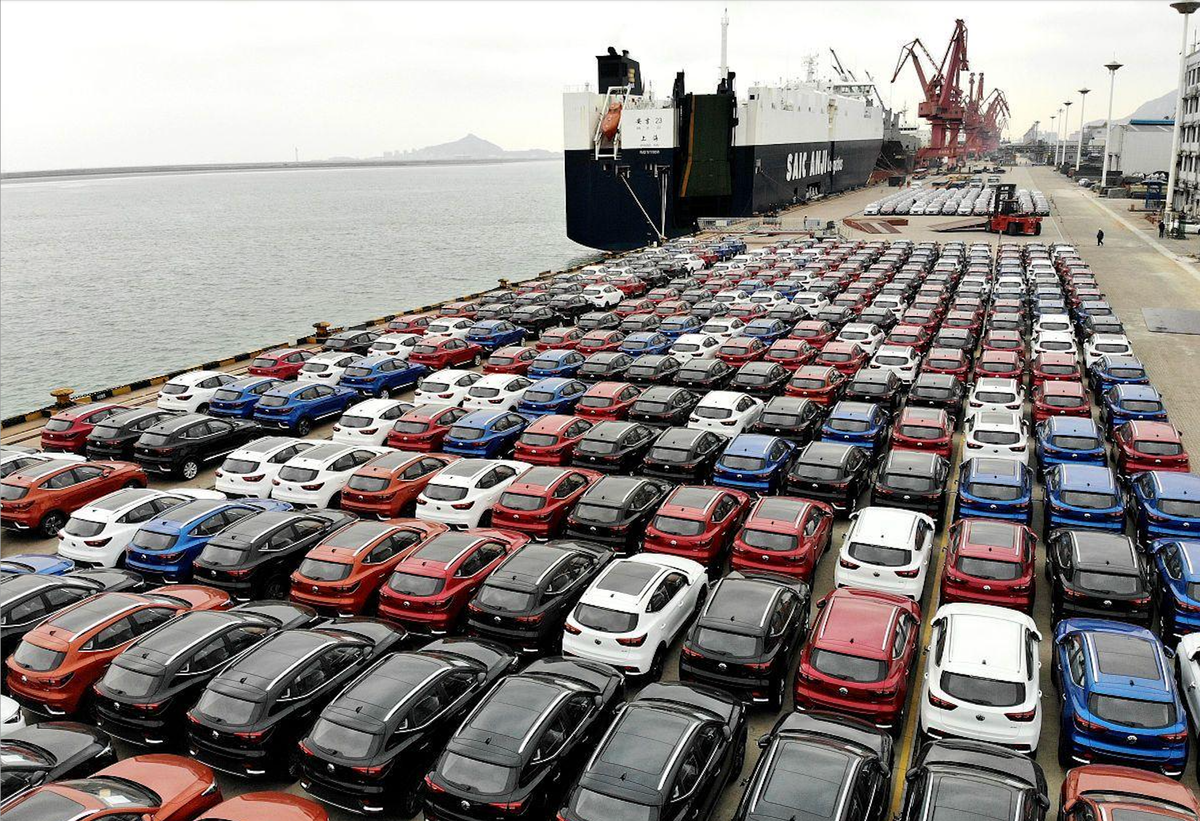
Beijing's dominance in global auto sales is showing its first meaningful cracks in six years, with China's world market share sliding 4.2 percentage points to 31.2% in the first five months of 2026 — a structural warning signal that analysts say reflects suppressed entry-level demand rather than a permanent reversal.
The contraction marks a sharp deceleration from the 35.4% peak recorded in full-year 2025, when China's output accounted for more than one-third of the world's 96.89 million vehicles sold. The retreat is being driven by a dual drag: sluggish passenger vehicle sales in the January–February window, compounded by a slow rollout of Beijing's "trade-in subsidy" program that left early-year demand without a policy floor. By May, however, China's monthly share had partially recovered to 32.2%, suggesting the bottom may be forming.
Global auto sales reached 39.15 million units in the January–May 2026 period, up just 2% year-on-year — a deceleration from the 6% expansion that drove full-year 2025 to a record 96.89 million units, according to data compiled by industry analyst Cui Dongshu and cross-referenced against OICA (Organisation Internationale des Constructeurs d'Automobiles) production figures.
Emerging Markets Absorb the Slack Left by China and the U.S.
The headline 2% global growth figure masks a dramatic geographic divergence. While China contracted 4% and the United States fell 5% year-on-year in the first five months of 2026, a cohort of emerging economies delivered outsized gains: Vietnam surged 35%, India climbed 17%, Thailand rose 15%, and Russia expanded 10%.
This shift is not incidental. It reflects a structural rebalancing in which vehicle penetration rates in Southeast Asia and South Asia are still in an early-adoption phase, absorbing demand that mature markets can no longer generate organically. India's 17% growth, driven in large part by Suzuki Motor Corporation's dominant position through Maruti Suzuki India Ltd., and Vietnam's 35% jump — partly fueled by Chinese brand exports — point to a sustained multi-year tailwind for Asian emerging markets.
Russia's 10% recovery, while notable, comes off a depressed base following the sharp market contraction of 2022–2023. Its global share has already declined to approximately 1.3% in 2026, limiting its macro-level impact.
Chinese Brands Consolidate Global Rankings as European Groups Retreat
The most consequential structural story of the January–May 2026 period is the accelerating divergence between Chinese domestic brands and legacy Western automakers. Three Chinese groups now rank among the world's top 10 by global sales volume: Geely at sixth, BYD recovering to seventh, and Chery Automobile at tenth.
This represents a historic milestone. In 2019, Chinese domestic brands held negligible share in global rankings. By 2026, Geely, BYD, Chery, SAIC Motor Corporation, and Changan Automobile have collectively displaced European incumbents across multiple regional markets.
The contrast with European automakers is stark. Stellantis N.V., Volkswagen AG, and Renault-Nissan-Mitsubishi Alliance have each shed approximately 3 percentage points of global share versus 2019 levels — equivalent to roughly 3 million units of annualized volume. The electrification transition, which Chinese brands navigated more aggressively, has proven a structural liability for groups that delayed EV platform investment.
Toyota Motor Corporation remains the most resilient legacy player, holding approximately 11.1% of global share in 2026 — roughly flat versus 2019 — underpinned by its strength in North America and Europe. Hyundai Motor Group has similarly maintained its 7.7% share, leveraging North American and non-China Asian market exposure to offset persistent weakness in the Chinese domestic market. Honda Motor Co., by contrast, has lost 2.3 percentage points versus 2019, a decline directly attributable to its underperformance in China.
Entry-Level Demand Compression Signals a Policy Inflection Point
The mechanics behind China's early-2026 share decline deserve closer examination. The 4.2-percentage-point drop from 35.4% to 31.2% is not uniformly distributed across vehicle categories. Commercial vehicles have shown relative resilience, while passenger vehicles — particularly entry-level segments — bore the brunt of the contraction. Export volumes, meanwhile, surged, partially offsetting domestic weakness in production utilization terms.
This pattern — weak domestic passenger sales, strong commercial vehicles, explosive export growth — is characteristic of a demand-side squeeze at the lower end of the income distribution, rather than a broad-based cyclical downturn. The implication for policymakers is direct: consumption-side stimulus targeted at lower-income households would yield the highest marginal return in auto market recovery.
The partial rebound in China's global share from 31.2% in January–February to 32.2% in May suggests that trade-in subsidies and other demand-side measures are beginning to transmit through the system. Cui's analysis projects a progressive strengthening of the Chinese auto market in the second half of 2026 as policy effects accumulate.
Historical Context Frames the Magnitude of the Shift
China's auto market share trajectory over the past decade provides essential context. From approximately 30% in 2016–2018, the share dipped to 29% in 2019 before recovering sharply: 32% in 2020–2021, 33.5% in 2022, 33.8% in 2023, 34.2% in 2024, and 35.4% in 2025. The 2026 reading of 31.2% therefore represents the first meaningful reversal of a six-year upward trend.
Whether this constitutes a cyclical correction or the beginning of a structural plateau will depend heavily on the pace of entry-level demand recovery and the competitive response of Chinese brands in export markets. With Vietnam at 35% growth and India at 17%, Chinese automakers are increasingly insulated from domestic volatility by their expanding international footprint — a strategic hedge that did not exist in 2019.
Global auto production in 2025 reached 96.38 million units, up 4% from 92.72 million in 2024, with China accounting for 36% of output — a figure that underscores the country's manufacturing centrality even as its consumption share temporarily contracts.
Related Coverage:
China's Auto Market Faces Historic Shift as EV Penetration Breaches 60% Amid Fuel Vehicle Collapse