
China’s Auto Sector Faces Profitless Growth as Upstream Suppliers Siphon EV Margins
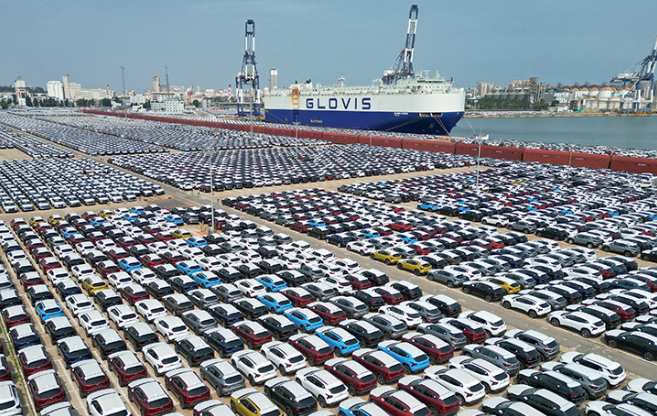
A relentless domestic price war and surging upstream component costs have compressed Chinese automakers' profit margins to a historic low of 2.9% in early 2026, triggering a structural shift in how the world's largest auto market generates value.
Despite record sales volumes across the sector, both legacy and new energy vehicle (NEV) manufacturers are ensnared in a profitless growth trap. The industry’s distress is marked by a stark divergence in supply chain profitability: while upstream battery and chip manufacturers post rapid earnings growth, downstream automakers are absorbing the financial shock of continuous price cuts to maintain market share.
Initial market feedback suggests investors are recalibrating valuation models—shifting focus from raw delivery volumes to supply chain leverage and ecosystem monetization.
Upstream Monopolies Extract Downstream Value
The automotive industry, which historically maintained profit margins around 8%, has seen its profitability collapse. According to Cui Dongshu, Secretary General of the China Passenger Car Association, the auto manufacturing sector's margin fell to 2.9% in the first two months of 2026. In contrast, upstream non-ferrous metal margins surged to 39.4%, up from 9% in 2017.
This structural wealth transfer is evident in corporate earnings. Contemporary Amperex Technology Co. Limited reported a first-quarter 2026 net profit of RMB 20.74 billion (US$2.88 billion), up 48.52% year-over-year. The battery giant's net profit has grown at a compound annual rate of 66.9% over the past five years.
In contrast, even vertically integrated market leaders are struggling to defend margins. BYD Co. reported full-year 2025 revenue of RMB 803.96 billion (US$111.66 billion), yet its net profit declined by 19% to RMB 4.53 billion—its first profit contraction in four years. The data suggests that scale and vertical integration are no longer sufficient to offset systemic margin compression.
Escalating Price Wars Erode Hardware Economics
The profitability crisis is further exacerbated by an intensifying price war in early 2026. Across the industry, nearly 70 models saw price reductions. First-quarter data shows NEV prices dropped by an average of RMB 38,000 (US$5,277), representing a 13.7% decline, while internal combustion engine (ICE) vehicles saw discounts of 14.3%.
William Li, Founder and Chairman of NIO Inc., noted that batteries and chips now account for over 50% of smart EV manufacturing costs. The rapid iteration of these components forces automakers into compressed product lifecycles, generating significant supply chain inefficiencies. The “smartphone-ification” of vehicles accelerates obsolescence, leading to supply-demand mismatches that erode capital at the OEM level.
Zhao Fei, General Manager of Changan Automobile, confirmed this operational reality at a 2026 industry forum, stating that automakers can no longer rely solely on vehicle sales for profitability.
Standardizing Components Signals Survival Strategy
To break the cycle of profitless volume growth, industry executives are pivoting toward structural cost discipline and global ecosystem expansion. NIO’s Li advocates for industry-wide standardization of battery cell specifications and unification of chip platforms. Reducing technical fragmentation in core components could potentially cut supply chain costs by as much as RMB 100 billion (US$13.88 billion) across the sector.
Simultaneously, export strategies are evolving. Wang Lang, Vice President of Chery Automobile, emphasized that overseas expansion must shift from exporting low-cost hardware to deploying integrated ecosystems, including smart connectivity, charging infrastructure, and financial services.
For automakers like Voyah, the mandate from investors is increasingly clear: transition from consuming shareholder capital for market share to demonstrating sustainable cash generation. The Chinese EV market is moving from a hyper-growth, volume-driven race to a prolonged margin defense phase—where only companies controlling core technologies and standardized supply chains are likely to survive industry consolidation.
Related Coverage:
China's Carmakers Are Flooding the World. The Hard Part Is Just Beginning.