
China's EVs Court Europe as U.S. Slams the Door Shut
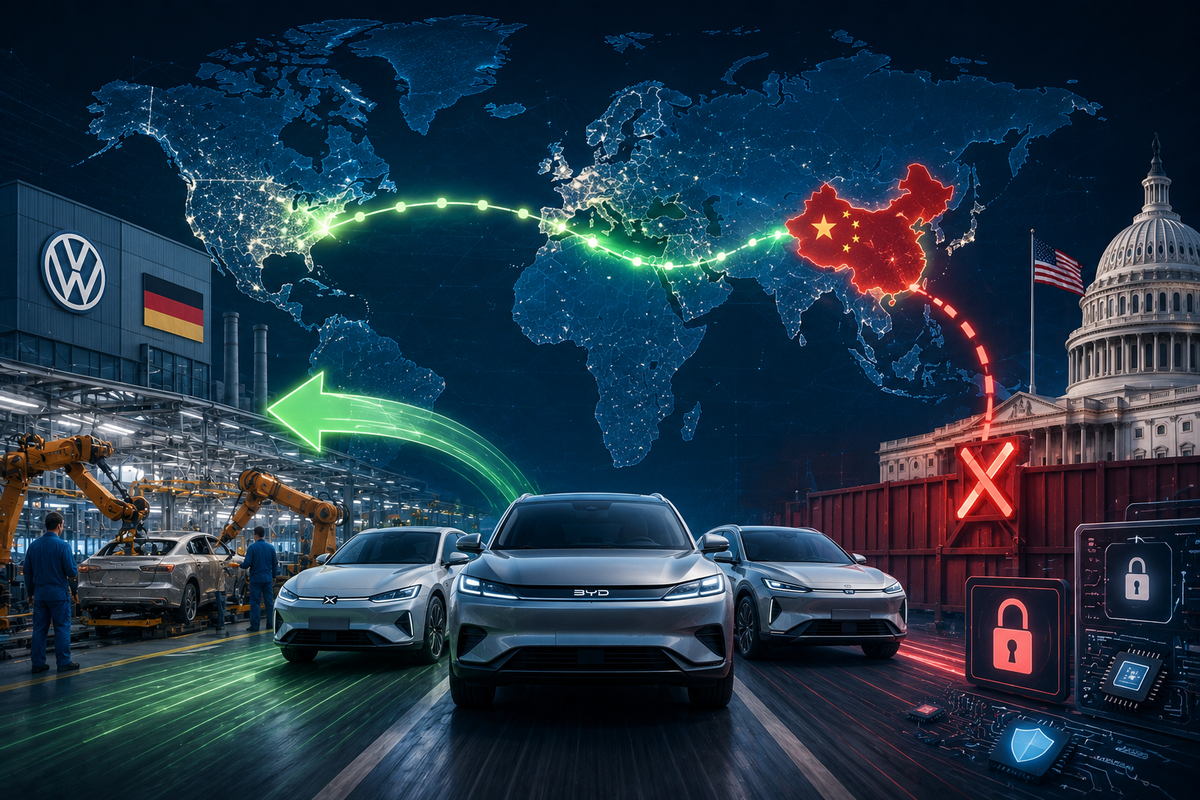
Germany's industrial crisis hands Chinese automakers a rare foothold in Europe's third-largest car market, even as Washington's "connected vehicle" rules effectively bar Chinese-linked brands from American roads.
The divergence could not be starker. Within days of each other in late June 2026, Germany's Saxony state government invited Chinese automakers to occupy idle Volkswagen factory floor space, while the U.S. Commerce Department denied Polestar a market-access permit under its connected-vehicle security framework — a ruling that blocks the 2027 model year from American dealerships entirely. The twin developments crystallize a structural fork in the road for China's overseas automotive ambitions: Europe is opening a crack, while the United States is welding the door shut.
Markets absorbed the news with cautious attention. Shares of XPeng and SAIC Motor edged higher on the Shanghai and Hong Kong exchanges following the German reports, reflecting investor optimism that a European manufacturing beachhead — long considered prohibitively complex — may now carry a lower political price tag than previously assumed.
Volkswagen's Crisis Pulls Chinese Brands Into Germany's Industrial Core
The proximate trigger is Volkswagen AG's accelerating cost crisis. The German automaker is weighing a restructuring plan that would eliminate up to 100,000 positions and shutter as many as four domestic plants — a scale of contraction that has drawn a joint statement of "fierce opposition" from IG Metall and Volkswagen's own works council, which warned it would deploy "every available means" to block closures.
The German government's response has been telling. A government spokesperson confirmed that Berlin's objective is to prevent domestic plant closures. More significantly, multiple officials have proposed filling idle capacity not by cutting jobs, but by inviting Chinese partners to produce jointly developed models on German soil.
Lower Saxony Premier Stephan Weil went furthest, suggesting that Volkswagen's domestic plants could manufacture vehicles co-developed with XPeng and SAIC — retaining German workers on the assembly line rather than exporting the work. Saxony Economic Minister Martin Dulig took an even more direct line, proposing that Chinese automakers be brought into Volkswagen's Zwickau plant outright. "We must move with the times," Dulig said. "China is an opportunity for Zwickau."
The strategic calculus behind these invitations is straightforward, if uncomfortable for European industrial pride: Germany's auto sector has transitioned from an era of expansion into one of structural overcapacity. The question is no longer market share — it is whether assembly-line workers have jobs at all. A Chinese brand producing vehicles in Zwickau is no longer simply an export competitor; it becomes a domestic employer and a taxpayer.
Europe's Fractured Landscape Creates Asymmetric Entry Points
The invitation from Saxony does not represent a pan-European consensus — far from it. Data from the European Automobile Manufacturers' Association (ACEA) for full-year 2025 illustrates both the opportunity and the complexity. Total sales across the EU-27, the UK, and EFTA reached 13.27 million vehicles, of which new-energy vehicles (battery-electric BEV plus plug-in hybrid PHEV) accounted for 3.858 million units, or 29.1% of the market.
Chinese brands are gaining ground but remain structurally marginal. SAIC's MG brand posted European sales of 305,700 units in 2025, up 24.9% year-on-year, ranking 11th overall. BYD recorded EU sales of 187,100 units, a 271.8% surge that lifted it to 20th place — ahead of Tesla's 18th-place finish, a data point that would have seemed implausible three years ago.
Yet the political map of Europe is deeply fractured along lines of industrial self-interest. Germany, Hungary, and a cluster of central European states constitute what analysts call the "pragmatic cooperation bloc": their domestic industries are either deeply integrated with Chinese supply chains or entirely dependent on foreign manufacturing investment for employment and tax revenue. Volkswagen, BMW, and Mercedes-Benz collectively derive roughly one-third of their global sales from China, making punitive tariffs on Chinese EVs an act of economic self-harm.
France and Italy anchor the opposing camp. Renault and Stellantis hold negligible Chinese market share, leaving their governments free to pursue tariff protection without incurring supply-chain blowback. Italy's dense ecosystem of small combustion-engine component manufacturers has little capacity to pivot, making Rome a consistent advocate for regulatory barriers.
The fault lines, however, are not immovable. Stellantis's partnership with Leapmotor — in which the Franco-Italian conglomerate holds a 21% stake and manages global distribution outside China — has already introduced commercial interdependence that complicates Paris's protectionist posture. Capital, as always, dilutes ideology.
Washington Tightens Its "Connected Vehicle" Perimeter
The American picture offers no such nuance. The Commerce Department's rejection of Polestar's 2027 model-year application under the Connected Vehicle Rule — originally promulgated during the Biden administration — applies to any vehicle containing Chinese or Russian software or hardware components that connects to external networks. The rule is technology-agnostic and ownership-agnostic: it targets the component origin, not the brand's nationality or its manufacturing location.
The Polestar case is instructive precisely because it strips away the usual counterarguments. Polestar is majority-owned by Geely, but it markets itself as a Swedish-designed, premium EV brand. It has already exited the Chinese domestic market. It assembles vehicles in the United States. None of these factors secured an exemption.
What makes the ruling additionally jarring is the contrast with Volvo Cars, which is also majority-owned by Geely Holding and did receive a connected-vehicle exemption. The divergent treatment of two sister companies under the same Chinese parent underscores the degree to which U.S. market access now hinges on regulatory discretion rather than transparent, rules-based criteria — a structural uncertainty that makes long-term investment planning for any Geely-linked entity in America extremely difficult.
Chinese brands in the U.S. mainstream passenger-car segment remain effectively absent. Their current American footprint takes three forms: capital-controlled European marques (Volvo, Polestar), niche premium vehicles (Lotus), and commercial electrification plays such as BYD's municipal bus contracts. The indirect supply-chain approach — building American presence through Fuyao Glass, Joyson Electronics, and CATL battery partnerships — remains the least-risk vector for Chinese industrial capital, but it generates brand equity slowly and offers no shortcut to passenger-vehicle market share.
The historical parallel with Japanese automakers is instructive but ultimately misleading. Toyota, Honda, and Nissan entered the U.S. market in a manufacturing-centric era when the primary gatekeeping mechanism was tariffs and voluntary export restraints — barriers that could be negotiated or circumvented through localization. The current framework is fundamentally different: it is data-sovereignty-based and software-defined, meaning compliance requires not just building factories in Ohio but redesigning the entire technology stack to satisfy U.S. national-security standards. Chinese automakers face a "rules-first, entry-second" paradigm for which there is no historical playbook.
Impact Assessment: Who Gains, Who Loses
XPeng and SAIC stand to gain most directly from the German opening. Both are named in Lower Saxony's proposal, and both have existing co-development relationships with Volkswagen. A Zwickau production arrangement would grant them European manufacturing status, potentially insulating future models from EU tariff escalation while generating the "local employer" political capital that has historically been the most durable form of market protection.
BYD is positioned differently. Its European growth — 271.8% in 2025 — has been achieved almost entirely through imports, leaving it exposed to tariff risk. A German manufacturing foothold, even a minority one, would materially reduce that exposure, though BYD's Hungarian plant (already under construction) represents its primary localization bet.
Volkswagen faces the most complex calculus. Accepting Chinese production partners into its domestic plants preserves jobs in the short term but accelerates the technology transfer that German industry has spent years trying to manage carefully. The union's opposition reflects not just wage concerns but a deeper anxiety about whether German workers will be assembling German-designed vehicles or serving as contract labor for Chinese platforms.
U.S. consumers are the collateral damage of Washington's framework. The connected-vehicle rules effectively prevent the entry of competitively priced Chinese EVs that retail in China for the equivalent of US$15,000–25,000 — a price band that American domestic manufacturers do not currently serve.
The New Rulebook Is Being Written in Real Time
The simultaneous emergence of Germany's capacity-sharing proposal and America's connected-vehicle enforcement action is not coincidence — it is the visible expression of a global automotive order undergoing structural realignment. Access to major markets is no longer determined primarily by price, range, or brand equity. It is determined by compliance with locally defined technology sovereignty standards, supply-chain origin rules, and — in Europe's case — the willingness to absorb local employment risk.
For Chinese automakers, the strategic implication is clear: the era of pure export-led internationalization is closing. The next phase requires capital commitment, manufacturing presence, and political relationship management in each target market. Europe, for all its internal contradictions, is offering an entry point. The United States, for now, is not.
Related Coverage:
J.P. Morgan’s Europe Auto Warning: China’s OEMs are coming for 20% Market Share