
China's Home Appliance Giants Accelerate Push Into Auto Sector as Smart Cabin Race Intensifies
China's leading home appliance manufacturers are rapidly expanding into the automotive sector, forging strategic alliances with major automakers in a race to define the next generation of smart vehicle cabins. The convergence of home and car ecosystems is accelerating as traditional appliance makers seek new growth avenues while automakers scramble to compete with integrated offerings from Xiaomi and Huawei.
In the past six months, Midea Group has signed strategic cooperation agreements with BYD Co. and Changan Automobile, while Haier Group has positioned Avatr 12 vehicles as official company cars. Gree Electric Appliances Inc.'s Chairwoman Dong Mingzhu recently suggested that half of GAC Group's automotive chips could eventually be replaced by Gree products. The simultaneous push by China's top three appliance giants signals a fundamental shift in the country's manufacturing landscape.
The partnerships center on creating seamless "human-car-home" ecosystems, where smart home systems integrate directly with vehicle cabins. This convergence offers appliance makers access to automotive scenarios while providing automakers with established home IoT infrastructure—capabilities that competitors like Xiaomi and Huawei have already built into closed-loop systems.
Industry observers note that 2026 marks a critical juncture as Level 3 autonomous driving becomes mainstream, transforming vehicles into genuine "mobile living rooms" where occupants' attention shifts from driving to entertainment, work, and home control functions.
Strategic Partnerships Accelerate
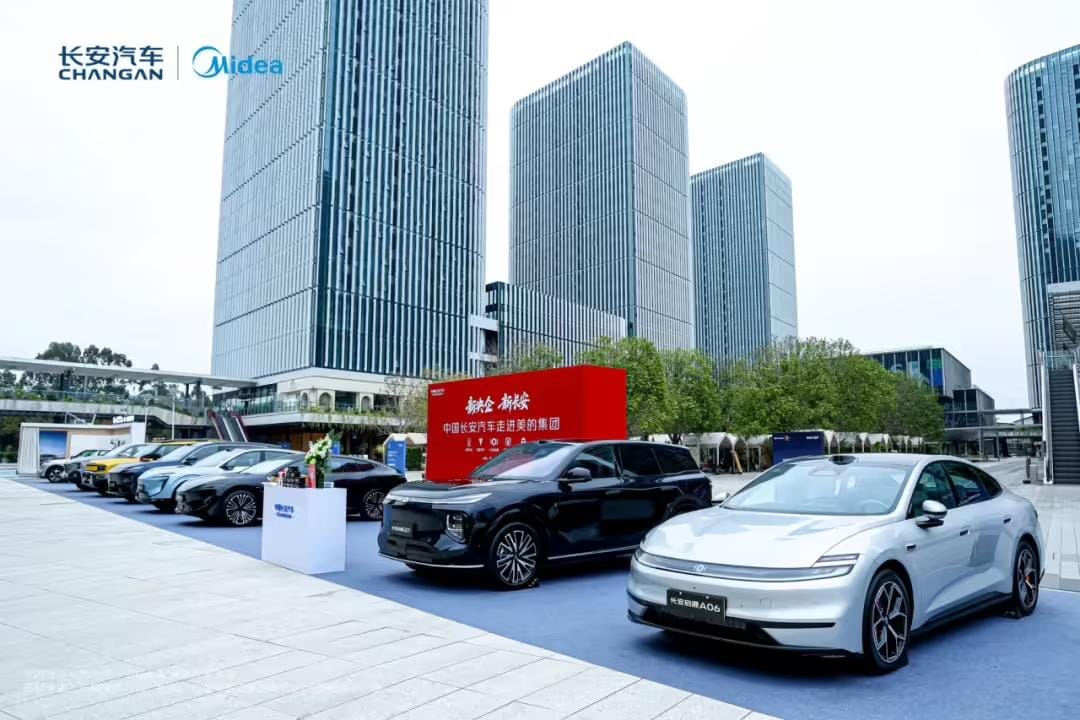
On January 21, Changan Automobile announced a comprehensive strategic cooperation agreement with Midea Group, marking the automaker's second major appliance partnership within six months. Last July, Changan signed a similar deal with Haier Group to integrate smart home connectivity into its intelligent cabin systems.
The rapid succession of partnerships reveals urgency on both sides. Beyond Changan, Haier has expanded its automotive footprint through multiple channels. In November, Haier's smart home division reached a strategic agreement with Chery Holding Group's lifestyle ecosystem platform. Earlier in August 2025, Haier's subsidiary Catarc Holdings completed a strategic investment in Autohome Inc., further strengthening its automotive industry presence.
Midea formally launched its whole-home intelligence strategy in August 2025, explicitly designating the "human-car-home ecosystem" as one of three core business segments. The company has emphasized that genuine whole-home intelligence requires devices to possess understanding and coordination capabilities, not merely internet connectivity.
Other appliance manufacturers are pursuing varied approaches. Skyworth Group entered vehicle manufacturing early, developing proprietary systems focused on car-home integration. Sharp Corp. showcased its LDK+ concept vehicle at Japan's 2025 mobility exhibition, transforming a five-meter van into a "mobile living room."
Divergent Paths to Common Goal
Home appliance companies are adopting distinct strategies based on their technological foundations and resource capabilities. Xiaomi, Sharp, and Dreame Technology have chosen direct vehicle manufacturing to complete their ecosystems, treating automobiles as next-generation intelligent terminals.
In contrast, Midea and Haier emphasize a philosophy of "doing what we do best." According to Dr. Shang Zhe from Midea, in an interview with Leikeji, the company deliberately avoids smartphones and automobiles, instead focusing resources on perfecting home scenarios while partnering with leading brands in other domains. This open strategy was amplified through Midea's collaboration with BYD.
Midea selected BYD specifically for its rapid evolution in intelligent cabins, vehicle-based large language models, operating systems, and ecosystem applications—capabilities that align with Midea's vision of pushing smart vehicles beyond infotainment toward proactive user intent understanding.
Whether through deep integration via proprietary vehicle manufacturing or ecosystem collaboration through strategic partnerships, appliance giants share a unified objective: discovering new growth beyond saturated home appliance markets where price wars have intensified, particularly following Xiaomi's aggressive entry into home appliances.
Automakers' Calculated Compromise
The question remains why automakers would permit external players to penetrate their core territory—the smart cabin. Industry analysis suggests home appliance partnerships enable "car controls home" and "home controls car" seamless integration, which automakers cannot achieve independently.
Automakers' critical weakness lies in lacking "lifestyle scenario" expertise. While excelling in powertrains, chassis, and autonomous driving, they struggle to understand home contexts—such as why users need air conditioning activated 15 minutes before arriving home rather than five. Midea and Haier possess behavioral data from billions of devices across hundreds of millions of households accumulated over decades, a differential that cannot be bridged through short-term R&D investment.
The deeper motivation stems from competitive pressure. Huawei's Harmony Intelligent Mobility Alliance and Xiaomi have already constructed full-scenario closed loops. Xiaomi's vehicle launch completed the final piece of its human-car-home ecosystem puzzle, enabling seamless transitions across three scenarios through its Pengpai OS. Huawei's "1+8+N" strategy, centered on smartphones with Harmony cabins naturally integrated with smart homes, has secured early user mindshare in this ecosystem race.
For traditional automakers like Changan and BYD, the threat is existential: once users grow accustomed to Xiaomi or Huawei's integrated phone-vehicle-home experience, purchasing other brands creates "ecosystem fragmentation" switching costs. This lock-in effect proves more formidable than technical specifications.
Appliance giants thus become automakers' "least bad option." Rather than ceding smart cabin dominance to Huawei and Xiaomi, proactive alliances with Midea and Haier offer advantages—these partners neither manufacture vehicles nor compete for end customers, merely collecting "scenario service fees." This arrangement allows appliance companies to leverage full-scenario ecosystems through asset-light models while automakers rapidly acquire home scenario resources to enrich cabin functionality.
Market timing adds urgency. With 2026 viewed as the threshold year for Level 3 autonomous driving proliferation, when drivers' hands leave steering wheels and attention becomes available, vehicle interiors genuinely transform into mobile living rooms. User demand for in-vehicle entertainment, work capabilities, and home control will surge exponentially. All positioning must conclude in 2026 to capture 2027's anticipated market explosion.
From Hardware to Scenarios
The appliance-automotive convergence transcends individual growth strategies, representing a collective pivot by Chinese manufacturing in the digital era. For four decades, Chinese manufacturing dominated through scale, cost efficiency, and operational excellence. In the intelligent age, hardware itself depreciates while connectivity and scenarios constitute value highlands.
Appliance giants spent a decade connecting refrigerators, air conditioners, and washing machines into ecosystems. Now they aim to extend these ecosystems into automobiles, ultimately covering life's complete scenarios. For automakers, embracing transformation proves wiser than fearing cross-industry disruption.
The open postures of Changan, BYD, and Avatr demonstrate strategic wisdom—exchanging cabin access for scenario capabilities. Those who hesitate risk elimination; those who experiment at least retain opportunity.
The ultimate "human-car-home" endgame will not produce victors who eliminate rivals but rather spawn new species—entities neither purely appliance companies nor strictly automakers, defying existing categorical definitions.
The table is set and appliance giants have boarded the vehicle. Whether their tickets convert into future passage depends on truly understanding what constitutes authentic "human-car-home" integration.