
China's Humanoid Robot Makers Take to the Mall — But Only One Is Drawing Crowds
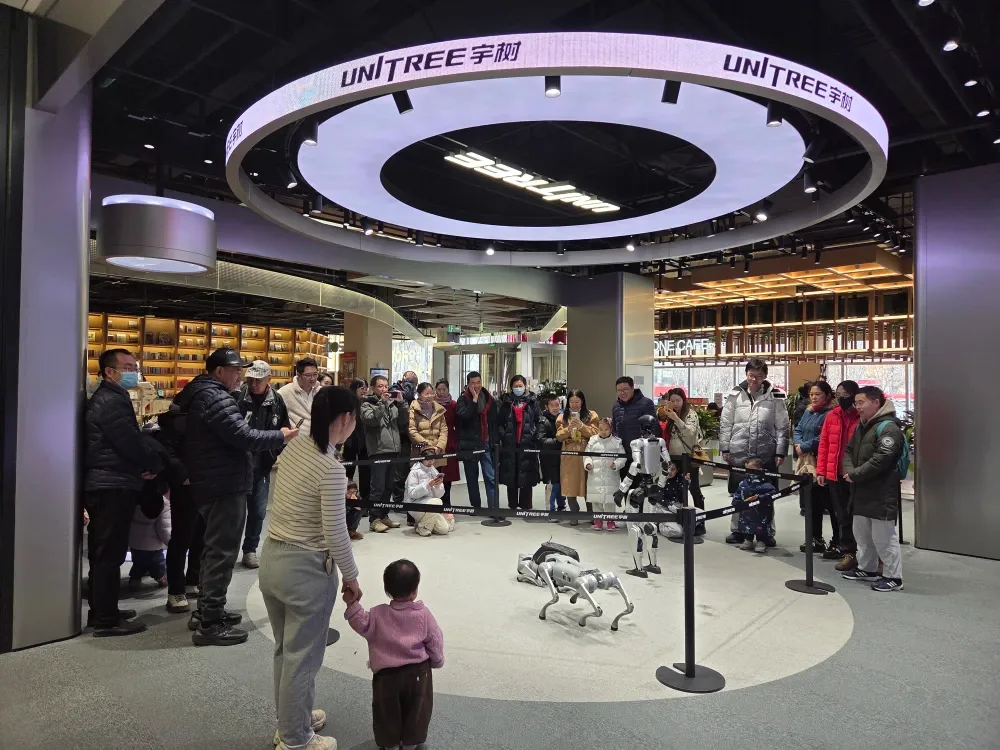
Unitree's flagship store on Shanghai's premier shopping strip is ringing up sales while Zhiyuan's suburban pilot outlet sits largely empty, exposing a stark divergence in go-to-market strategy as both companies race toward capital markets.
The simultaneous brick-and-mortar push by China's two most-watched humanoid robot startups has produced an unintended stress test: foot traffic, not factory output, is now the metric separating credible commercialization stories from IPO theater. With Unitree Robotics having cleared its STAR Market listing review on June 1, 2026, and Zhiyuan Robot fielding persistent Hong Kong IPO speculation, every customer who walks through — or past — a showroom door carries outsized significance for investor narratives.
The contrast crystallized on June 13, 2026, when Zhiyuan opened its first global retail outlet inside a JD Mall on Caobao Road in Minhang district — a location one staff member privately acknowledged would perform "completely differently" if it were on Nanjing Road. Three days after opening, a reporter from Kechuang Daily found the store largely deserted during a weekday evening visit, with dynamic robot demonstrations restricted to just three fixed daily slots: 11 a.m., 3:30 p.m., and 5:30 p.m. For the majority of operating hours, Zhiyuan's Lingxi and Yuanzheng humanoid series and D1 quadruped robots stood as silent exhibits. "There's no interaction, no promotion — most visitors glance and leave," one consumer on the floor observed.
Unitree Converts Foot Traffic Into First-Day Sales; Zhiyuan Bets on Process Over Volume
Unitree's Asia-first experiential store, which opened May 31, 2026 on Nanjing West Road inside Jiuguang Department Store — the corridor widely regarded as China's most commercially prestigious retail strip — told a different story. Even on a midweek afternoon nearly two weeks after launch, the store sustained steady consumer flow. On opening day alone, the outlet sold more than ten robotic dogs and two humanoid units, with in-store pricing at roughly an 80% discount to list price.
The product range spans RMB 8,697 (approximately US$1,208) for entry-level quadrupeds to RMB 170,000 (US$23,611) for commercial-grade humanoids. The consumer entry point for a humanoid — the R1 Air — is priced at RMB 29,500 (US$4,097), cheaper than a top-configured iPhone by local retail standards. Staff noted that while R1 carries spot inventory, flagship humanoid models G1 and H2 remain subject to factory scheduling queues, a supply constraint that caps near-term conversion even as demand signals strengthen.
The location gap between the two stores encodes their strategic intent. Unitree is explicitly pursuing C-end retail conversion using premium-mall traffic as a demand funnel. Zhiyuan, by contrast, is running what its own staff described as a "4S dealership model" — a reference to China's automotive service-center format — designed primarily to stress-test operational workflows before any broader rollout. "We want to figure out how this model works before expanding," a Zhiyuan employee told reporters. "Eventually there may be one store per Tier-1 city, but first we need to get the process right."
Pricing Collapse Reshapes the Addressable Market — But Deployment Lags Hardware
The pricing trajectory disclosed in Unitree's IPO prospectus is among the most striking data points in China's robotics sector. Average selling prices for the company's humanoid robots fell from RMB 593,400 (US$82,417) in 2023 to RMB 260,700 (US$36,208) in 2024, and further to RMB 167,600 (US$23,278) in 2025 — a cumulative decline exceeding RMB 400,000 (US$55,556) in roughly 24 months.
Yu Yiran, Managing Director at CIC, told Kechuang Daily that the price compression is now breaching a psychological threshold. "Parts of the price range have crossed out of pure industrial goods territory and into territory accessible to hardcore tech enthusiasts and high-net-worth households," she said.
Yet the more consequential bottleneck is not price — it is application. Store staff and consumers alike flagged the same structural gap: robots can be manufactured and sold, but stable, value-generating use cases in the real world remain scarce. "Buying a robot — application scenario is everything," a Unitree employee said. The hardware cost curve has bent sharply downward; the software and deployment curve has not kept pace.
"Wild Monetization" Scenarios Reveal the Real Commercial Baseline
On-the-ground reporting from Zhiyuan's store surfaced an unanticipated demand segment that neither company has formally addressed in its investor materials. Sales staff disclosed that some buyers — primarily individuals — purchase quadruped robots and deploy them at public squares and subway entrances as performance attractions, collecting voluntary contributions from passersby. "One unit can bring in RMB 200 a day; hardware costs can be recovered in three to six months," a Zhiyuan sales representative said.
The overseas arbitrage dynamic is equally revealing. Staff noted that robots sold domestically are resold abroad at multiples of six times the local price. One German buyer reportedly purchased two quadrupeds and one humanoid unit for public interactive performances, generating approximately RMB 2,000 (US$278) per day in net receipts. A separate channel involves buyers acquiring base units, performing secondary development, and reselling at a significant premium.
These informal monetization pathways — unplanned by manufacturers and absent from any roadmap — represent the clearest market signal yet of where genuine willingness-to-pay currently sits in the embodied-AI value chain.
IPO Pressure Amplifies Both the Upside and the Risk of Retail Expansion
Unitree's financials illustrate the tension between growth momentum and profitability sustainability. Full-year 2024 revenue reached RMB 392 million (US$54.4 million), rising to RMB 1.7 billion (US$236.1 million) in 2025. Adjusted net profit climbed from RMB 78.5 million (US$10.9 million) in 2024 to RMB 591 million (US$82.1 million) in 2025. The company is seeking to raise RMB 4.202 billion (US$583.6 million) at an implied valuation of approximately RMB 42 billion (US$5.83 billion).
However, Q1 2026 data signals a meaningful deceleration. Revenue of RMB 420 million (US$58.3 million) represented year-on-year growth of 68.49%, as R&D and sales expenditures — including costs associated with the new retail push — expanded materially.
Zhiyuan, meanwhile, has not officially confirmed Hong Kong listing plans. CEO Deng Taihua has publicly projected 2025 revenue of RMB 1.05 billion (US$145.8 million), "several-fold" growth in 2026, a target of RMB 10 billion (US$1.39 billion) by 2027, and RMB 100 billion (US$13.89 billion) by an unspecified future year — a trajectory that would require execution at a scale no Chinese robotics company has yet demonstrated.
CIC's Yu cautioned that the retail expansion wave carries dual implications. "If manufacturers treat stores purely as a marketing tool to spin narratives for secondary-market investors and inflate valuations, then rent, operations, and hardware depreciation will accelerate cash burn and inflate the bubble," she said. "But over the longer term, physical stores are a genuine proving ground — they will accelerate industry differentiation, elevating companies with real mass-production, deployment, and operational capabilities while eliminating those that only know how to build slide decks."
The June 2026 convergence of falling prices, proliferating storefronts, and queued IPOs marks an inflection point for China's embodied-intelligence sector. The decisive variable is no longer who can manufacture the cheapest robot — it is who can make these machines consistently useful enough that someone, somewhere, is genuinely willing to pay for what they do.
Related Coverage:
Unitree Races to Commercialize After Record-Speed IPO Approval
Zhiyuan Robot ships Expedition A3 humanoids, testing China’s embodied AI in tourism & rentals.