
China's Humanoid Robotics Industry: From Demo Stage to Commercial Reality
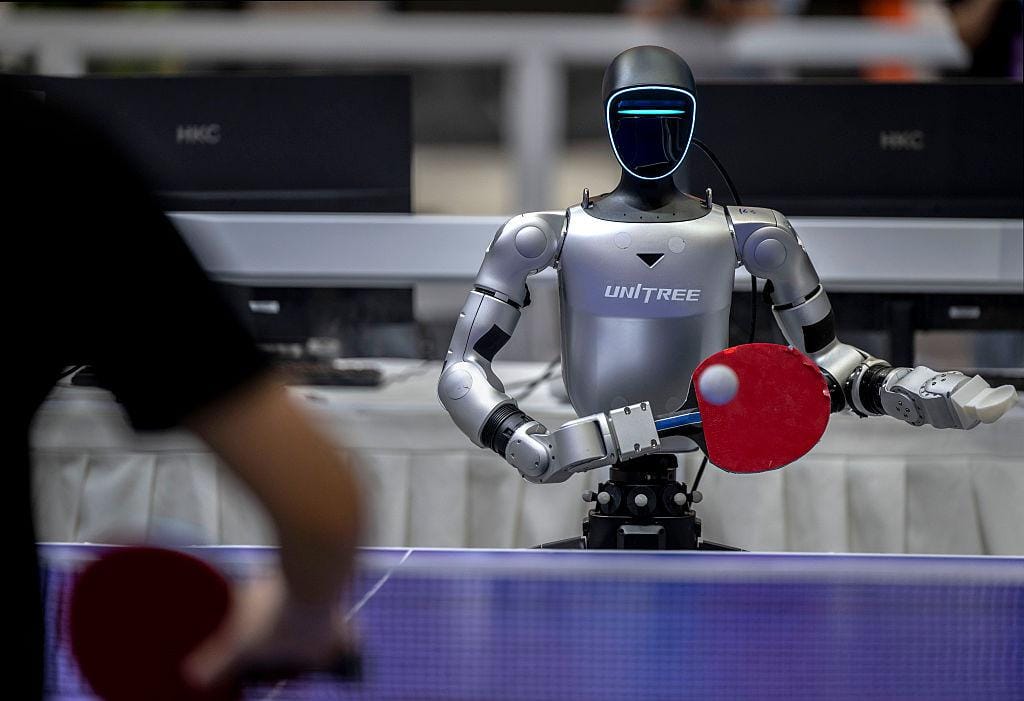
What it takes to build a sustainable robotics business — and why hardware alone is no longer enough
What Is the Humanoid Robotics Industry, and Where Does It Stand Today?
Humanoid and legged robotics represents a category of automation fundamentally different from conventional industrial machinery. Unlike fixed robotic arms on a factory floor, humanoid platforms are designed to operate in environments built for humans — navigating unstructured spaces, performing physical tasks, and increasingly making decisions using AI-driven control systems.
The sector sits at the intersection of several mature and emerging technologies: precision mechatronics, battery systems, sensor arrays, actuators, motion-control software, and embodied artificial intelligence. This convergence is what makes it both technically complex and commercially promising.
As of the mid-2020s, the industry has moved past the question of whether humanoid robots can walk, balance, or perform staged demonstrations. The operative question is now whether they can perform useful work — safely, reliably, and at a cost that makes economic sense for enterprise buyers. That transition from proof-of-concept to repeatable commercial deployment defines the current moment in the sector's development.
Global shipments of humanoid and legged robots are projected to grow from roughly 60,000 units in 2026 to approximately 1.75 million units by 2030. China accounts for the dominant share of both production and consumption — roughly 84% of global humanoid shipments in 2026, declining to around 52% by 2030 as international adoption broadens.
Why Does China Dominate Humanoid Robotics Production?
China's position in humanoid robotics is not accidental. It reflects structural advantages that have compounded over decades of manufacturing development.
The country produces over 90% of the world's humanoid robots and leads globally in factory robot installations. Its supply chain depth is critical: more than half of the core components in a humanoid robot — motors, batteries, sensors, structural materials — can now be sourced from suppliers already serving the new energy vehicle (NEV) industry. This overlap dramatically lowers the barrier to entry for new robotics manufacturers and accelerates cost reduction as volumes scale.
Chinese manufacturers also benefit from rapid product iteration cycles, proximity to component suppliers, and a domestic market large enough to absorb early-stage production at meaningful scale. Government policy has reinforced this momentum, with national standards for humanoid robotics and embodied AI under development — measures expected to reduce fragmentation, improve interoperability, and support mass production.
The result is a competitive environment that drives prices down quickly. Average selling prices for humanoid robots in China have fallen sharply — from approximately Rmb 593,000 per unit in 2023 to around Rmb 166,000 in 2025. Projections suggest prices will continue declining toward Rmb 72,000 or below by 2028. This deflation expands the addressable market but simultaneously compresses margins and erodes the competitive moat of any single hardware provider.
How Does the Humanoid Robotics Value Chain Work?
Understanding where value is created — and where it is migrating — is essential to evaluating any company in this sector.
The hardware layer encompasses the robot's physical body: legs, torso, arms, head, and the actuators that enable movement. Chinese manufacturers have demonstrated significant cost advantages here, particularly through self-developed quasi-direct-drive (QDD) actuators that can be produced at roughly one-quarter to one-third the cost of Western equivalents. A competitive 29-degree-of-freedom humanoid body can now be assembled for a bill of materials cost of approximately US$9,000.
The locomotion layer refers to a robot's ability to move — walking, balancing, navigating terrain. This has historically been the primary differentiator among humanoid platforms. However, as supply chains mature and more manufacturers master locomotion, this layer is becoming commoditized.
The manipulation layer — dexterous hands, force control, precision grasping, and real-world task execution — has emerged as the critical bottleneck for commercial deployment. Most enterprise use cases that justify humanoid robots over conventional automation require reliable manipulation: picking, sorting, assembling, inserting cables, handling irregular objects. This capability remains difficult to achieve consistently outside controlled environments and is where most leading platforms are still underperforming.
The intelligence layer encompasses the AI models, training data, and software that enable robots to perceive their environment, make decisions, and adapt to new tasks. This is increasingly where long-term value is expected to concentrate. Embodied AI foundation models — trained on large datasets of real-world robot interaction data — are becoming a strategic asset. Companies and research initiatives are targeting 500,000 to 1 million hours of high-quality embodied AI training data as a near-term milestone.
The data layer sits beneath the intelligence layer. The most valuable training data for physical AI — joint torque readings, tactile feedback, dual-arm coordination signals, real-world interaction logs — is generated by robots operating in the field. This creates a potential feedback loop: more deployed robots generate more data, which improves AI models, which makes robots more capable, which enables broader deployment.
The industry's value chain is visibly shifting from the hardware and locomotion layers toward manipulation, intelligence, and data. This transition has significant implications for how companies in the sector should be evaluated.
Who Are the Major Players, and What Differentiates Them?
The competitive landscape in humanoid robotics spans hardware-native manufacturers, AI-first platforms, and diversified technology companies that have entered the space from adjacent industries.
Hardware-native platforms — companies whose primary strength is building cost-effective, reliable robot bodies — include Unitree Robotics, Fourier Intelligence, LimX Dynamics, and Engine AI on the Chinese side, and Agility Robotics in the US. These companies excel at locomotion, manufacturing cost discipline, and rapid product iteration. Their challenge is demonstrating that hardware expertise can translate into durable competitive advantage as the value chain shifts toward software and intelligence.
Manipulation and physical intelligence platforms — companies that prioritize dexterous hands, task execution, and AI integration — include Agibot, Figure AI, Physical Intelligence, and Genesis AI. These platforms generally score higher on manipulation capability but often at greater hardware cost and lower manufacturing scale. They are positioned to lead the next commercialization phase as enterprise buyers demand robots that can actually perform tasks, not just navigate spaces.
Diversified technology entrants — including Tesla (Optimus), NVIDIA (through its Isaac GR00T reference platform), and Xpeng Robotics — bring significant AI, compute, and ecosystem resources. NVIDIA's approach is illustrative: rather than manufacturing its own robot body, it pairs third-party hardware (including Unitree's H2 Plus platform) with its own compute (Jetson Thor) and tactile sensing technology, positioning itself as the intelligence and compute layer rather than the physical manufacturer.
Automotive and electronics crossovers — the participation of companies like Honor (which won the 2026 Beijing humanoid half-marathon with a robot developed in a short timeframe) illustrates how quickly locomotion performance gaps can close when well-resourced companies enter the market.
The competitive dynamic points toward a structural pattern common in technology hardware markets: as the hardware layer commoditizes, value concentrates in software, data, and ecosystem control. Companies that fail to establish a defensible position in at least one of these layers risk being relegated to component or contract manufacturing roles.
What Does the Path to Enterprise Deployment Actually Look Like?
Early commercial deployments of humanoid robots have been concentrated in structured industrial environments where tasks are repetitive, environments are controlled, and failure consequences are manageable. Automotive manufacturing and logistics have been the primary proving grounds — partnerships between companies like BYD and Foxconn with UBTech, GXO with Agility Robotics, BMW with Figure AI, and Mercedes with Apptronik represent the current frontier of enterprise adoption.
These deployments share several characteristics. They involve small batch sizes rather than fleet-scale rollouts. They focus on specific, well-defined tasks rather than general-purpose operation. They require significant integration support, including installation, training, fleet management, and maintenance. And they are evaluated primarily on demonstrable return on investment — whether the robot can perform work more efficiently or safely than human labor or conventional automation.
The transition from pilot deployment to repeat enterprise orders is the critical commercial milestone that the industry has not yet broadly achieved. Pilots can be funded by novelty, strategic interest, or government support. Repeat orders require proven ROI. The distinction matters enormously for how revenue should be interpreted: early shipments to research institutions, universities, and demonstration programs carry fundamentally different commercial signals than recurring orders from enterprise customers expanding proven deployments into larger fleets.
Near-term use cases that do not require full general intelligence — inspection, guided delivery, sorting, structured manufacturing support — are the most credible candidates for early scale. The addressable market for these applications within China's manufacturing base alone is substantial, and localized supply chains and cost advantages could accelerate adoption timelines.
What Are the Key Constraints and Risk Factors?
Several structural constraints limit the pace at which the humanoid robotics industry can scale.
Manipulation capability remains the primary technical bottleneck. Even simple pick-and-place tasks are unreliable outside controlled environments. Many structured tasks are already handled more cost-effectively by conventional industrial robots. The real commercial opportunity for humanoids lies in flexible, contact-rich manipulation — precisely the capability that most current platforms have not yet mastered at production scale.
Average selling price deflation is accelerating faster than in most technology hardware markets. The combination of Chinese manufacturing competition, NEV supply chain overlap, and aggressive pricing strategies is compressing ASPs rapidly. While lower prices expand the addressable market, they also reduce revenue per unit and compress gross margins. Companies must scale shipment volumes substantially just to maintain flat revenue, let alone grow it.
Regulatory complexity is increasing, particularly in the context of US-China technology tensions. US Federal Communications Commission restrictions introduced requirements for extensive disclosure and conditional approval for foreign-produced advanced robotic devices, including humanoids and quadrupeds. For Chinese manufacturers with meaningful US revenue exposure, this introduces material uncertainty around international growth prospects and new product launches. The regulatory environment is also tightening domestically in China, with authorities raising the bar for humanoid startups seeking public listings — now requiring demonstrated recurring revenue and real innovation rather than demonstration-stage shipments.
The shift from hardware to intelligence creates a strategic dilemma for hardware-native companies. Building competitive AI foundation models requires heavy upfront investment, large-scale compute infrastructure, and tolerance for uncertain payback timelines — a very different operational profile from disciplined hardware manufacturing. Companies that attempt to transition risk diluting their manufacturing focus; companies that do not attempt it risk being left behind as the value chain shifts.
Data ownership and monetization is an emerging and unresolved question. Even if a hardware platform becomes the dominant physical substrate for training AI models, owning the hardware does not automatically translate into owning the data generated by it. As data collection methods evolve — including human-demonstration approaches that do not require robot hardware at all — the assumed link between hardware market share and data advantage may weaken.
How Should Humanoid Robotics Companies Be Valued at This Stage?
Valuing companies in an industry at this developmental stage is inherently uncertain. Traditional earnings-based multiples are of limited utility when profitability is highly sensitive to adoption timing, ASP trajectories, and operating expense scaling.
Price-to-sales multiples have become the primary valuation framework, with revenue serving as the most direct indicator of commercialization progress. For hardware-native companies, shipment volume signals market acceptance while ASP reflects pricing power and value chain positioning. However, the quality of revenue matters as much as its quantity: sales to research institutions carry different implications than repeat enterprise orders; pilot deployments are fundamentally different from fleet expansions.
As the sector matures, investor focus is shifting from scarcity-driven premiums — which characterized early listed humanoid robotics companies — toward the sustainability of earnings, the quality of revenue composition, and evidence of durable platform positioning. The relevant questions for any humanoid robotics company are: What share of revenue comes from repeat enterprise customers? Are pilots converting to fleet deployments? Can margins be maintained as ASPs decline? Is the company building defensible capabilities in manipulation, intelligence, or data — or does its competitive advantage rest solely on locomotion hardware that is becoming commoditized?
The experience of other technology hardware markets is instructive. In electric vehicles, early market leaders commanded price-to-revenue multiples above 5x at launch; as competition intensified and the novelty premium faded, multiples compressed toward 1x or below even as revenue continued to grow. The pattern suggests that being early in a hardware market is not sufficient for sustained premium valuation — durable platform economics require either defensible technology differentiation or control of a higher-value layer in the stack.
What Happens Next? Key Variables to Watch
The humanoid robotics industry is approaching what analysts describe as a commercialization inflection — a period, likely spanning two to four years, during which technology matures sufficiently and costs decline sufficiently for adoption to broaden meaningfully beyond early-mover customers.
Several variables will determine which companies emerge from this period in strong positions:
Manipulation capability breakthroughs will likely be the most significant catalyst for accelerating enterprise adoption. Any platform that demonstrates reliable, repeatable dexterous manipulation at production scale will unlock a substantially larger addressable market.
Repeat enterprise order evidence is the near-term proof point that separates sustainable commercial businesses from demonstration-stage operations. Companies that can show customers expanding pilots into fleets will command meaningfully different valuations than those still selling primarily to research and education buyers.
Data strategy and AI model development will increasingly differentiate platforms over a three-to-five-year horizon. Companies that establish defensible data advantages — through deployed robot fleets, proprietary collection methods, or strategic partnerships with AI developers — will be better positioned as the intelligence layer becomes the primary source of value.
Regulatory evolution in both China and the US will shape the competitive landscape for international players. The direction and pace of US restrictions on Chinese robotics hardware, and China's domestic standards development, will influence which companies can access which markets and on what terms.
Industry consolidation is a near-certainty as capital deployment increases and competition intensifies. With dozens of humanoid robotics companies in various stages of development and a wave of IPOs in the pipeline, the sector is likely to consolidate significantly. Historical patterns in technology hardware markets suggest that the final competitive field will be narrow — perhaps three to five scaled platforms globally — with the remainder either acquired, pivoting to component supply roles, or exiting.
The companies most likely to occupy those final positions will combine manufacturing scale and cost discipline with demonstrated capability in manipulation and AI integration, a defensible data strategy, and enterprise customer relationships that generate recurring, measurable ROI. Hardware alone — even excellent, affordable hardware — is unlikely to be sufficient.
Related Coverage;
Humanoid Robot Wars: China Racks Up Orders While US Players Tout Tech And Tussle With "Fake News"
Humanoid Robots Far From Factory Floor Despite Order Surge, Industry Experts Say