
China's Low-Altitude Economy Races Toward RMB 1.5 Trillion Milestone Amid Infrastructure and Regulatory Headwinds
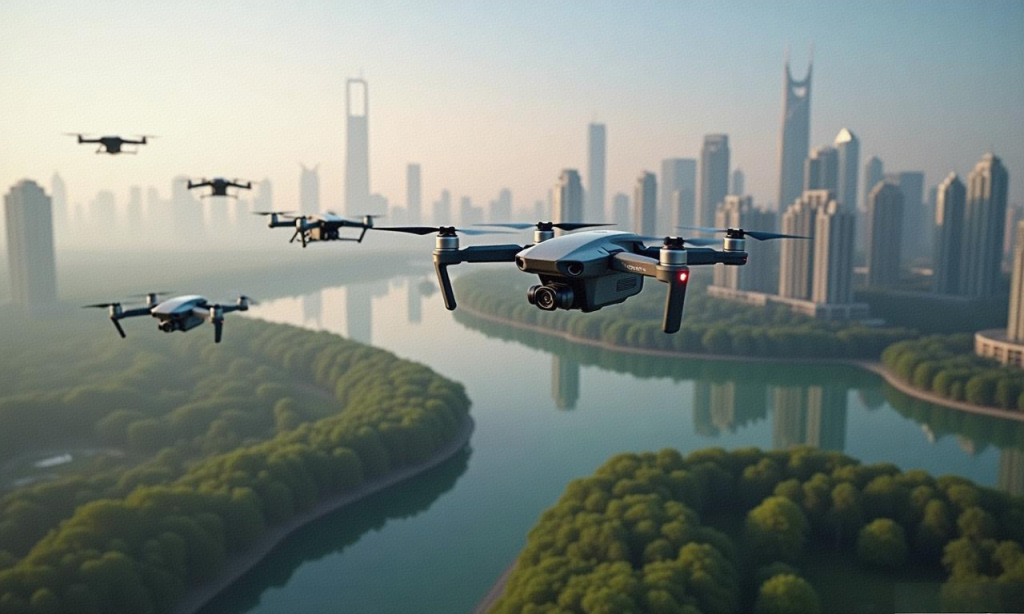
China's low-altitude economy sector—encompassing unmanned aerial vehicles (UAVs), electric vertical take-off and landing aircraft (eVTOL), and light aviation systems operating below 1,000 meters—is projected to reach RMB 1.5 trillion in market value by 2025, according to Civil Aviation Administration forecasts. This rapid ascent positions the nascent industry alongside new energy vehicles in strategic importance, yet its trajectory hinges on resolving critical gaps in airspace governance, charging infrastructure deployment, and commercial viability across regional markets.
Policy Architecture Evolves From Experimentation to Systematic Deployment
The elevation of low-altitude operations from pilot programs to national industrial strategy crystallized through successive government work reports in 2024 and 2025, with the latter emphasizing "safe and healthy development" as the operational guardrail. This rhetorical shift reflects mounting concerns over airspace congestion and safety protocols as enterprise registrations surged past 86,500 by May 2025—a 200% year-on-year increase driven primarily by UAV logistics and eVTOL component manufacturers.
The 2023 National Airspace Classification Method introduced pivotal regulatory architecture by carving out G-class zones (below 300 meters true altitude) and W-class zones (below 120 meters), effectively legalizing operations for lightweight drones and eVTOL platforms previously constrained by ambiguous jurisdictional boundaries. Six cities—Hefei, Hangzhou, Shenzhen, Suzhou, Chengdu, and Chongqing—initiated eVTOL trial routes in November 2024, serving as testbeds for integration protocols between manned and unmanned traffic flows.
Provincial governments responded with differentiated industrial policies. Anhui's Wuhu district, designated as a comprehensive demonstration zone, cultivated a vertically integrated supply chain spanning 200 enterprises producing engines, avionics, and complete aircraft with 100% domestic core technology localization. Xiamen's ecosystem of 2,699 UAV-related firms achieved provincial leadership in supply chain coverage, while Chongqing leveraged mountainous terrain to optimize low-altitude logistics networks, evidenced by RMB 800 million in flying car purchase commitments secured during the 2025 Smart Expo.
Application Battlegrounds Reveal Uneven Commercial Maturation
Low-altitude logistics operations demonstrate the clearest path to profitability. Meituan's Shenzhen deployment achieved 210,000 deliveries using a "3 kilometers in 15 minutes" model, while SF Express operationalized an automated sorting hub in Chongqing's Liangping district designed to anchor a regional "trunk-branch-terminal" UAV network across northeast Sichuan and Chongqing. Over 140 new logistics routes launched nationally in 2024, with unit economics approaching RMB 3-4 per passenger-kilometer for certain eVTOL configurations—competitive with traditional taxi services.
Agricultural applications captured 25.4% of April 2025 procurement spending (RMB 197 million), driven by precision spraying systems that reduce pesticide usage while completing tasks in one-tenth the time required by manual labor. Industrial inspection and cleaning services achieve similar efficiency gains, with specialized UAVs completing photovoltaic panel maintenance in six hours versus two days for suspended human workers.
Conversely, urban air mobility (UAM) and tourism segments remain capital-intensive with protracted payback periods. While Hainan recorded 60,000 aerial sightseeing passengers nationally in 2023 and Xiamen's coastal helicopter routes served 43,000 visitors (40% annual growth), these volumes require substantial subsidization. EHang's EH216-S secured global-first type certification, production approval, and airworthiness certificates, yet widespread commercial deployment awaits resolution of air traffic management complexities in dense urban corridors.
Infrastructure Deficit Constrains Network Effects Despite Rapid Buildout
China operated 475 certified general aviation airports by end-2024, adding 79 facilities in two years—yet this remains 2.4% of the U.S. benchmark of 19,500 airports. Inner Mongolia's blueprint for 500+ automated UAV stations and 10 permanent logistics routes illustrates the scale of planned investment, but execution timelines remain contingent on local fiscal capacity and inter-agency coordination between aviation authorities, telecommunications operators, and urban planning bureaus.
Software infrastructure advances through China Mobile's 5G-Advanced sensing networks and Beidou navigation integration, enabling real-time tracking and millisecond-latency controls critical for autonomous flight. The low-altitude air traffic management systems market is forecast to reach RMB 22.8 billion by 2027, propelled by ADS-B (Automatic Dependent Surveillance-Broadcast) and edge computing deployments. However, interoperability standards across provincial platforms remain fragmented, creating barriers to cross-regional route optimization.
Energy infrastructure lags behind aircraft development cycles. While hydrogen-lithium hybrid powertrains extend endurance and Zongshen Aero's CA500 piston engine recently obtained airworthiness approval, charging station density in secondary cities remains insufficient for scheduled operations. The absence of unified technical specifications for battery swapping compounds capital inefficiency as manufacturers deploy proprietary systems.
Regional Clusters Exhibit Specialization But Risk Redundant Capacity
The Pearl River Delta commands global UAV manufacturing supremacy through Shenzhen-Guangzhou-Zhuhai integration, while the Yangtze River Delta (Shanghai-Hangzhou-Hefei-Suzhou axis) concentrates on high-margin eVTOL components including batteries and motors. Chengdu-Chongqing focuses on logistics and emergency response applications exploiting topographical advantages, whereas Beijing-Tianjin leverages regulatory proximity to drive standards-setting and certification processes through institutions like Beihang University.
This geographic specialization mirrors developmental patterns in solar and EV industries, yet risks overcapacity if demand projections underwhelm. The sector attracted RMB 1.74 billion across 52 financing rounds in H1 2025 (48.6% year-on-year increase), with 82.7% of deals in Series B or earlier stages—indicating prolonged cash burn before profitability. Suzhou, Chengdu, and Hangzhou established industrial funds exceeding RMB 30 billion combined, but sustainable returns depend on regulatory clarity around liability frameworks and insurance mechanisms still under formulation.
The projected RMB 3.5 trillion valuation by 2035 assumes resolution of airspace coordination bottlenecks, achievement of eVTOL battery energy densities enabling 200-kilometer ranges at commercial load factors, and societal acceptance of urban air corridors. Current noise levels of 65 decibels—while superior to helicopters—still constrain residential area overflights, requiring advances in rotor acoustics and operational protocols limiting nighttime missions. Investment cycles must account for these technical and social adoption variables rather than extrapolating current growth rates linearly.
By ChinaBiz Insider Analysis Desk