
China's RISC-V Push Expands Into AI Inference as Alibaba and SpacemiT Break New Ground
Two Chinese chipmakers have delivered separate RISC-V milestones over the past week, signaling that the country's open-source processor ecosystem is moving from academic ambition toward commercially deployable hardware — and broadening the range of architectures available for AI inference beyond GPU-centric systems.
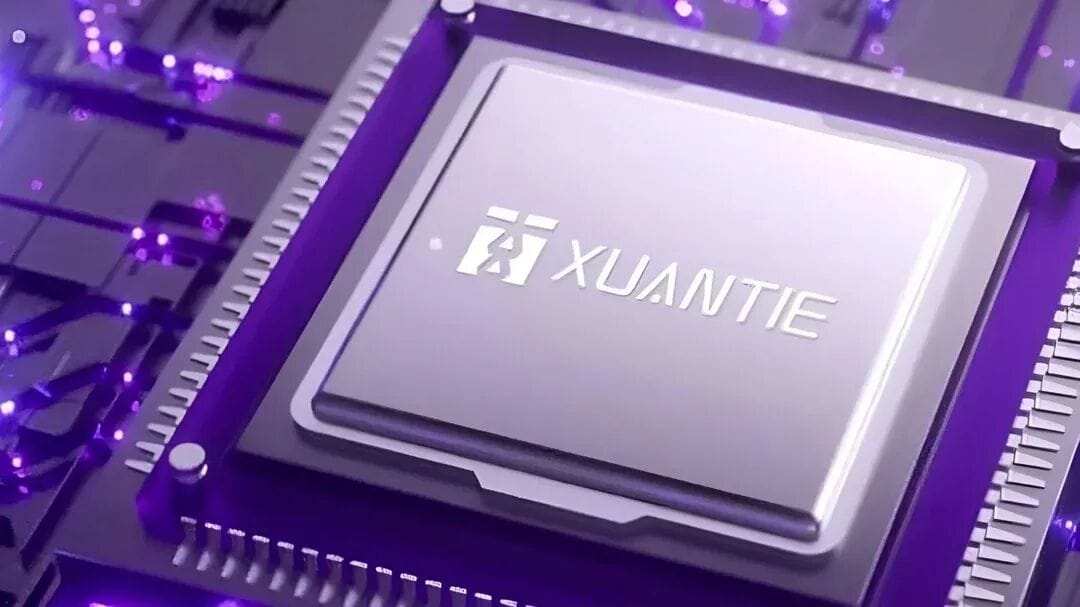
The latest came on Aug. 19, 2026, when Alibaba confirmed that its DAMO Academy-developed XuanTie C950 processor ran the 27-billion-parameter Qwen3.8-27B large language model natively at 30 tokens per second, with a first-token latency of 1.9 seconds — entirely without GPU assistance or emulation layers such as QEMU.
The demonstration followed an earlier milestone from SpacemiT Computing. Several days earlier, at the 5th Dishui Lake China RISC-V Industry Forum in Shanghai, SpacemiT unveiled the K3, which it claims is the world's first mass-production chip fully compliant with the RVA23 RISC-V profile standard. While the two announcements were separate events, together they highlight how China's RISC-V push is advancing across distinct computing segments: Alibaba is targeting server-class, CPU-native LLM inference, while SpacemiT is pushing RISC-V deeper into embodied intelligence and edge AI.
The broader significance lies less in the proximity of the announcements than in the capabilities they demonstrate. As U.S. export controls continue to constrain Chinese access to advanced Nvidia accelerators, domestic chipmakers are expanding RISC-V from embedded and connectivity applications into higher-performance AI workloads — creating additional domestically controlled inference pathways.
XuanTie C950 Breaks the GPU Inference Narrative
The XuanTie C950, fabricated on TSMC's 5-nanometer node and formally launched in March 2026, is a 64-core server-class RISC-V processor clocked at up to 3.2 GHz. Its architecture groups cores in eight-core clusters interconnected via AMBA CHI high-speed fabric, and integrates both a matrix acceleration engine and a vector acceleration engine on-die — a design choice that allows the chip to handle the tensor-heavy workloads of LLM inference without offloading to a discrete GPU.
The chip's memory bandwidth is more than four times that of its predecessor, the XuanTie C920, and its single-core SPECint2006 score exceeds 70 points, a new global record for any RISC-V processor. The 8-wide instruction decode front-end and 16-stage pipeline are consistent with a chip engineered for sustained throughput rather than peak burst performance.
Running Qwen3.8-27B — a 27-billion-parameter model that would typically demand a GPU with 16 GB to 24 GB of VRAM — at 30 tokens per second places the C950 within a commercially usable performance band for latency-tolerant workloads: document summarization, offline translation, private-cloud chatbots, and regulated-data environments where GPU clusters are either cost-prohibitive or geopolitically sensitive.
The significance for Alibaba's corporate strategy is structural. The company simultaneously controls Qwen (model), XuanTie (silicon), and Alibaba Cloud (infrastructure), a vertical stack that mirrors Nvidia's software-hardware flywheel. Operators can co-optimize model kernels for the chip's native instruction extensions, and future silicon generations can be tuned against real production inference traces — a compounding advantage that pure hardware vendors cannot replicate.
Critically, RISC-V carries no ARM or x86 licensing fees, eliminating a recurring cost and a potential geopolitical choke point in one move.
SpacemiT K3 Sets Four Global Firsts in Mass Production
SpacemiT Computing's K3 arrives with a more aggressive claim: four simultaneous global firsts within the RISC-V ecosystem. The chip is the first to achieve mass production under the RVA23 profile standard; the first to support 1,024-bit RVV vector width; the first to offer native FP8 inference; and the first to implement full chip-level virtualization in the RISC-V space.
Architecturally, K3 pairs eight proprietary X100 high-performance CPU cores (peak 2.4 GHz, single-core performance comparable to ARM Cortex-A76) with eight A100 ultra-wide parallel AI cores on a homogeneous fused-compute fabric. The chip delivers 130,000 DMIPS of general compute and 60 TOPS of AI inference throughput.
In a live demonstration running Qwen 30B-A3B, first-token latency measured 0.9 seconds at approximately 15 tokens per second — a lower throughput than the C950's 30 tokens per second, but achieved on a chip targeting a different market: embodied intelligence and robotics rather than cloud inference servers.
That distinction matters. K3 integrates two RISC-V real-time cores, 3 MB of real-time cache, and ten CAN-FD interfaces — a specification sheet that reads like a bill of materials for a humanoid robot controller. The chip's deployment record supports the positioning: in April 2026, multiple Linglong 2.0 humanoid robots equipped with K3 completed a half-marathon in Beijing's Yizhuang district. K3 is also in active use at both the Beijing and Shanghai National Humanoid Robot Innovation Centers.
SpacemiT confirmed it has secured orders from overseas customers for single-board computers and compute-cluster servers, providing early evidence that the chip's commercial trajectory extends beyond China's domestic market.
RISC-V's Commercial Velocity Accelerates Across Segments
The broader RISC-V picture becomes clearer when a third data point from the Dishui Lake forum is added. At the same Dishui Lake forum, Timesintelli Technology R&D Vice President Chou Jianle disclosed that the company's PT153S — a fully domestically designed USB 3.2 Gen1 to Gigabit Ethernet adapter chip built around a 32-bit RV32IMAC RISC-V core running at 187.5 MHz — shipped one million units within three months of its December 2025 launch, reaching that threshold by March or April 2026.
The contrast Chou drew is instructive: an edge AI chip took the company more than a year to reach comparable volume, while a simpler connectivity chip built on RISC-V crossed the million-unit mark in a quarter. The PT153S achieves approximately 950 Mbps in iperf throughput testing, approaching the theoretical gigabit ceiling, and supports Windows, macOS, Linux, Android, and HarmonyOS without driver installation. Its pin-compatible design with incumbent market leaders allows customers to substitute without PCB redesign — a classic displacement strategy.
The episode illustrates a bifurcation in China's RISC-V market: high-performance AI inference chips (C950, K3) capture headlines, while high-volume connectivity and microcontroller chips quietly accumulate the manufacturing scale and software ecosystem depth that will underpin the architecture's long-term competitiveness.
Assessing the Limits: Where GPU Clusters Remain Irreplaceable
Investors and procurement officers should resist overreading the milestone. Nvidia's H100 delivers inference throughput measured in hundreds of tokens per second for comparable model sizes — an order-of-magnitude gap that makes GPU clusters the only practical choice for high-concurrency consumer AI services. The C950's 30 tokens per second is commercially viable for batch or low-concurrency workloads, not real-time multi-user inference at scale.
Model scale also constrains the narrative. The 27B parameter tier sits in the mid-range; 70B, 140B, and frontier-scale models above 400B parameters remain firmly in GPU territory. Neither the C950 nor the K3 has published power consumption figures, volume production timelines, or commercial pricing — data points that will determine whether the performance demonstrations translate into supply chain decisions.
The software ecosystem gap is real but narrowing. K3's Linux mainline submission at launch and its support across Ubuntu, OpenKylin, OpenEuler, GCC, and LLVM represent meaningful progress. The C950's integration with Alibaba's own Qwen model stack provides a controlled optimization environment. Neither, however, yet matches the breadth of CUDA's toolchain, which represents two decades of developer investment.
The most defensible near-term thesis positions RISC-V inference chips as purpose-built edge accelerators — government cloud, financial private deployment, industrial IoT, automotive — rather than hyperscale data center GPU replacements. In those segments, data sovereignty requirements, power budgets, and cost sensitivity create a structural demand that Nvidia's product line is neither designed nor politically positioned to serve.
Equipment Layer Signals Broader Ecosystem Maturation
Separately, Huahai Qingke announced the first shipment of its Versatile-DT300D dual-stage dicing system to a leading domestic advanced memory manufacturer. The equipment targets memory chips, advanced packaging, and image sensors — precisely the components that 2.5D/3D stacking and Chiplet heterogeneous integration demand in increasing quantities.
The announcement is notable for its timing: it arrives three months after Huawei's formal publication of the "Tao (τ) Law" in May 2026, a proposed successor framework to Moore's Law that prioritizes reducing signal propagation time constants through logic folding rather than geometric transistor shrinkage. Huahai Qingke's dicing equipment, with its dual-stage throughput architecture and integrated defect detection, is a direct industrial expression of that framework's emphasis on system-level packaging density over raw node advancement.
For investors monitoring China's semiconductor equipment sector, the shipment confirms that Huahai Qingke's product matrix — now spanning CMP, ion implantation, wafer thinning, dicing, edge polishing, wet processing, and wafer reclaim — is capturing orders at the advanced packaging layer, where domestic demand is structurally insulated from import substitution cycles.
Related Coverage:
Alibaba’s Damo Academy Unveils XuanTie C950, Pushing RISC-V Into Server-Class AI Computing