
China’s Surging Satellite Launch Demands Set to Supercharge Entire Aerospace Supply Chain
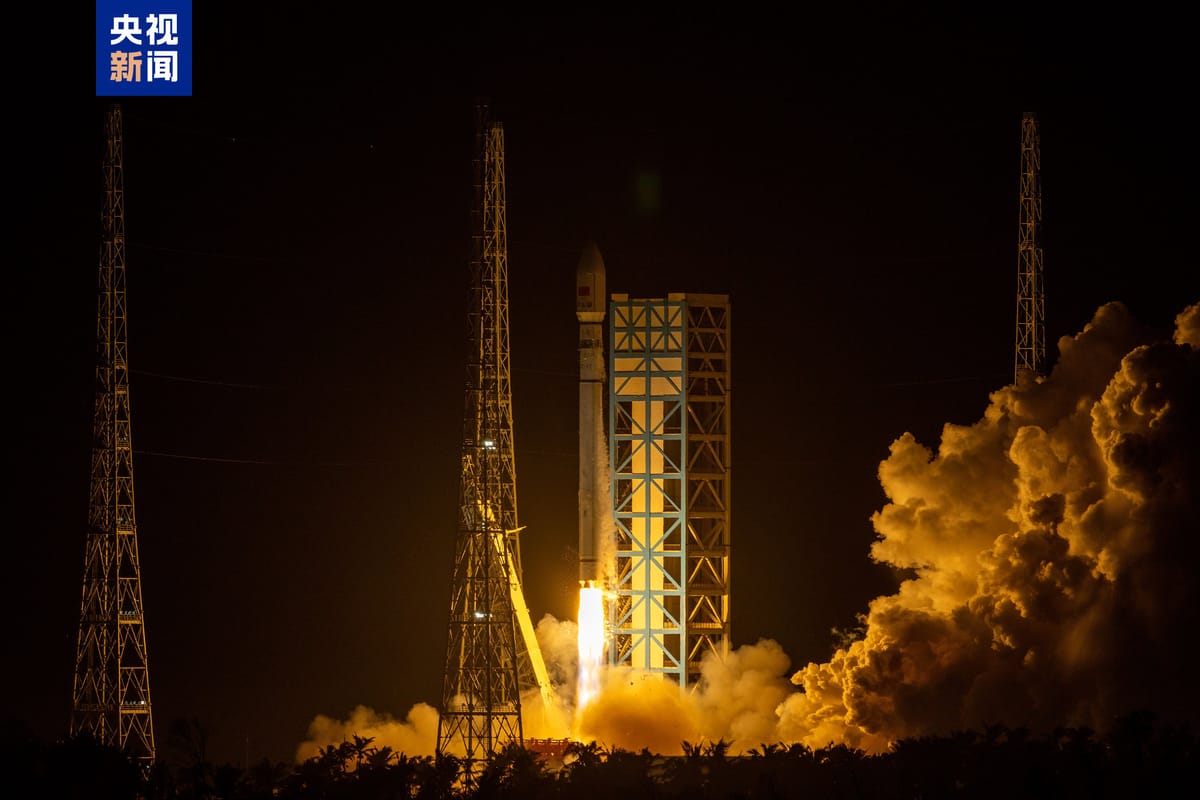
The maiden flight of China’s Chang Zheng 12A (Long March 12A) rocket highlights a pivotal shift toward a hybrid manufacturing model, signaling that the nation's projected demand for thousands of annual satellite launches will act as a powerful catalyst for the entire upstream aerospace supply chain. This structural evolution is poised to offer exponential growth potential for component and material suppliers well beyond the primary launch providers.
The rocket, developed by the state-owned China Aerospace Science and Technology Corp. (CASC) in collaboration with private suppliers, conducted its test flight on Wednesday at the Dongfeng Commercial Aerospace Innovation Pilot Zone. While the mission achieved its primary orbital insertion goals for the second stage, the recovery of the first stage was not fully realized. However, the mission successfully validated the "National Team plus Private Enterprise" strategy, marking the first time a state-developed rocket has utilized main engines procured from the commercial sector.
Investors are currently looking beyond immediate technical hurdles, focusing instead on the long-term industrial implications. The integration of private firms like Jiuzhou Cloud Arrow Space Technology into top-tier state projects suggests a broadening revenue pool for manufacturers of engines, advanced materials, and high-end manufacturing segments. This collaboration combines the technical depth of state-owned enterprises (SOEs) with the cost-efficiency of the private sector.
Market participants emphasize that the sheer scale of China's satellite network expansion—projected to exceed 1,000 units annually—will create a "strong pull" effect across the industrial base. According to Jiang Chun, a partner at Puhua Capital, this demand trajectory creates a growth potential of more than ten-fold for upstream sectors, suggesting that capital flows will increasingly target the supply chain ecosystem regardless of the pacing of specific recovery technologies.
The Multiplier Effect on Critical Components
The operational logic of the Chinese commercial space sector is shifting from isolated product development to deep supply chain value extraction. The ultimate users, such as satellite network operators like China Satellite Network Group, are driving a requirement volume that necessitates a robust industrial base. Jiang Chun notes that this massive launch demand benefits the entire vertical, from rocket manufacturers to sub-component suppliers and raw material producers.
The Long March 12A mission has already clarified the beneficiaries of this open supply chain. Aside from Jiuzhou Cloud Arrow providing the "Longyun" liquid oxygen-methane engines, the supply network includes Bright Laser Technologies, which utilized 3D printing for core engine components, and Shaanxi Sirui Advanced Materials, which supplied high-strength copper alloys capable of withstanding temperatures exceeding 3,000 degrees Celsius. Additionally, Shanghai Hugong Electric Group handled airframe structure manufacturing.
This broad participation indicates that the capital market’s focus is expanding from system integrators to specialized technology providers who can enter the procurement streams of both state and private launch vehicles.
Hybrid Procurement Model Reduces Costs
The Long March 12A represents a new paradigm in Chinese aerospace: a "mixed development mode." While the Shanghai Academy of Spaceflight Technology (SAST), a subsidiary of CASC, led the overall design and guidance control, the decision to procure engines commercially was strategic.
This model is designed to leverage the "National Team's" systematic engineering and quality control capabilities while exploiting the flexible R&D mechanisms and cost advantages of private enterprises. The rocket achieved a localization rate of no less than 90%. By adopting this approach, the industry aims to lower the cost per kilogram to orbit, a critical metric for the commercial viability of mega-constellations. The acceptance of the "basic success" of the flight test—despite the recovery anomaly—further suggests a pragmatic approach to iterative development, prioritizing data accumulation and supply chain validation over absolute initial perfection.
Technical Differentiation and Competition
The global reusable rocket market remains dominated by the Falcon 9 from Space Exploration Technologies Corp. (SpaceX), but the Long March 12A attempts to carve a niche through different technical choices. Unlike the Falcon 9’s kerosene-based propulsion, the Chinese vehicle utilizes liquid oxygen and methane, a fuel combination that reduces soot accumulation and theoretically supports easier reuse—targeting up to 50 flights per booster.
This places the Long March 12A in competition not only with US counterparts but also with domestic private options like the Zhuque-3 from LandSpace Technology. While the Falcon 9 relies often on sea-based recovery, the Long March 12A is optimized for inland launch sites with a land-based recovery profile, addressing China’s specific geographical infrastructure. The growing diversity of technical routes—ranging from heavy-lift methane rockets to medium-lift solid variants—ensures that the upstream supply chain remains resilient, as suppliers are not dependent on a single technical architecture.
Accelerating Launch Pipeline for 2026
The competition to secure launch contracts is expected to intensify rapidly. Following the Long March 12A, at least four types of reusable rockets are scheduled for maiden flights starting in 2026. This includes the Long March 10 series (CZ-10B), which is expected to be flight-ready by April 2026, targeting medium-lift reusability from the Hainan Commercial Aerospace Launch Site.
Simultaneously, private players are advancing their timelines. Galactic Energy Space Technology has completed ground tests for its Pallas-1 (Zhishenxing-1) liquid rocket and is preparing for a launch before the Lunar New Year. With multiple reusable models entering the validation phase, the demand for standardized, mass-produced aerospace components is set to surge, reinforcing the investment thesis that the supply chain holds the most certain growth trajectory in the sector.