
Chinese AI Apps Gain Global Traction as GenAI Market Shifts to Action and Regionalization
Chinese generative AI applications have emerged as major players in the global market, with DeepSeek ranking fourth in a top 100 GenAI consumer apps list, marking a collective rise of China's AI tools in the global application layer as competition shifts from basic chat functions to actionable AI agents and regional ecosystem building.
Venture capital firm a16z released its sixth “Top 100 Generative AI Consumer Apps” ranking on March 9, based on SimilarWeb web traffic and SensorTower mobile monthly active users (MAU). ChatGPT retains an unassailable lead with 900 million weekly active users, but multiple Chinese AI products including DeepSeek, Kimi, Qwen and Kling AI have broken into the top 50, showcasing China's growing competitiveness in AI product engineering and commercialization.
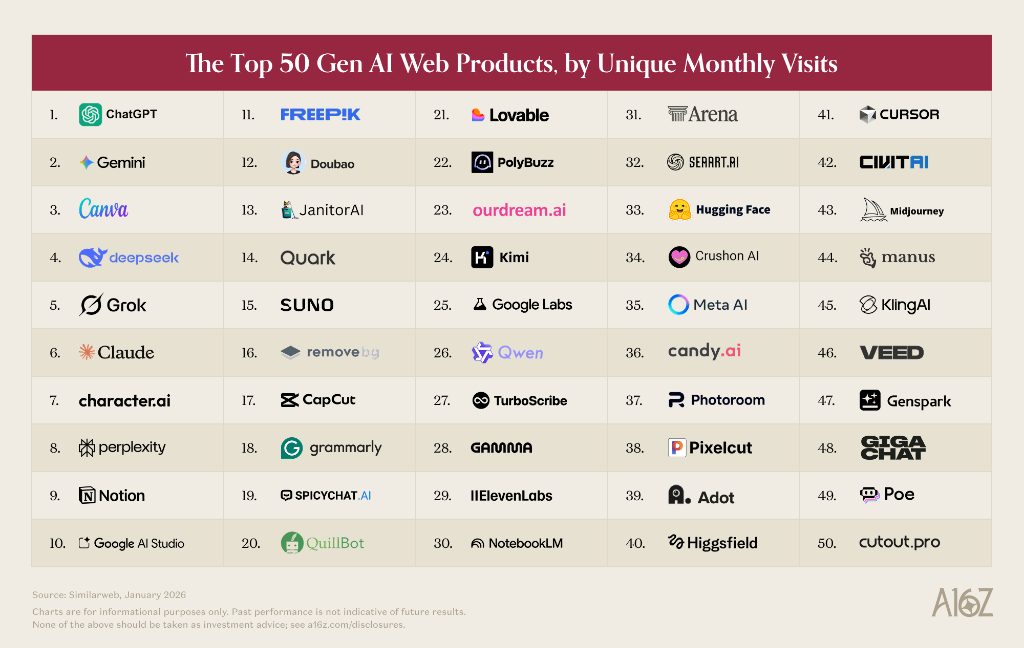
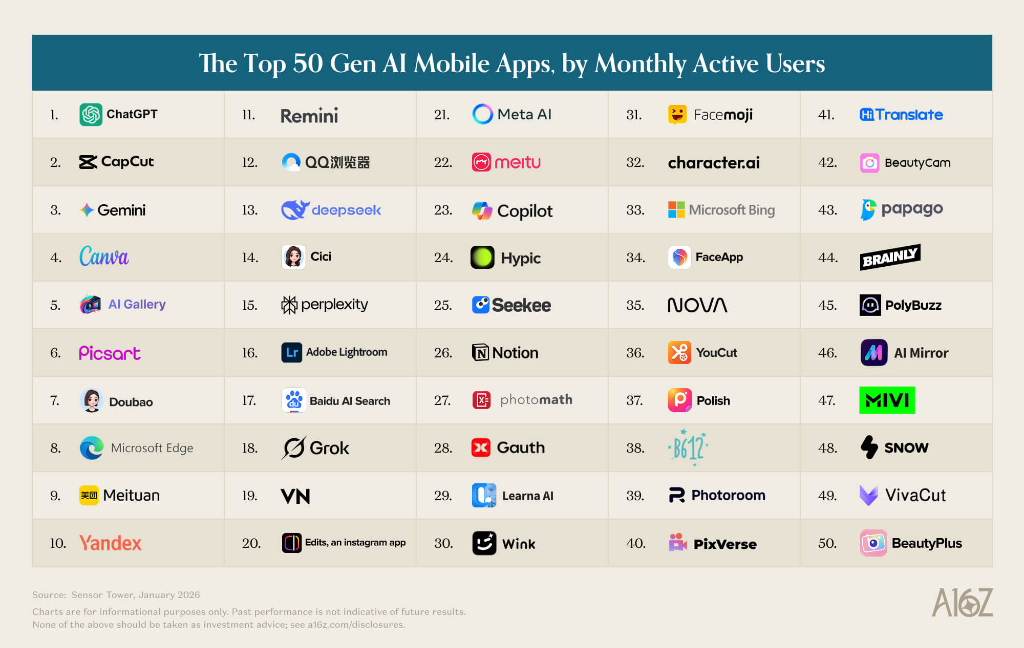
DeepSeek stands out as the highest-ranked Chinese AI app, claiming fourth place in the web category with a geographically diverse user base: 33.5% from China, 7.1% from Russia and 6.6% from the U.S. Other Chinese tools, including ByteDance's Doubao and CapCut, Alibaba Group Holding's Qwen and Kuaishou Technology's Kling AI, feature prominently in both web and mobile rankings, forming a cohesive Chinese contingent in global AI traffic.
The report also highlights two pivotal industry trends: the rise of AI Agent tools typified by OpenClaw, which redefines AI from conversational to actionable,and the shift from image generation to video and voice tools as the fastest-growing GenAI segment. Additionally, the global AI market has evolved into three distinct regional ecosystems, mirroring the early mobile internet era and creating new dynamics for investors and developers.
China's AI Collective Breakthrough in Global Rankings
China's AI developers have solidified their global presence with multiple products landing in a16z's top 50 web and mobile GenAI rankings, a milestone that underscores the country's strengths in rapid product iteration and overseas expansion.
In the web top 50, Chinese-backed products include DeepSeek, Kimi (Moon Shadow), Qwen (Alibaba's ERNIE Bot), Kling AI (Kuaishou's AI video tool) and Manus, an AI agent by Chinese team Monica. On mobile, Doubao, Baidu's AI Search and Tencent Holdings's QQ Browser are among the Chinese entries, with industry analysts framing the list as a successful "overseas battle report" for China's AI sector.
DeepSeek's fourth-place web ranking is the most notable achievement, its diversified user base reflecting effective overseas market penetration—a key goal for Chinese tech firms looking beyond domestic borders. China's AI advantage lies in its ability to translate technical capabilities into market-ready products quickly, with video generation tools like Kling AI leading in global performance and productivity-focused AI agents gaining traction for practical utility. This niche differentiation has allowed Chinese products to carve out market share amid competition from U.S. tech giants.
ChatGPT's Dominance Remains, But Competition Heats Up
ChatGPT remains the undisputed global GenAI leader, with user scale approaching major internet platforms, but the battle for the "default AI entry point" is intensifying as rivals gain traction, creating new competitive dynamics for the industry.
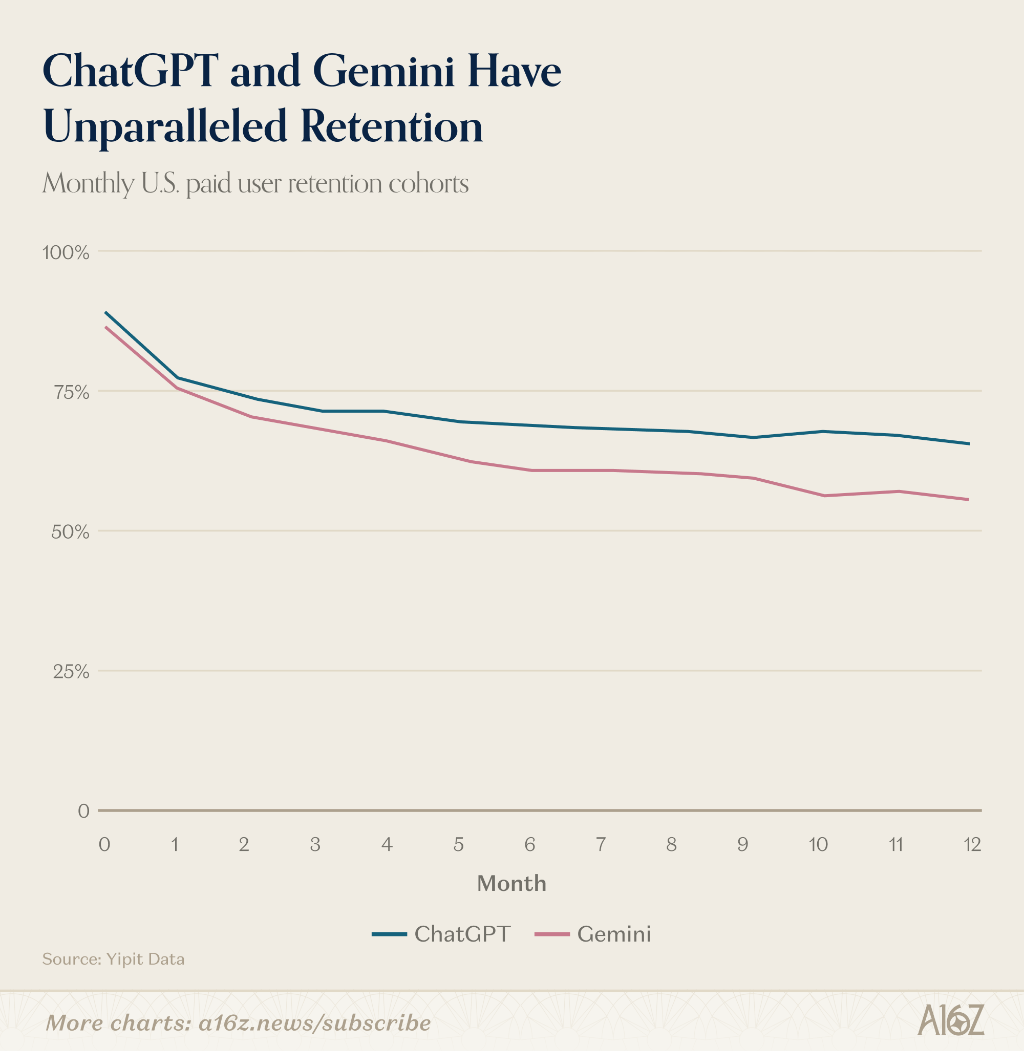
Data from the report underscores ChatGPT's massive lead: its web traffic is 2.7 times that of Google's Gemini, mobile MAU 2.5 times higher, and it boasts superior user retention with higher daily active user-to-MAU ratios, more daily sessions and longer session times than competitors. Yet competition is mounting rapidly: Anthropic's Claude saw paid user growth of over 200% year-on-year, while Gemini's paid user base surged 258%. Around 20% of ChatGPT users also access Gemini weekly, indicating low user loyalty and a willingness to switch for better functionality.
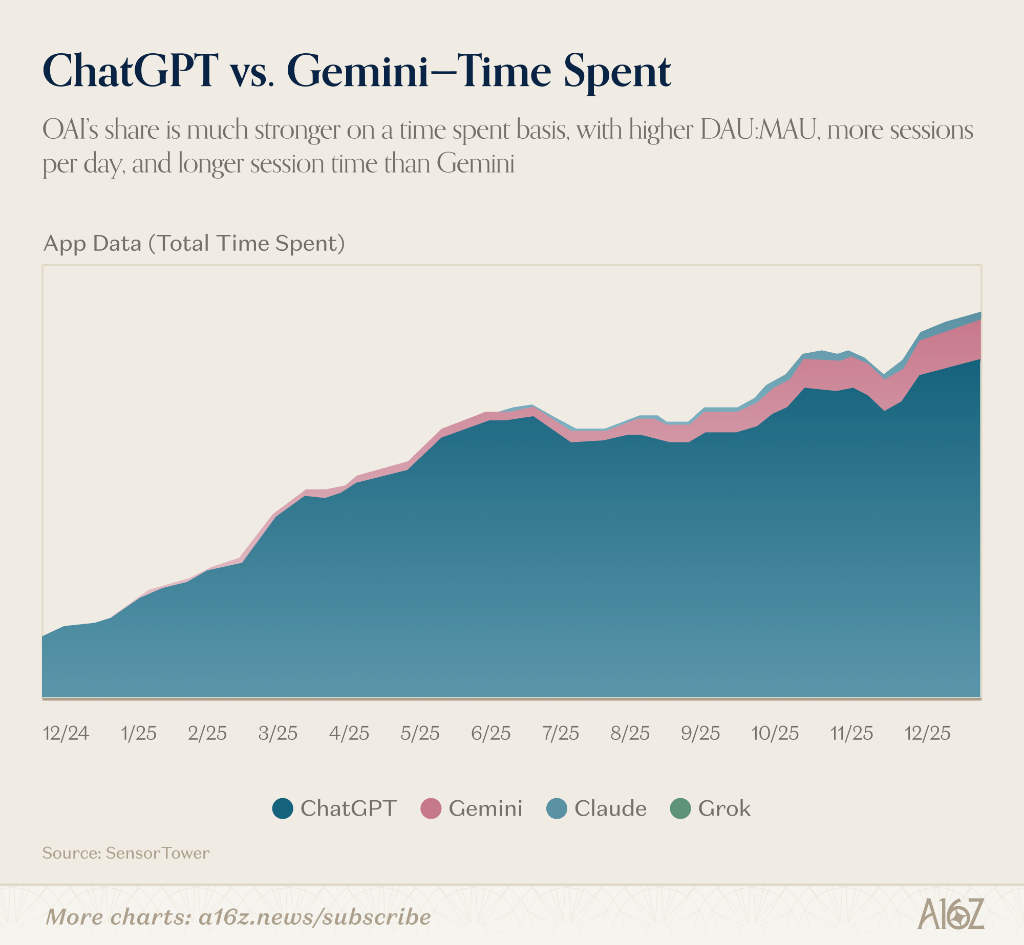
Top players are adopting distinct strategies to capture the default AI entry point. OpenAI is expanding ChatGPT's consumer use cases, testing an advertising model and planning a "ChatGPT Login" identity system to turn it into a unified internet service entry. Anthropic, by contrast, focuses on professional users, integrating its tools with development and enterprise data platforms and launching Claude Code to attract developers and knowledge workers. a16z notes this structure is set to mirror the mobile operating system ecosystem, with platforms building loyal user bases around specific use cases and demographics.
AI Agents and Video Generation: New GenAI Growth Drivers
The a16z report identifies AI Agent tools and video/voice generation as the two fastest-growing GenAI segments, redefining product development priorities and investment trends in the global market.
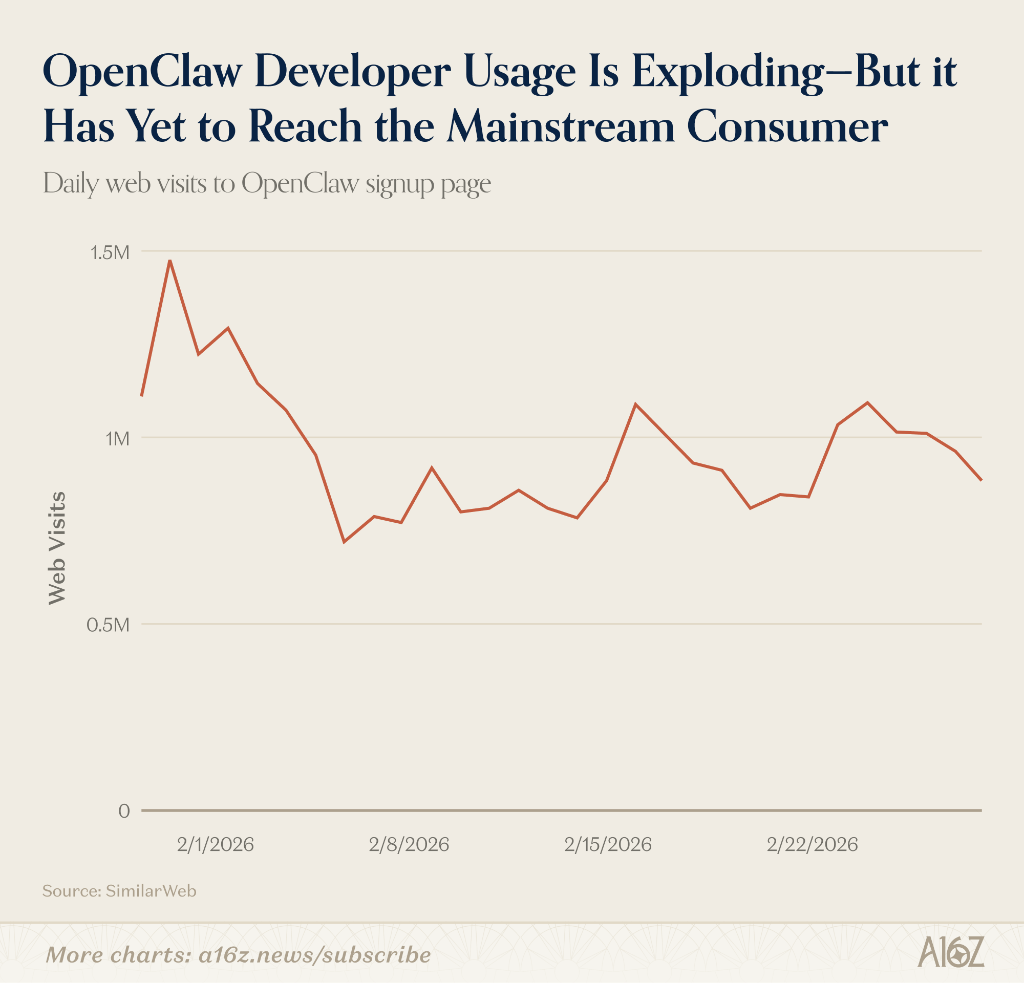
OpenClaw, an open-source AI Agent project by Austrian developer Peter Steinberger, has emerged as a game-changer, with a16z stating: "If ChatGPT introduced users to conversational AI, OpenClaw introduced them to actionable AI." The locally-run system lets users connect to WhatsApp, Telegram and Signal to assign multi-step tasks like data collection and processing, earning 68,000 GitHub stars in weeks and becoming one of the platform's most popular projects before OpenAI's acquisition in February 2026. While it currently caters to technical users due to Terminal deployment requirements, its rapid rise signals strong market demand for task-executing AI, not just conversational tools.
Video and voice generation have overtaken image generation as the top growth drivers, with Chinese-developed tools leading in quality and user growth. Kling AI, Hailuo and Pixverse are among the video products seeing surging traffic, showcasing China's strengths in this segment. Additionally, AI is increasingly becoming a core feature of traditional software rather than a standalone product: ByteDance's CapCut has 736 million MAU, while Notion's AI feature paid adoption rate has jumped from 20% to over 50%, highlighting GenAI's integration into everyday tools as a key industry shift.
Global AI Market Splits Into Three Regional Ecosystems
The global GenAI market has evolved into three distinct, relatively independent regional ecosystems, a structural shift mirroring the early mobile internet era that is reshaping global competition and investment strategies, according to a16z.
The U.S.-Europe ecosystem is dominated by ChatGPT, Gemini, Claude and Perplexity, with core users in the U.S., India, Brazil, the UK and Indonesia. China's ecosystem is a closed loop shaped by data compliance and local deployment rules, with Doubao, DeepSeek and Kimi as leading products. Russia's ecosystem has seen rapid growth of local AI tools amid technical sanctions, with Yandex Browser—integrated with an AI assistant—boasting 71 million mobile MAU.
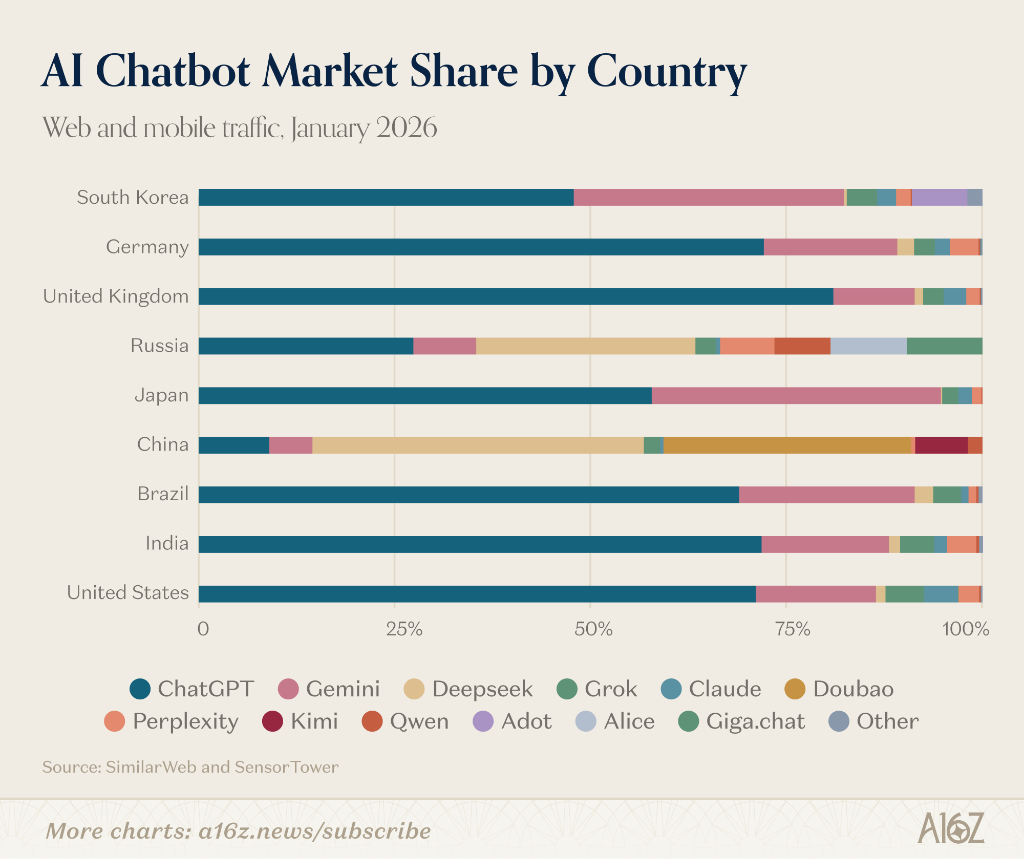
This regionalization is a critical development for investors, as AI success now hinges on local adaptation rather than a one-size-fits-all global strategy. For Chinese AI firms, the domestic ecosystem provides a stable innovation base, while overseas expansion requires tailoring products to regional user needs and regulatory frameworks—a challenge DeepSeek's diverse user base shows is surmountable with targeted development. For global giants like OpenAI and Google, the split means competing in China requires local partnerships or regulatory compliance, while Russian and emerging market ecosystems offer new growth opportunities for adaptive developers. a16z notes this regional structure is set to persist, with each market developing unique technical platforms and user preferences that will shape the GenAI industry for years to come.