
Chinese Researchers Develop Centaur-Style Wearable Robot, Promising New Solutions for Heavy-Load Operations
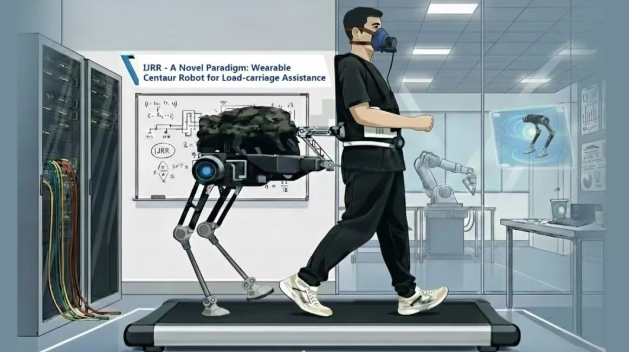
A research team from the Southern University of Science and Technology has developed an innovative wearable centaur robot designed to assist with load-carriage walking, presenting a significant technological shift in the wearable robotics sector.
The newly developed system functions as an independent mechanical structure connected to the user's back, significantly reducing the physical toll of carrying heavy weights. Experimental data indicates that the robot reduces the human metabolic cost of walking by up to 35% and decreases plantar pressure by 52% when carrying a 20-kilogram load.
By establishing a human-machine hybrid quadruped system, the technology bypasses the structural inefficiencies of traditional human-shaped exoskeletons. This advancement is positioned to influence the commercial robotics market, offering new operational capabilities for emergency rescue, outdoor exploration, and complex terrain logistics.
The research findings, titled "Design, Modeling, Control, and Evaluation of a Wearable Centaur Robot for Load-carriage Walking Assistance," were recently published in the International Journal of Robotics Research (IJRR). The study was led by Professor Fu Chenglong from the university's Department of Mechanical and Energy Engineering.
Breaking Traditional Exoskeleton Paradigms
The centaur robot challenges the conventional concept that wearable exoskeletons must strictly follow a humanoid form. Traditional exoskeletons often suffer from low assistance efficiency due to the large angle between the directional force provided and the human's forward movement. Compared to standard backpack carrying, conventional exoskeletons typically reduce the human metabolic rate by only about 10%.
In contrast, the new system draws structural inspiration from quadruped animals. Rather than rigidly attaching to human legs, the robot operates as an independent entity connected to the user via a wearable elastic coupling interface. This configuration creates a collaborative model where the human operator is responsible for environmental perception and navigation, while the robot bears the weight load and provides efficient forward propulsion.
Core Technology and Dynamic Performance
To address the complex dynamic coupling between human and machine, the research team engineered a "softened elastic coupling mechanism" utilizing rhombic linkages and antagonistic springs. This mechanism features nonlinear stiffness—providing high stiffness and quick response under minor forces, while offering low stiffness and strong shock absorption under heavy forces. This allows the robot to be controlled stably as an independent unit while accurately delivering assistance.
Supported by a "Loco-interaction" collaborative control framework, the centaur robot perceives human movement intentions in real-time. It achieves high-precision, omnidirectional following without the need for manual commands. During maneuverability tests, the robot demonstrated advanced terrain adaptability, utilizing visual perception to autonomously plan routes across stairs, slopes, and complex outdoor surfaces. It also successfully navigated a figure-eight course within a narrow one-meter space. Gait analysis confirmed that the system significantly improves lateral stability during heavy-load walking, showing no significant difference from walking unburdened.
Application Prospects and Industry Impact
From an industry perspective, the centaur robot expands the design boundaries for load-carrying assistance devices. By actively compensating for the propulsion work required during load-bearing tasks, the system enhances both operational efficiency and sustainability.
The technology targets practical applications in emergency rescue, material transport, field inspection, and logistical support in unstructured environments. By combining human decision-making advantages with the load-bearing and ground-interaction capabilities of legged robots, it provides a new approach for operations in challenging terrains.
The research was backed by multiple funding sources, including the National Natural Science Foundation of China, the Ministry of Education, the Science, Technology and Innovation Bureau of Shenzhen Municipality, and special funds from the university. Doctoral students Tu Zhixin and Jiang Yihao served as co-first authors of the paper, with Fu Chenglong as the sole corresponding author.