
Chinese AI Models Dominate OpenRouter Rankings for 11 Weeks, Outpacing U.S. Rivals 4-to-1
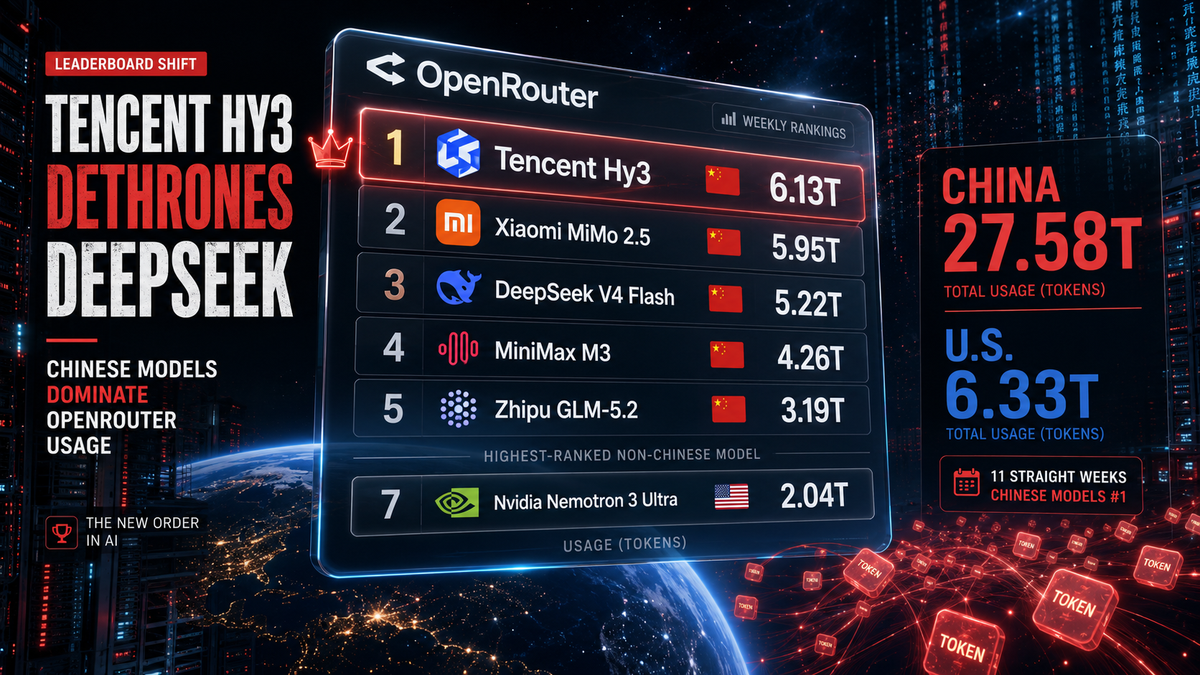
Chinese large language models now account for more than half of all global API traffic on OpenRouter, the world's largest AI model-routing platform, with weekly token consumption hitting 27.58 trillion in the seven days ended July 12—more than four times the U.S. figure—as American enterprises quietly shift billions of tokens of workload to Chinese providers.
The data, compiled from OpenRouter's weekly usage statistics and reported by China's National Business Daily on July 13, 2026, marks the eleventh consecutive week in which Chinese models have outpaced their American counterparts on the platform. More striking than the streak itself is the trajectory: the gap is widening, not narrowing. China's 27.58 trillion tokens dwarfed the U.S. tally of 6.33 trillion, a ratio that would have been unthinkable twelve months ago.
For investors tracking the global AI infrastructure stack, the OpenRouter leaderboard functions as a real-time revenue proxy. Every token routed through the platform represents a billable API call tied to a live commercial workload—a customer-service bot, an autonomous coding agent, or an enterprise data-analysis pipeline. The week's numbers therefore reflect genuine developer spending, not benchmark performance or marketing claims.
Tencent Hy3 Dethrones DeepSeek, Reshaping the Domestic Pecking Order
Tencent Hy3 (free tier) seized the top spot with 6.13 trillion tokens, ending a seven-week winning streak by DeepSeek-V4-Flash. The timing is deliberate: Tencent officially launched the full production version of Hy3 on July 6, 2026. The model employs a Mixture-of-Experts (MoE) architecture with 295 billion total parameters and 21 billion activated parameters, supports a 256,000-token context window, and integrates a hybrid fast-slow reasoning design. Tencent positions Hy3 as matching the capability of models two to five times its activated parameter count—a claim the OpenRouter traffic data appears to validate.
Xiaomi MiMo-V2.5 held second place at 5.95 trillion tokens, a 36% week-on-week surge that extends its four-week run in the runner-up slot. DeepSeek-V4-Flash slipped to third at 5.22 trillion. MiniMax M3 ranked fourth at 4.26 trillion, while Zhipu AI GLM-5.2 rounded out the top five at 3.19 trillion, up 24% week-on-week. The highest-ranked non-Chinese model was Nvidia Nemotron 3 Ultra, debuting at eighth place with 2.04 trillion tokens—less than one-third of Hy3's volume.
Nvidia's entry into the top ten is itself a data point worth monitoring. Nemotron 3 Ultra recorded the highest accuracy among open-source models in LangChain's deep-agent benchmark, at an inference cost roughly one-tenth that of leading closed-source rivals. Its appearance signals that U.S. chipmakers are competing not just in silicon but increasingly in the model layer—though its debut ranking suggests the gap remains substantial.
U.S. Enterprises Accelerate Adoption, Reversing a Year-Ago Baseline
The most structurally significant finding in the dataset is not the aggregate volume but its origin. Since February 8, 2026, American enterprises have consistently directed more than 30% of their OpenRouter token consumption toward Chinese models, with a peak reading of 46%. In the first half of 2025, that share stood at 4.5%.
A tenfold increase in less than twelve months constitutes a procurement shift, not a trial experiment.
Kyle Chan, a researcher at the Brookings Institution, attributes the rotation to a straightforward cost-performance calculation: Chinese models typically price at a fraction of comparable U.S. offerings while operating within roughly six to nine months of frontier capability. DeepSeek's input cost of RMB 0.02 (approximately US$0.003) per million tokens is, by the source data's own arithmetic, approximately 1/170th the cost of GPT-5.5. At enterprise scale—where token volumes run into the billions per month—that differential is not a preference; it is a budget constraint.
Hu Yanping, a distinguished professor at Shanghai University of Finance and Economics, identifies two additional enterprise decision criteria beyond raw capability: price-performance ratio and suitability for agentic workflows, including tool-calling and Model Context Protocol (MCP) orchestration. Both criteria currently favor Chinese providers.
Agent Supercycle Amplifies Token Demand, Favoring High-Volume, Low-Cost Models
The broader market context reinforces the structural argument. Industry observers have characterized 2026 as the inflection year for AI agents—autonomous, multi-step systems that consume hundreds or thousands of times more tokens per task than single-turn question-answering. Code generation, automated infrastructure management, intelligent customer service, and real-time data analytics are all token-intensive workloads that scale non-linearly with deployment breadth.
Chinese model providers have optimized specifically for these scenarios. MoE architectures reduce per-token inference cost without proportional capability loss. KV cache compression and speculative decoding further lower the marginal cost of long-context, multi-turn agent sessions. The result is a cost structure that becomes more advantageous—not less—as enterprise AI deployment matures from pilot to production.
The competitive dynamics within China's own model market compound this effect. Unlike the U.S. landscape, which is dominated by a small number of closed-source providers, China's frontier model tier features active competition among DeepSeek, Tencent Hy3, Xiaomi MiMo, Zhipu GLM, Stepfun Step 3.7 Flash, and MiniMax M3. Price and performance competition among these providers is continuous and visible in weekly ranking shifts—a dynamic that benefits enterprise buyers globally.
Data Flywheel Effect Raises the Stakes for Long-Term Market Structure
Eleven consecutive weeks of leadership is sufficient to trigger what technologists call a data flywheel: higher call volumes generate richer inference feedback, feedback accelerates model fine-tuning, improved models attract incremental adoption, and incremental adoption drives further volume. Once established at scale, this feedback loop is historically difficult for late-entrant competitors to interrupt.
The risk factors are real but bounded. U.S. frontier models—including OpenAI's GPT-5.6 and Google's Gemini 3 Pro—retain measurable advantages in high-complexity, multi-domain reasoning tasks. A significant price reduction by U.S. providers, or a supply-side constraint on Chinese inference capacity, could alter the trajectory. The 6-to-9-month capability gap cited by Brookings remains a ceiling on Chinese models' penetration of the most demanding enterprise use cases.
Nevertheless, the direction of travel is unambiguous. In February 2026, Chinese models first crossed the threshold. By July 2026, they command a 4-to-1 volume advantage on the world's largest neutral routing platform, with American enterprises themselves accounting for a rising share of that demand. The OpenRouter leaderboard has become the AI industry's most credible weekly referendum on where the global developer community is allocating real capital—and for eleven weeks running, that referendum has returned the same verdict.
Related Coverage:
DeepSeek Tops Global AI Model Usage Rankings as China’s Token Consumption Surges