
China’s EV Trio Hits $12B — Three Paths, Three Playbooks
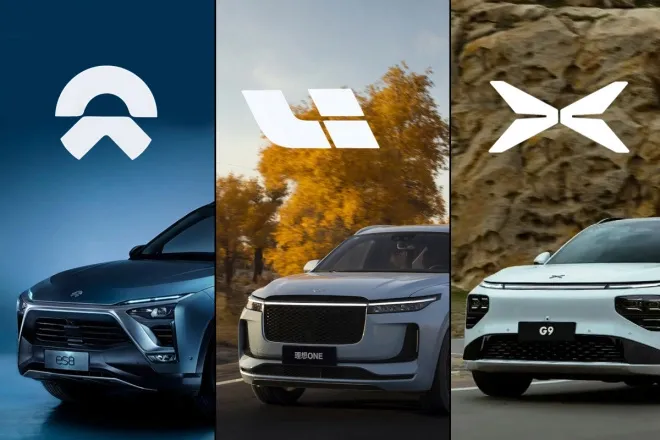
Three companies that once traded at multiples of each other have arrived at the same market capitalization — not as a triumph, but as a shared reckoning with a maturing, brutally competitive industry.
As of the July 10 U.S. equity close, XPeng traded at approximately $12.5 billion, Li Auto at $12.2 billion, and NIO at $12.0 billion — a convergence that would have seemed statistically improbable just three years ago. The clustering is less a coincidence than a verdict: capital markets have repriced China's pure-play EV sector from high-growth tech to capital-intensive automotive, compressing valuations across the board regardless of individual narrative. All three remain more than 60% below their respective all-time highs, with NIO down over 85% from its peak of nearly $100 billion.
The convergence arrives as China's new energy vehicle penetration rate surpasses 60%, stripping the sector of the scarcity premium that once justified technology-stock multiples. Rivals including BYD and Geely have further crowded the field, while Leapmotor competes aggressively on price. The blue ocean has become a red one.
Li Auto's Profitability Edge Erodes Under the Weight of a Failed Pivot
Li Auto's investment thesis was always the simplest to underwrite: it made money. In Q4 2020, the company became the first of the three to post a quarterly profit — Non-GAAP net income of approximately RMB 120 million (US$16.7 million) — on the back of the Li ONE extended-range SUV and tight cost discipline. By 2023, the L9, L8, and L7 SUV lineup drove deliveries to 376,000 units, net profit to RMB 11.81 billion (US$1.64 billion), and vehicle gross margin above Tesla's. Market capitalization touched RMB 470 billion (US$47 billion equivalent), exceeding the combined value of NIO and XPeng at the time.
Four days after that earnings release, the MEGA — a RMB 560,000 (US$77,800) pure-electric MPV — launched to a hostile market reception. Design controversy suppressed monthly sales to the hundreds of units. Within five trading sessions, Li Auto shed over $10 billion in market value.
The subsequent two years produced a pattern of partial recovery and relapse. The L6 sedan propped up 2024 volumes at a lower price point; the i8, aesthetically reminiscent of the failed MEGA, met a similar fate; only the i6 finally delivered Li Auto's first pure-EV mass-market hit. But the damage to the financial profile was severe: 2025 revenue fell 22.3% year-on-year, while net profit collapsed from RMB 8 billion to RMB 1.1 billion (US$153 million), a decline exceeding 85%. The company's ambitious target of 1.6 million deliveries in 2025 went unmet by roughly 75%.
In response, Li Auto has pivoted its investor narrative toward AI and embodied intelligence — developing the in-car large language model MindGPT, AI glasses branded Livis, a proprietary autonomous driving chip "Mahe M100," and the StarRing OS. The refreshed L9 is now marketed as an "automotive robot." Management has set a Q4 2026 target to match Tesla's FSD V14 on integrated autonomous driving capability. Capital markets, however, remain skeptical: the AI story lacks near-term revenue contribution, and at least eight senior executives overseeing smart driving, chip, and product functions have departed over the past year — precisely the personnel needed to execute the transition.
XPeng Trades as a Technology Option, But Cash Flow Remains the Constraint
If Li Auto's valuation is anchored to a profit-and-loss statement, XPeng's is priced as an option on autonomous driving and robotics — a premium that has historically proven both rewarding and treacherous.
XPeng listed on the New York Stock Exchange in August 2020 in what was then the world's largest EV IPO, reaching $50 billion within three months. The company has consistently been the most Tesla-like of the three: earliest to pursue full-stack in-house development, earliest to commercialize advanced driver assistance, and earliest to commit capital to Robotaxi and humanoid robotics. Its first production Robotaxi fleet is scheduled to begin passenger operations in H2 2026; humanoid robot IRON — whose walking gait was so lifelike at its November 2025 debut that observers questioned whether a human performer was involved — is targeted for Q4 2026 mass production.
The credibility of XPeng's technology narrative is grounded in demonstrated progress rather than mere aspiration, which differentiates it from many peers. But that narrative nearly collapsed entirely. The 2022 launch failure of the flagship G9 SUV triggered organizational upheaval, and by early 2023 the stock had fallen over 80%, with market cap below $10 billion — the steepest drawdown among the three.
Recovery came from two catalysts. First, Volkswagen AG's equity investment and technology licensing agreement — announced in mid-2023 — sent shares up 26.7% in a single session, with subsequent disclosure of collaboration details generating incremental 3%-5% moves. Second, the acquisition of the MONA vehicle platform from Didi Global and the subsequent launch of the MONA M03 — which delivered over 10,000 units monthly for 11 consecutive months — rebuilt the revenue base. XPeng's stock rose nearly 300% in the six months following the M03 launch, pushing market cap above $20 billion.
At its November 2025 AI Day, XPeng simultaneously announced IRON's debut, Robotaxi commercialization timelines, and Volkswagen as the first external paying customer for its Turing chip and second-generation VLA model. The stock surged over 16% in the following week, reaching approximately $24.9 billion — prompting Morgan Stanley to raise its price target and subsequently name XPeng its top pick in Chinese autos for 2026.
The fundamental picture, however, remains stretched. Vehicle gross margin was 12.8% in 2025, below NIO's 14.6% and Li Auto's 17.9%. XPeng returned to a net loss in Q1 2026 after a brief profitable quarter in Q4 2025. The entire capital structure — and every ambitious roadmap — remains financially dependent on a single mass-market vehicle priced at RMB 100,000–150,000 (US$13,900–20,800). The recently launched MONA L03, planned for a July 2026 German market debut, represents XPeng's most significant globalization bet to date; 2025 overseas deliveries reached 45,000 units, up 96% year-on-year, against CEO He Xiaopeng's stated target of 1 million annual overseas units by 2030, contributing over 70% of group profit.
NIO Narrows Its Story — and Discovers the Limits of That Strategy
NIO's valuation history is the most volatile of the three. Its peak-to-trough amplitude exceeded $90 billion — equivalent to roughly eight times its current market capitalization. The nadir came in Q2 2019: net loss of RMB 3.29 billion (US$457 million), gross margin of -33.4%, a battery recall crisis, and a market cap of $1.35 billion in October of that year. Analysts openly debated whether the company would survive.
A RMB 7 billion (US$972 million) injection from the Hefei municipal government in April 2020 resolved the liquidity crisis. By early 2021, NIO's market cap had surpassed Ford, BMW, and General Motors, approaching $100 billion — a level none of the three companies has since recovered.
Post-recovery, NIO pursued an expansive multi-business strategy: proprietary battery and semiconductor development, a branded smartphone, European showroom and battery-swap infrastructure buildout, and three distinct vehicle sub-brands. The ambition was coherent in theory; in practice, revenues could not scale fast enough to absorb the overhead. In 2023, NIO delivered 160,000 vehicles — less than half of Li Auto's 376,000. Losses widened. Middle Eastern sovereign capital injected funds twice, but could not arrest the stock's decline. By 2024, NIO's market cap had fallen more than 50% from its prior-year peak.
The strategic response was retrenchment: battery and smartphone projects were discontinued, European expansion was slowed, and organizational structures across three brands were consolidated. Product strategy shifted toward tangible consumer value — larger cabins, premium in-car amenities — a playbook borrowed directly from Li Auto. The Onvo L90 and third-generation ES8 six-seat SUVs lifted monthly deliveries from 20,000 to 40,000 units. NIO achieved Non-GAAP net profit of approximately RMB 730 million (US$101 million) in Q4 2025 — fulfilling a public commitment — and returned to profitability again in Q1 2026.
The strategic narrowing has clarified NIO's investment case, but not necessarily improved it. With ancillary businesses stripped away, the company is increasingly valued as a conventional automaker — one required to demonstrate sustained profitability rather than technology optionality. That framework places NIO in an awkward middle position: lacking XPeng's technology-driven valuation premium, while its core automotive fundamentals have historically trailed Li Auto's. Its vision of a premium EV ecosystem built around battery-swap infrastructure and service loyalty remains compelling as a concept; the monetization pathway remains opaque to standard valuation models.
Sector Re-Rating Reflects a Structural Shift, Not Temporary Sentiment
The $12 billion convergence point is analytically significant beyond the symmetry of the numbers. It reflects a structural re-rating of the entire China pure-play EV category — from growth-technology multiples toward automotive-industry multiples — driven by EV penetration exceeding 60%, intensifying domestic competition, and the absence of a clear path to the autonomous-driving monetization that continues to sustain Tesla's valuation at approximately 10 times its 2020 level.
Tesla Inc.'s current market capitalization is supported not by vehicle delivery volumes but by Robotaxi commercialization progress, Full Self-Driving subscription metrics, and Optimus humanoid robot production expectations. All three Chinese EV makers are attempting a version of the same narrative migration — from car companies to AI-and-robotics platforms. XPeng is furthest along in demonstrated technical progress; Li Auto is investing heavily but faces execution credibility questions; NIO has yet to articulate a technology story that capital markets can price.
The road narrows from here. For all three, the critical variable in H2 2026 is whether robotics and autonomous driving milestones translate from announcement to revenue — or whether the $12 billion floor proves to be a ceiling.
Related Coverage:
NIO, Xpeng, Li Auto Abandon Auto Identity to Claim Next Computing Platform