
LimX Dynamics Races Toward IPO After Pulling $400M in Six Months, Valuation Hits RMB 15B
Global capital — from Abu Dhabi to Silicon Valley — is crowding into the Pre-IPO round of a humanoid robotics company that filed for corporate restructuring in March, signaling the sector's sharpest financing inflection point yet.
LimX Dynamics, the Shenzhen-based general-purpose humanoid robot developer, has closed a Pre-IPO funding round of nearly $200 million, pushing its total capital raised over the past six months to approximately $400 million and its post-money valuation to RMB 15 billion (US$2.08 billion), according to an announcement on July 14, 2026.
The round's composition is the headline: roughly 70% of the capital originated from overseas institutions, including Abu Dhabi-based Stone Venture, Silicon Valley fund Huashan Capital, and pan-European conglomerate GGG Group alongside Redstone VC. That cross-border capital structure is rare among Chinese embodied-intelligence startups and carries a direct commercial implication — overseas investors typically open procurement pipelines, not just balance sheets. For a company that already holds thousands of units in overseas backorders, the distinction matters.
Overseas Capital Rewrites the Risk Profile
The investor roster reads like a deliberate supply-chain assembly exercise. IDG Capital anchors the institutional tier, while Lens Technology — the Shenzhen-listed consumer-electronics manufacturer known as the "crown jewel of Chinese manufacturing" and a tier-one supplier to global smartphone brands — brings something no purely financial investor can: precision assembly capability at scale.
Humanoid robots contain roughly 1,000 components per unit. The manufacturing threshold is lower than passenger vehicles, but high-volume delivery, structural aesthetics, and precision integration all demand a mature consumer-electronics supply chain. Lens Technology's entry effectively de-risks LimX's ability to fulfill growing overseas batch orders — a bottleneck that has constrained several Western rivals.
Hefei Binhu Industrial Development Group rounds out the strategic investors, adding municipal-level policy support from one of China's most aggressive robotics-investment cities.
Stone Venture has now backed LimX across multiple consecutive rounds, a pattern that signals conviction beyond passive portfolio construction. Returning shareholders including Oasis Capital, Cornerstone Capital, Nanshan Strategic Emerging Industry Investment, Shangqi Capital, and NIO Capital all exercised over-allotment rights, a technical signal that insider demand exceeded the round's initial allocation.
Three-Layer Architecture Challenges Figure's Helix Playbook
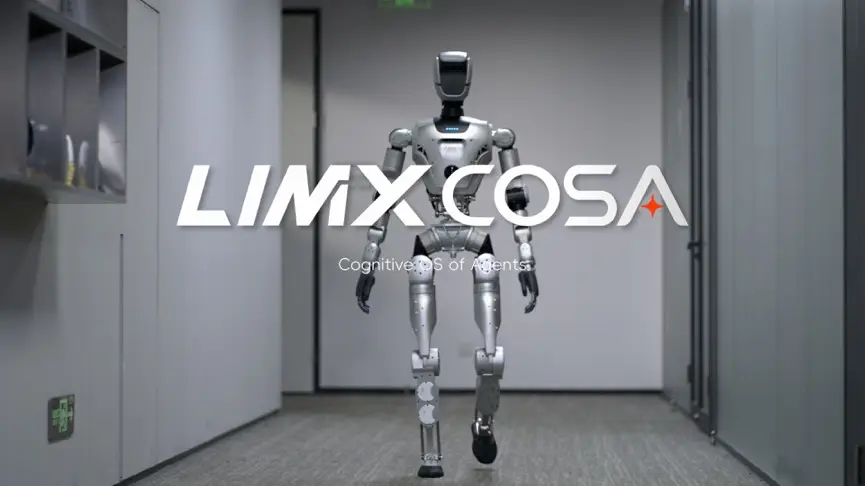
Founded in 2022 by Zhang Wei, a tenured professor at Southern University of Science and Technology who previously held a faculty position at Ohio State University, LimX has built what it calls a full-stack, self-developed three-tier cognitive architecture: System 0 for whole-body motion control, System 1 for VLA/WAM skill execution, and System 2 — branded COSA and released in January 2026 — for high-level cognition and task orchestration.
The architecture invites direct comparison to Figure's Helix 02 system, released the same month, which employs an identical System 0-1-2 labeling convention. The substantive difference is architectural philosophy: Figure's upper layers remain end-to-end model systems; LimX treats models as discrete skills embedded within a broader agentic operating system that integrates cognition, memory, scheduling, and full-body motor control.
The timeline gap is commercially significant. LimX demonstrated integrated cerebellum-cortex locomotion on its full-size humanoid Oli — including stair-climbing at the Guangzhou Tower and autonomous tennis-ball retrieval — as early as 2023. Figure achieved comparable whole-body control only in early 2026, a roughly two-to-three-year lag that LimX's investors are clearly pricing in.
In January 2026, LimX open-sourced its FluxVLA Engine, providing a standardized model training, iteration, and deployment infrastructure to global developers. The move mirrors the platform-first playbook that defined software ecosystems: commoditize the infrastructure layer to accelerate third-party application development and entrench the underlying system as the industry standard.
Commercial Positioning Diverges From Western Peers
LimX's go-to-market strategy is a deliberate counterpoint to the factory-automation thesis championed by Figure and Agility Robotics. Zhang Wei has articulated a "Serve People, Not Process" mandate, targeting commercial services and interactive scenarios as the primary deployment vector, with industrial applications as a secondary channel.
The logic is long-cycle: humanoid robots are ultimately destined for household deployment, and commercial service environments — hotels, retail, healthcare — provide the unstructured, human-proximate training data that factory floors cannot replicate at scale.
Product execution supports the thesis. In May 2026, LimX shipped the LimX Luna, a 160-centimeter, 27-degree-of-freedom interactive humanoid targeting commercial service scenarios; domestic and overseas deliveries commenced within four weeks of launch. The LimX Oli serves as a general-purpose research and developer platform, while the TRON series offers multi-morphology configurations — a single TRON 2 chassis supports dual-arm, biped, and wheeled-biped modes, as well as full quadruped reconfiguration.
Across all product lines, cumulative orders have reached several thousand units, with more than half sourced from overseas clients. Initial shipments of several hundred units have been completed.
IPO Race Tightens as Sector Consolidation Looms
LimX completed its corporate restructuring in March 2026 — a procedural prerequisite for a domestic A-share listing — and sources familiar with the matter indicate the IPO process is advancing on schedule. The company is one of the so-called "Shenzhen Eight", an informal grouping of the city's most-capitalized humanoid robotics ventures.
The IPO calculus has sharpened across the entire sector. Capital markets are increasingly bifurcating the field between companies with stable order books, full-stack technology, and self-sustaining revenue, and those dependent on continuous external funding to maintain prototype-stage operations. Zhang Wei, who has observed multiple technology cycles, frames the current moment as analogous to the GPT-3 inflection — the eve of exponential commercial adoption, where linear extrapolation systematically underestimates long-term scale.
The competitive moat LimX is building is deliberately multi-layered: a differentiated cognitive architecture, a service-first commercial strategy, thousands of overseas batch orders, and now a capital structure dominated by international institutions that provide both market access and manufacturing credibility. Whether that combination proves sufficient to sustain a public-market premium will depend on delivery execution — the one variable no funding round can guarantee.
Related Coverage: