
Chinese AI Researchers Crack Robotics Scaling Bottleneck
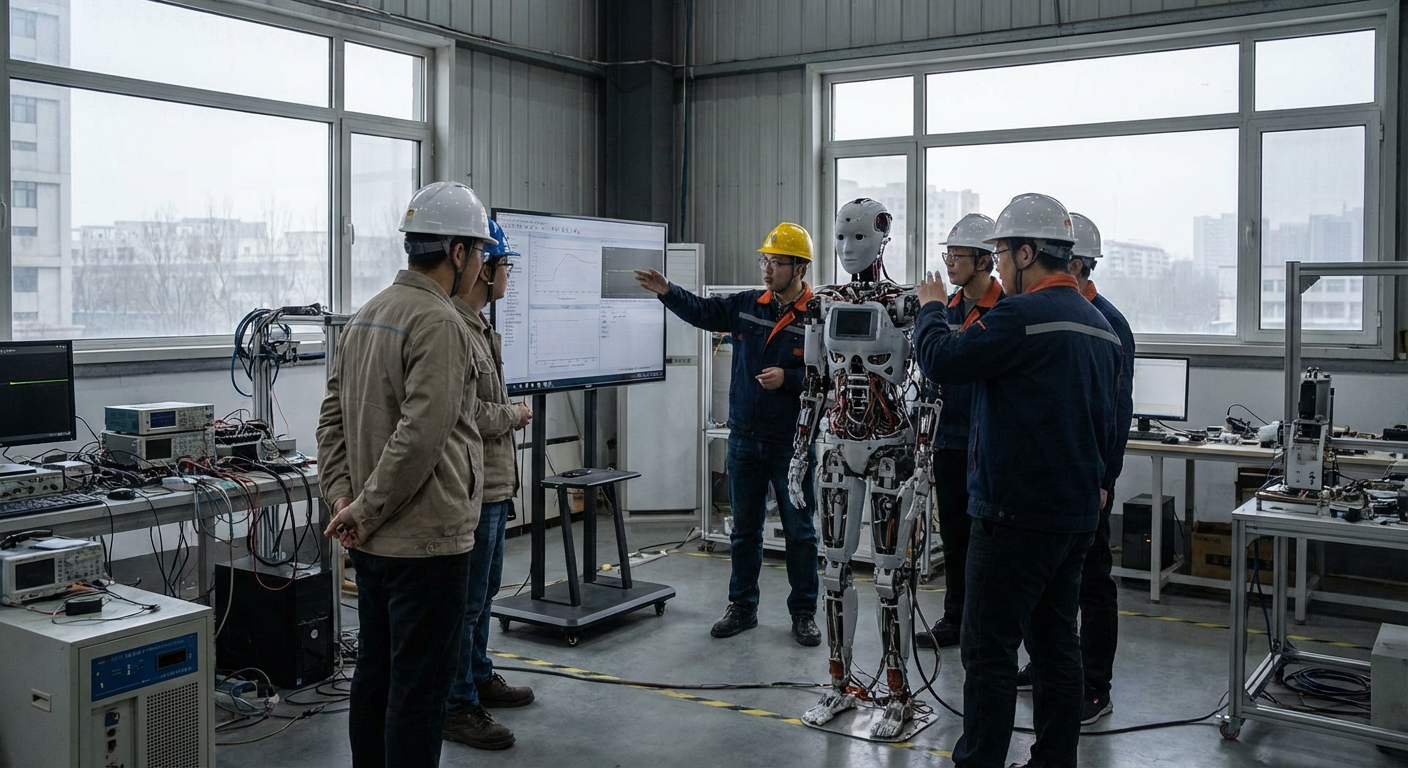
Chinese researchers have unlocked a critical bottleneck in humanoid robot commercialization by training a 1-billion-parameter foundation model on unrefined, "low-quality" data, marking a fundamental industry pivot from rigid behavioral cloning to physics-based world understanding in 2026.
Developed jointly by Peking University and embodied AI startup Galbot, the new Latent World Action Foundation Model, dubbed LDA-1B, disrupts the highly expensive robotics data supply chain. By proving that noisy, unstructured data can actually improve performance rather than degrade it, the breakthrough challenges the industry's reliance on costly, human-teleoperated expert demonstrations.
Early deployment metrics show the model achieves an 80% to 90% success rate in zero-shot grasping tasks across varying robot hardware. More crucially, the incorporation of sub-optimal data into the training pipeline yielded an unexpected 10% performance boost in complex environments, signaling a shift in how embodied AI developers assess data acquisition costs.
Rethinking the Robotics Data Supply Chain
For the past two years, the robotics sector has been constrained by the limitations of behavioral cloning. Under this paradigm, models require highly specific, error-free expert demonstrations. As companies attempt to scale, the cost of acquiring this pristine data—and discarding vast amounts of "non-standard" interaction data—has become financially unviable.
The LDA-1B framework introduces a universal data ingestion mechanism. Paired with a newly standardized dataset named EI-30k, which encompasses over 30,000 hours of heterogeneous inputs, the model simultaneously processes high-quality demonstrations, noisy trajectories, and unannotated first-person human videos.
Instead of filtering out imperfect data, the architecture assigns different functional roles to varying data tiers. High-quality data drives policy learning, while lower-quality trajectories and unannotated videos are utilized to train the model on environmental dynamics and visual prediction.
Shifting from Visual Memorization to Physics Modeling
Traditional robotics models often predict future states directly within the pixel space, causing systems to overfit on visual noise like lighting or background textures rather than physical causality. LDA-1B bypasses this by operating within a structured latent space built on DINO visual features, forcing the model to focus on physical interactions and force feedback.
In 2026 field tests, the model was deployed across diverse hardware profiles, including the Galbot G1 equipped with a 22-degree-of-freedom dexterous hand, and the Unitree G1 featuring a BrainCo prosthetic hand. In complex debris-sorting tasks, LDA-1B achieved a 35% success rate, outperforming existing benchmarks like GR00T-N1.6 and π0.5.
By effectively converting discarded data into a strategic asset for dynamics learning, the Peking University and Galbot collaboration offers a scalable blueprint for the industry. As hardware commoditization accelerates in 2026, software architectures that can extract physical laws from chaotic, real-world data will likely dictate the winners in the commercial robotics race.