
Chinese Automaker Xpeng Skips L3 Autonomous Driving, Bets Directly on L4 Technology
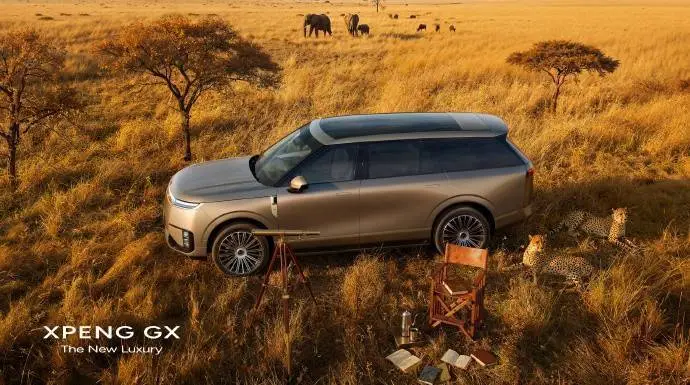
Chinese electric vehicle maker Xpeng is abandoning the intermediate L3 autonomous driving stage, opting instead to leap directly to L4 full self-driving technology—a strategic shift driven by regulatory bottlenecks, mounting development costs, and the pressing need to differentiate in a brutally competitive market where industry profit margins have collapsed to historic lows.
The Guangzhou-based automaker has begun road testing its GX model with L4-level capabilities in February 2026, featuring 3,000 TOPS of computing power and operating without safety drivers. CEO He Xiaopeng has repeatedly stated that both Chinese and American markets will "skip L3 and move directly to L4," dismissing L3 as a "transitional technology trap" constrained by legal liability issues and narrow operational design domains.
The move comes as China's automotive sector faces a profitability crisis. While autonomous driving investment reached 700-750 billion yuan ($97-104 billion) in 2025—up 40% year-on-year—the industry's profit margin has fallen to just 4.1%. For loss-making companies like Xpeng, whose sales plunged 46% month-on-month in January 2026, the choice between L3 and L4 has become a zero-sum resource allocation decision rather than a sequential development path.
However, industry experts question whether skipping L3 is technically feasible or merely a strategic gamble on regulatory timing, as L4 deployment faces its own substantial technical and commercial hurdles.
Regulatory Gridlock Stalls L3 Deployment
L3 autonomous driving systems remain trapped in regulatory limbo despite hardware and software readiness. Voyah, which plans to launch its Taishan Black Warrior SUV in March as "China's first mass-produced L3 SUV," faces the same constraint. "We have the hardware and software ready, just waiting for regulatory approval," a Voyah representative said.
Current regulations limit L3 testing to only two scenarios: urban traffic following and designated highway routes. Only two vehicles—from Deepal and Arcfox—have received road testing permits under these restrictions. According to a test engineer at the National New Energy Vehicle Technology Innovation Center, "the operational design domain for L3 is too narrow for rapid adoption, and expansion requires legislative changes."
This narrow scope undermines the commercial value proposition of L3 systems. Even budget models like BYD's 150,000 yuan vehicles can handle these limited scenarios competently, making it difficult for automakers to justify the premium pricing needed to recoup investments in high-powered computing platforms exceeding 2,000 TOPS.
The safety redundancy requirements compound the cost challenge. L3 systems mandate dual-chip architectures, redundant sensors, dual electronic control units, and backup power systems for critical functions. "You could essentially build two cars from the parts in an L3 vehicle," said a BAIC road test personnel. While this reduces failure probability, it significantly increases production costs—and consumer willingness to pay for safety redundancy remains unproven.
Xpeng's L4 Bet Follows Tesla's Playbook
Xpeng's pivot to L4 rests on two pillars: Tesla's technical validation of camera-only systems and emerging commercial viability of robotaxi operations.
The company's GX model employs a pure vision approach similar to Tesla's Full Self-Driving system, which has begun robotaxi pilot operations in the US with plans to expand to 15 cities by year-end. After testing Tesla's latest V14 model in Silicon Valley, He Xiaopeng said he was "shocked by the capability leap achieved with the same hardware and computing power through large model improvements—a completely different realm that signals a new era."
This software-driven advancement suggests L2 systems could jump directly to L4 capabilities without intermediate hardware upgrades—a cost-efficient path that avoids L3's regulatory quagmire and expensive redundancy requirements.
Commercial L4 trials in China provide the second rationale. Pony.ai has achieved per-vehicle profitability, while Baidu's Apollo Go has turned profitable in Wuhan and Beijing's Yizhuang district. Nine automakers including Changan and NIO have secured L4 testing licenses. A research report projects that by 2035, autonomous commercial vehicles will account for over 80% of capacity, with ride-hailing jobs declining 60%.
Supply chain maturation further enables the L4 push. Lidar costs have dropped substantially, high-computing chips have scaled, and large language models have accelerated development cycles. "Whether in China or the US, L4 advancement is very rapid, and UN traffic regulations expedited L2 and L3 frameworks in late 2025," He said.
Technical and Commercial Obstacles Remain
Industry experts dispute the feasibility of skipping L3 entirely, citing data accumulation requirements and unresolved technical challenges.
"True L4 depends on large-scale L2++ urban navigation-on-autopilot deployment to accumulate data," said Xu Jian, chief ecosystem officer at Horizon Robotics. "When L2++ covers most scenarios and users only take over at edge cases, that experience already matches L3's definition." The implication: L4 requires L3-level data just as L3 requires L2 data—there is no shortcut in the development sequence.
Yi Qiang, former head of Bosch's automotive product line, argues the L3-versus-L4 debate is a "false proposition" from a technical standpoint. "Current SAE classifications divide legal liability, not technical capability. L3 is essentially L4 with a limited operational design domain," he wrote. The distinction is primarily regulatory: L3's human-machine shared control complicates liability and insurance frameworks, while L4's manufacturer-assumes-all-responsibility model simplifies legal implementation.
Xpeng's technical execution faces scrutiny as well. The company delayed its VLA 2.0 system from pre-Spring Festival to March 2026. While VLA 2.0 eliminates the translation step from visual signals to machine language, shortening the perception chain, automotive media outlet Zhiliao Auto questioned pure vision's robustness: "In heavy rain, dense fog, tunnel white-balance transitions, and oncoming high-beam glare, pure vision inherently has lower perception redundancy than lidar solutions."
Unlike Tesla, which has fed extensive shadow-mode data into its models to handle edge cases, Xpeng's data disadvantage raises questions about whether it can achieve L4 reliability through vision and world models alone—or whether the current deployment remains a limited technical validation.
Existing L4 implementations rely heavily on vehicle-to-infrastructure integration. Both Pony.ai and Apollo Go operate within smart city frameworks where lidar-equipped traffic lights and street infrastructure provide cloud-based computing support—hundreds or thousands of times more powerful than onboard systems. Even in these controlled environments, performance gaps persist: during a test ride in Yizhuang, an Apollo Go vehicle dropped this reporter several hundred meters from the requested subway entrance.
Industry Faces Strategic Crossroads
The L3-versus-L4 debate ultimately reflects resource allocation choices rather than pure technical pathways. Automakers are wagering on which regulatory framework will materialize first—and whether consumers will pay premiums for autonomous capabilities before full regulatory clarity emerges.
For Xpeng, with January sales down 46% and continued losses, concentrating resources on L4 offers a clearer narrative than waiting for L3's uncertain regulatory timeline. But the strategy carries substantial execution risk if pure vision systems cannot match lidar-equipped competitors' safety records, or if commercial L4 deployment remains confined to geofenced smart city zones rather than achieving the scalable consumer adoption needed to justify development costs.
As Chinese automakers navigate the narrowing gap between rising R&D expenses and collapsing profit margins, the autonomous driving technology race has become less about sequential capability building and more about strategic bets on regulatory evolution and consumer acceptance—with billions in investment and competitive positioning hanging in the balance.