
Four Chinese Robot Makers Battle for Spotlight at 2026 Spring Festival Gala
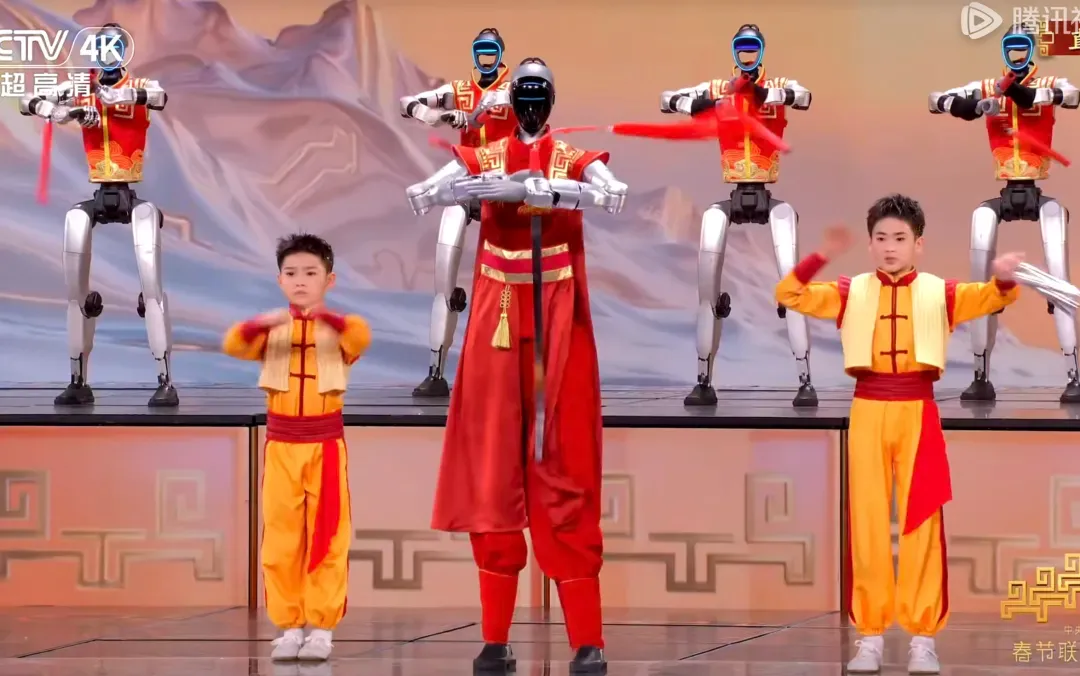
Chinese humanoid robotics companies are racing to capture public attention and investor confidence, with four firms making an unprecedented joint appearance at the 2026 Spring Festival Gala in a high-stakes gamble that could reshape the industry's competitive landscape.
Galaxea AI, Unitree Robotics, Magic Atom, and Fourier Intelligence each paid approximately 100 million yuan ($13.9 million) to secure distinct sponsorship titles for China's most-watched television event, according to media reports. The companies deployed their robots across multiple segments of the gala, demonstrating capabilities ranging from martial arts performances to food preparation in what industry insiders describe as a "zero-tolerance" live broadcast environment.
The massive investment reflects mounting pressure on Chinese robotics startups to achieve scale before Tesla's Optimus robot potentially dominates the market. With Tesla planning to launch million-unit production lines by year-end 2026, domestic players face a narrowing window to establish brand recognition, secure additional funding, and prove commercial viability beyond entertainment applications.
The gala appearance has sparked divided reactions online, with viewers questioning whether they were watching entertainment or a "capital markets roadshow." Yet for the participating companies—most valued between 2 billion and 21 billion yuan—the national exposure represents a calculated necessity as the industry transitions from research phase to mass production.
Divergent Technical Approaches on Display
Each company secured different sponsorship designations that reflect distinct technological and commercial strategies. Galaxea AI, valued at approximately 21 billion yuan ($2.9 billion) following a recent 2.1 billion yuan funding round, positioned itself as the "designated embodied AI model robot" partner.
The company's "Xiao Gai" robot appeared in a comedy sketch alongside actors Shen Teng and Ma Li, performing tasks including cracking walnuts, picking up glass shards, folding clothes, grilling sausages, and retrieving items from retail shelves. According to Galaxea AI, these actions were driven entirely by its embodied AI model "AstraBrain" without pre-programming, representing what industry professionals describe as extremely difficult manipulation tasks involving irregular shapes and soft materials.
"The preparation period was only three months with zero error tolerance," a Galaxea AI engineer said. "The stage lighting changes rapidly, creating high demands on the robot's visual perception systems."
Unitree Robotics, the industry veteran making its third consecutive gala appearance, deployed its G1 and H2 humanoid robots in a martial arts performance titled "Wu BOT" alongside students from Henan Tagou Martial Arts School. The company's founder Wang Xingxing emphasized that robots completed complex choreography while rapidly moving and regrouping—a global first for high-dynamic cluster control technology.
Unitree's repeated gala appearances have yielded tangible returns: its Series C valuation reached 12 billion yuan, orders surged 220% following the 2025 gala, and the company shipped over 5,500 humanoid robots in 2025, ranking first globally. The company is now preparing for an IPO.
Youngest Entrant Makes Aggressive Play
Fourier Intelligence, founded in September 2023 by 27-year-old Jiang Zheyuan after he left his third-year PhD program at Tsinghua University, deployed robots in a sketch featuring veteran comedian Cai Ming. The company's N2 robots performed consecutive backflips and side handsprings while interacting with human actors.
Jiang told media that he was still modifying underlying control code at 4 a.m. before the third dress rehearsal to stabilize the N2's side handspring movements. "If we had failed at the Spring Festival Gala, Fourier Intelligence would be in jeopardy. That's the reality," Jiang said in interviews.
The company, valued at over 2 billion yuan across six funding rounds, views the gala as essential for first-tier positioning. "The Spring Festival Gala is a card table—only those who can play at this table will truly remain in the industry's first tier," Jiang said.
Magic Atom, founded in January 2024 and the youngest participant, mounted the most extensive operation with appearances in both the main venue and Yibin sub-venue. The company deployed six MagicBot Z1 and two Gen1 robots performing alongside pop stars, while over 100 MagicDog robots dressed as pandas executed synchronized movements in what the company claims was the world's first hundred-unit bionic cluster control performance.
In Yibin's streets, Gen1 robots prepared noodles while Z1 models served dishes—marking the first time Spring Festival Gala featured robots executing real-world tasks. Co-founder Gu Shitao announced the company is pursuing the fastest possible timeline for public listing on the same day the gala partnership was revealed.
Technical Challenges of Zero-Error Environment
The Spring Festival Gala's live broadcast environment presents extreme technical challenges that industry participants describe using the term "zero tolerance." Stage lighting shifts dramatically from warm to cold tones with frequent strobes, severely disrupting vision-based positioning systems. Fog effects create false obstacles for lidar sensors, while dense wireless communication equipment generates electromagnetic interference that can cause control signal loss.
Rehearsal periods typically span 1.5 to 3 months, but differ fundamentally from human actor preparation. "Human rehearsals are about memorizing; robot rehearsals are about debugging," said a project team member from one participating company. Robots can theoretically load complete motion data in one second—the time-consuming work involves discovering and fixing problems in real environments.
The preparation process involves 4-6 weeks of environmental modeling, measuring floor materials, friction coefficients, temperature curves, and lighting sequences to simulate performances in digital twin environments. This is followed by 3-4 weeks of on-site debugging comparing simulated versus actual performance deviations, then 2-3 weeks of full-element rehearsals coordinating with human performers, lighting, sound, and camera positions.
"The three-month preparation was an absolutely brutal pace," the team member said. The gala conducted five dress rehearsals, with the fifth simultaneously recording backup footage. Backstage systems must be capable of assuming control within 0.5 seconds for safety purposes.
Industry Crossroads Beyond Entertainment
The true anxiety extends beyond the gala stage. According to Jiang Lei, chief scientist at the Humanoid Robot Innovation Center, 2026 represents a watershed year with approximately 80% of domestic robot manufacturers still in research phases rather than mass production.
Companies with preliminary production capabilities must now identify scenarios where robots can genuinely "work" rather than merely perform. While Unitree has successfully monetized the "dancing and performing" commercial path, the industry urgently needs robots entering factories, daily life, and households.
The year 2026 is widely viewed as the "IPO inaugural year" for embodied intelligence, creating a limited window of opportunity. External pressure comes from Tesla, whose Optimus production plans threaten to dominate markets with ultra-low costs. Startups unable to secure IPO funding before Tesla's market dominance will struggle to survive cost-based competition.
Internal industry cycles compound the urgency. As the sector transitions from "1 to 10" validation phase toward "10 to 100" scaling, robots are entering real production lines. Heavy-asset expansion requires massive capital for supply chains and production facilities that primary market financing alone cannot satisfy. Additionally, policy windows have opened with exchanges like Hong Kong lowering listing thresholds for unprofitable technology companies.
Unitree's Spring Festival Gala returns are evident to all, but with four companies simultaneously betting on the same stage in 2026, no one can predict how much returns will be diluted. Yet none dared stay away.
"I've been coexisting with pressure, constantly leveling up and fighting monsters," Jiang Zheyuan said—a statement that likely applies to the entire industry.
After the spotlights dim, robots must transition from gala stages to factory floors, hospital pharmacies, and community corners. Those places offer no applause or trending topics—only purchase orders and KPIs. That represents 2026's real examination.