
Chinese EV Brands Gain Global Share as Western Auto Sales Drop
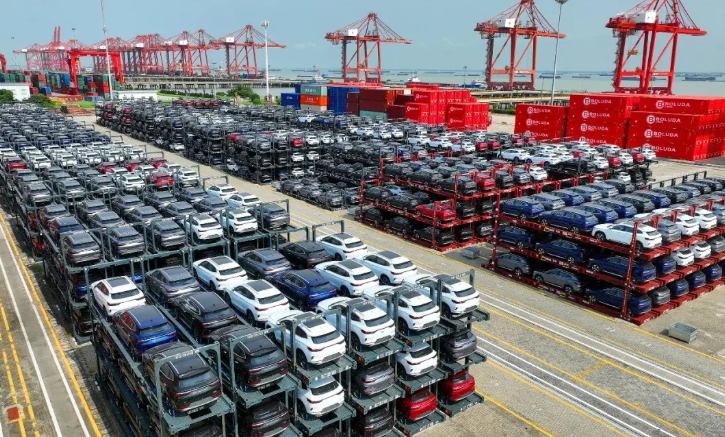
The March 2026 new energy vehicle (NEV) sales data from Deutsche Bank reveals a fundamental shift in the global automotive landscape, with Chinese manufacturers rapidly gaining market share across multiple continents while established Western automakers experience significant declines.
Global NEV Market Performance: Beyond the Headlines
According to Deutsche Bank's comprehensive tracking of the top 15 NEV markets globally, total sales reached 1.77 million units in March 2026, representing 8% year-over-year growth. However, this aggregate figure masks dramatic regional and brand-level variations that signal a broader industry transformation.
China maintained its position as the world's largest NEV market with 1.16 million units sold, though growth slowed to just 1.6% year-over-year. The United States, in stark contrast, experienced a 35.5% decline to 100,691 units, highlighting the divergent trajectories of the world's two largest automotive markets.
Chinese Brand Global Expansion Strategy
The most significant development revealed in the data is the systematic global expansion of Chinese NEV manufacturers. BYD, despite reporting overall growth of -13.2%, demonstrated remarkable international performance with triple-digit growth in key markets: Brazil (+104%), UK (+134%), Italy (+170%), and Germany (+329%).
This geographic diversification strategy extends beyond BYD. Leapmotor achieved 57% overall growth while establishing presence in Italy (2,727% growth), UK (+880%), Germany (+318%), and France (+102%). The company's expansion from primarily domestic sales to meaningful international market share occurred within a single year.
Geely, another major Chinese manufacturer, reported 7.9% growth overall while expanding operations across 14 countries, including significant positions in the UK (+48%), Thailand (+439%), and Brazil (+10,491%).
Traditional Automaker Challenges
Western automotive manufacturers face simultaneous pressures across multiple markets. General Motors reported a 34.4% decline, with weaknesses spanning China (-38%), the US (-19%), and Canada (+16% being the only bright spot). Ford experienced an 8.1% decline globally, while Honda suffered a 39.5% drop across all major markets.
The data suggests traditional automakers are struggling with the fundamental transition to electric powertrains while Chinese competitors benefit from purpose-built EV platforms and integrated supply chains.
Market Penetration Trends
NEV penetration rates vary dramatically by region, with Norway leading at 85.8%, followed by Finland (52.8%) and Sweden (57.2%). China maintains a 40.1% penetration rate, while the United States lags significantly at 7%.
These penetration differences create opportunities for Chinese manufacturers to establish market positions before local competition intensifies. The strategy appears particularly effective in European markets, where regulatory support for EVs creates favorable conditions for new entrants.
Supply Chain and Technology Advantages
Chinese manufacturers benefit from vertically integrated supply chains, particularly in battery technology and rare earth materials processing. This integration provides both cost advantages and supply chain security that traditional automakers struggle to replicate quickly.
The data shows Chinese brands dominating both pure electric (EV) and plug-in hybrid electric vehicle (PHEV) segments, suggesting technological competence across multiple powertrain architectures.
Implications for the Global Automotive Industry
The March 2026 data indicates a structural shift rather than cyclical variation. Chinese manufacturers are building sustainable competitive positions through:
- Geographic diversification: Reducing dependence on domestic markets
- Technology leadership: Advancing battery and electric powertrain capabilities
- Cost competitiveness: Leveraging integrated supply chains
- Market timing: Entering growth markets before established competition
For traditional automakers, the window for competitive response continues to narrow as Chinese brands establish distribution networks, brand recognition, and market share across multiple continents simultaneously.
Regional Market Analysis
Europe: Chinese brands gained significant traction across major European markets, with BYD, Leapmotor, and Geely all reporting substantial growth rates. The combination of EU environmental regulations and consumer acceptance of new brands creates favorable conditions for continued expansion.
Americas: Both North and South American markets show growing Chinese presence, with Brazil emerging as a particularly strong growth market for multiple Chinese manufacturers.
Asia-Pacific: Beyond China, markets like Thailand and Japan show increasing Chinese brand presence, suggesting regional expansion strategies.
The comprehensive Deutsche Bank dataset covering 90% of global NEV sales provides unprecedented visibility into these market dynamics, revealing the speed and scale of the ongoing automotive industry transformation.
Related Coverage:
China EV Outlook: Domestic Saturation Triggers Export Pivot and Channel Wars in 2026