
China's Humanoid Robot Dominance: What It Means for the Global Economy
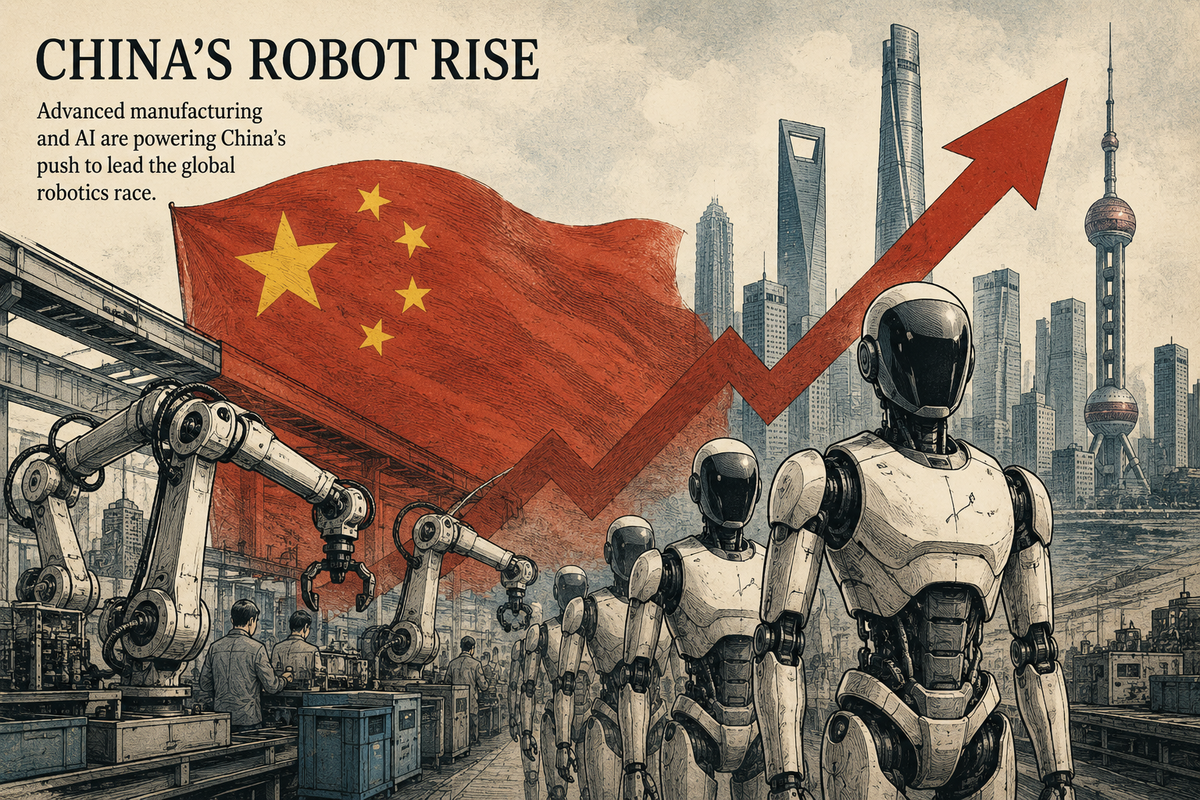
An inflection point in automation is here — and China controls the supply chain
This article is based on research from Barclays Research’s May 19, 2026 report, “AI gets physical: The decade of the robot belongs to China.”
What Is Happening with Humanoid Robots?
Humanoid robots — AI-powered machines designed to operate in human environments using the same tools and workflows as people — have moved from concept to deployment. Unlike traditional industrial robots that automate specific factory tasks, humanoids are built to work alongside humans across diverse settings, from manufacturing floors to logistics centers.
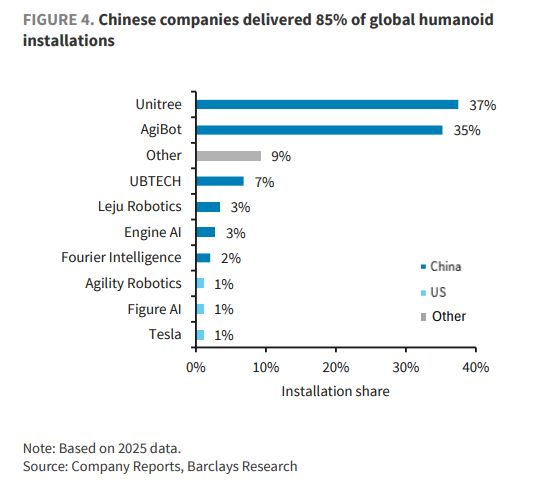
In 2025, global humanoid installations reached approximately 15,000 units, up sharply from just 2,000 the year before. By 2026, that figure is projected to hit 60,000 units based on current manufacturer guidance. China accounted for roughly 85% of those 2025 installations, with companies like Unitree and AgiBot leading the charge. The country now hosts around 140 active humanoid manufacturers and unveiled roughly 330 new models in 2025 alone.
This is not a sudden breakthrough. China has been building toward this moment for over a decade through coordinated industrial policy, sustained R&D investment, and deliberate control over critical supply chains.
Why China Leads: Industrial Policy Meets Innovation at Scale
A Decade of State-Guided Investment
China's robotics leadership reflects more than market forces — it is the result of explicit, multi-layered industrial strategy. Starting with the Made in China 2025 initiative in 2015, followed by robotics roadmaps under the 14th and 15th Five-Year Plans, the Chinese government designated robotics and embodied intelligence as strategic infrastructure industries.
Policy tools deployed include subsidies, tax incentives, grants, and state-backed financing at both central and local levels. The 2023 Robot+ Action Plan extended this framework beyond manufacturing into healthcare, agriculture, logistics, and elderly care — signaling a shift from building capacity to driving adoption across the economy.
Several targets have been met ahead of schedule. The Made in China 2025 goal of 1.8 million industrial robots in operation by 2025 was surpassed in 2023. Robot density — measured as robots per 10,000 workers — increased more than sixfold between 2016 and 2023, rising from around 70 to nearly 500 robots per 10,000 manufacturing employees, the fastest growth rate globally.

Innovation Anchored in Public Research
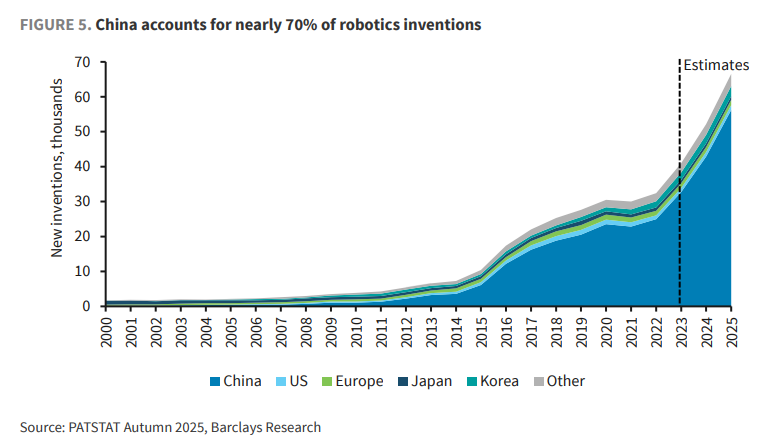
An analysis of over 300,000 robotics patents filed since 2000 reveals that China accounts for roughly 70% of global robotics inventions. In 2023 alone, China recorded over 30,000 robotics patent filings — nearly 30 times the number filed in the United States.
What distinguishes China's innovation model is its reliance on public institutions. Universities and state research institutes account for more than 30% of robotics patents in China, compared to roughly 10% in the US. This reflects a deliberate strategy to place academia at the core of technology development — a model that accelerates early-stage R&D and reduces dependence on private capital alone.
By 2018, China had already pulled ahead in humanoid-specific patents, with firms like UBTECH and Xiaomi leading in filings. Meanwhile, patent classifications show a clear divide: Chinese patents concentrate on robot kinematics — the physical structure and mechanics — while US patents tilt toward control and autonomy, the software that governs sensing, decision-making, and action.
How China Controls the Entire Robotics Stack
Vertical Integration from Raw Materials to Final Assembly
China's dominance is not limited to final assembly — it extends across the entire supply chain, from upstream raw materials to midstream components and downstream production.
Critical Minerals:
China refines more than 90% of global magnetic rare earths, essential for actuators that power robotic movement. It also leads in processing cobalt, lithium, and copper — inputs critical for batteries, wiring, and electronic systems.
Key Components:
- Actuators: China accounts for 22% of global exports
- Batteries: 45% of global exports
- Semiconductors: Second-largest exporter globally
Manufacturing Base:
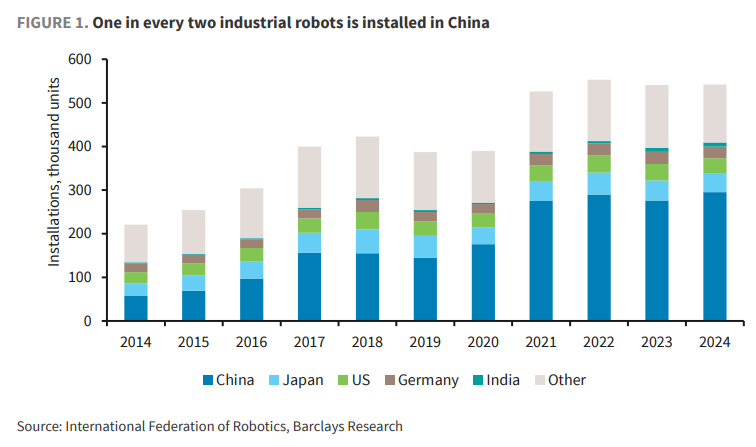
China now produces roughly 57% of the industrial robots it installs domestically, a sharp increase from earlier reliance on imports. In 2024, China deployed nearly 300,000 industrial robots — about half of all global installations — far outpacing Japan (44,000) and the United States (34,000).
This vertical integration creates a self-reinforcing advantage: domestic production fuels deployment, which generates operational data, which improves robot performance, which accelerates further deployment — a flywheel effect that compounds over time.

What's Driving Demand: Demographics and Labor Shortages
China's Workforce Is Shrinking — Fast
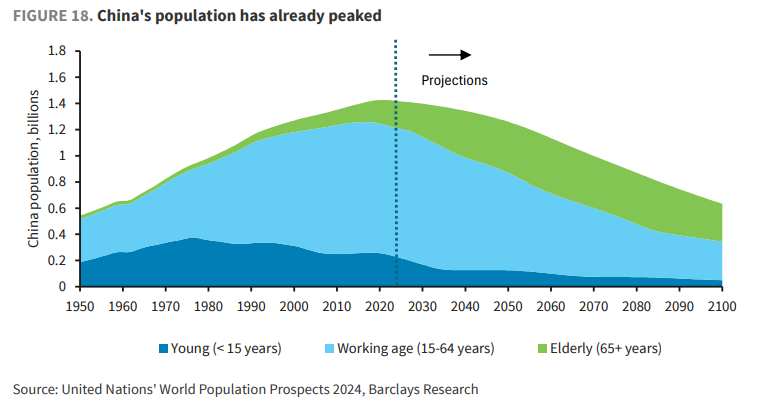
China's population peaked in 2021 at 1.42 billion and is now declining. By 2050, it is projected to fall to around 1.2 billion. The working-age population is expected to shrink by 6% between 2026 and 2035, translating to roughly 57 million fewer people of working age. At current labor force participation rates, that implies a 37 million decline in available workers over the next decade.
At the same time, the share of elderly (65+) in the population is set to double — from roughly 15% today to over 30% by 2050 — intensifying demand for healthcare and caregiving labor.
Manufacturing Under Pressure
China's manufacturing sector remains the world's largest, valued at approximately $4.7 trillion and accounting for roughly 25% of GDP. It still employs around 245 million workers — about 32% of the workforce — far higher than most developed economies.
But demographic pressures are creating a structural labor shortage in industry. As younger cohorts move toward services, manufacturing faces a tightening pipeline. Productivity gains alone are unlikely to fully offset this decline: UN projections suggest total factor productivity growth will slow to around 1% annually, implying only 11% cumulative TFP growth between 2026 and 2035.
Robots as a Demographic Offset
Under an upper-bound scenario — drawing on China's experience scaling electric vehicles — annual humanoid deployments in China could reach up to 11 million units by 2035, with a cumulative installed stock approaching 24 million robots.
At that scale, humanoids could represent up to 3.8% of China's effective labor force by 2035, equivalent to the output of roughly 24 million workers. That would offset approximately 60% of the projected workforce decline over the next decade.
The US and Europe: Still in the Race, But Taking a Different Path
Adoption Will Come Later — and Look Different
Global humanoid production could reach up to 13 million units annually by 2035 under optimistic assumptions, with roughly 2 million units deployed outside China — primarily in the United States.
However, the US deployment profile will differ significantly. China's manufacturing sector accounts for 25% of GDP; in the US, it's closer to 9%. As a result, near-term humanoid demand in China is concentrated in industrial applications, while US adoption is expected to tilt toward service sectors — retail, logistics, healthcare — where deployment is likely to accelerate in the 2030s.
The US also faces no immediate demographic pressure: the labor force is projected to grow from 139 million in 2024 to 141 million by 2035.
Security Concerns Create Openings for Western Producers
Chinese humanoid robots are sensor-rich systems capable of collecting vast amounts of operational data. Risks around data leakage, intellectual property theft, and embedded vulnerabilities are material concerns for Western enterprises and governments.
Regulators in the US and Europe are expected to impose guardrails on Chinese humanoid imports, particularly for applications deemed sensitive from a national security perspective. This creates a window for Western manufacturers — including Tesla, Figure AI, Agility Robotics, Boston Dynamics, and Sweden's Hexagon AB — to scale through consolidation, industrial policy support, and domestic production.
Several US firms have already announced ambitious targets:
- Tesla aims to convert its Fremont plant into a humanoid production site and produce roughly 1 million units by 2035 under CEO Elon Musk's compensation milestones
- Boston Dynamics targets 30,000 Atlas humanoid units annually by 2028
- Figure AI aims for 100,000 units within a similar timeframe
- Agility Robotics has a facility capable of producing 10,000 units annually at peak capacity
If deployment inflects exponentially after 2030 — as many in the industry expect — Western production could ramp meaningfully, though it will likely remain smaller in absolute terms than China's output.
Why the Technology Stack Matters More Than the End Product
Spillovers Into Defense, Aerospace, and Energy
Robotics innovation is not confined to humanoids or industrial automation. The underlying technologies — autonomy and control systems, sensors and perception, actuators, batteries, and edge computing — are dual-use by design and applicable across defense, aerospace, energy, and space exploration.
Patent analysis shows that nearly 20% of robotics patents filed between 2020 and 2025 are also classified under defense-related technologies, up from roughly 7% in the early 2000s. Spillovers into aerospace account for around 9%, and overlap with automotive applications has also increased.
This convergence reflects shared foundational capabilities:
- Sensing and navigation systems used in humanoids also apply to drones, autonomous vehicles, and military platforms
- Solid-state batteries extend humanoid runtime, enable grid-scale energy storage, power long-range drones, and extend satellite life
- Actuators and motion systems underpin robotic arms, missile guidance, and spacecraft maneuvering
Investment Implications: Betting on Enablers, Not Just Endpoints
For investors, the strategic value lies in controlling the technology stack, not just producing finished robots. Returns are likely to concentrate in five foundational areas:
- Autonomy software (control, decision-making, and learning)
- Sensing and perception (cameras, LiDAR, radar)
- Actuation (motors, servos, hydraulics)
- Batteries (energy density, charging speed, thermal management)
- Edge computing (on-device processing, latency reduction)
These components are reusable across multiple end-markets — robotics, defense, energy, mobility — creating overlapping adoption waves and reducing reliance on any single deployment timeline. Suppliers of enabling technologies benefit from diversified demand and lower cyclical exposure.
Policy Implications: The Robotics Supply Chain as Critical Infrastructure
Strategic Autonomy Shifts from Industries to Technologies
Historically, industrial policy focused on protecting or promoting specific sectors — steel, semiconductors, aerospace. Robotics challenges that framework. The strategic value now lies in controlling foundational technologies rather than finished products.
For policymakers, this means treating the robotics supply chain as critical infrastructure. Key vulnerabilities sit upstream:
- Critical minerals (rare earths, cobalt, lithium)
- Components (batteries, actuators, semiconductors)
- Software layers (autonomy, control systems)
China's vertical integration across this stack gives it leverage — not just in robotics, but in any adjacent industry reliant on the same inputs.
Demand Resilience Matters as Much as Supply Resilience
China's advantage is not only that it produces humanoids — it also deploys them at scale domestically. Deployment creates demand for the entire upstream ecosystem, from raw materials to components to software. This self-sustaining loop strengthens domestic suppliers and reduces dependence on foreign buyers.
Western economies seeking to build competitive robotics industries must address both sides: building production capacity and creating domestic demand. Without deployment, there is no data. Without data, there is no improvement. Without improvement, there is no adoption.
Regulatory Divergence Will Shape Market Structure
As robotics adoption accelerates, regulatory frameworks are likely to diverge across jurisdictions — particularly around data governance, safety standards, and national security considerations. This divergence will shape which companies can operate where, and which technologies are deemed acceptable for deployment in sensitive environments.
Countries that impose strict guardrails on Chinese humanoid imports may create protected markets for domestic producers. But they will also face higher costs, slower deployment, and reduced access to the data advantages that come from large-scale adoption.
The Bottom Line
Humanoid robots represent a structural shift in automation — one that moves machines out of controlled factory environments and into human-built spaces, using human tools and workflows. The technology is no longer speculative. Deployment has begun, and it is scaling exponentially.
China leads this transition by a wide margin. It controls the full supply chain, from critical minerals to components to final assembly. It has built the world's most advanced robotics innovation ecosystem, anchored in public research and coordinated industrial policy. And it faces acute demographic pressures that create both urgent demand for automation and a vast domestic market to absorb millions of robots.
The United States and Europe are not out of the race, but they are taking a different path — one shaped by consumer-led adoption, security concerns, and industrial policy catch-up. Western firms retain advantages in software, autonomy, and niche applications, but they lack China's scale, vertical integration, and deployment momentum.
The decade ahead will determine whether the West can close the gap — or whether China's lead becomes structural and irreversible.
For investors, the opportunity lies not in betting on individual robot makers, but in owning the enabling technologies that underpin the entire ecosystem. For policymakers, the challenge is clear: robotics is not just an industry. It is infrastructure. And infrastructure requires strategy, not just subsidy.
Source: Barclays Research, “AI gets physical: The decade of the robot belongs to China,” May 19, 2026.
Related Coverage:
China's Humanoid Robot "Seven Dragons": Who's Selling, Who's Storytelling?
The Great Cost Divide in Humanoid Robotics: China vs. the US